


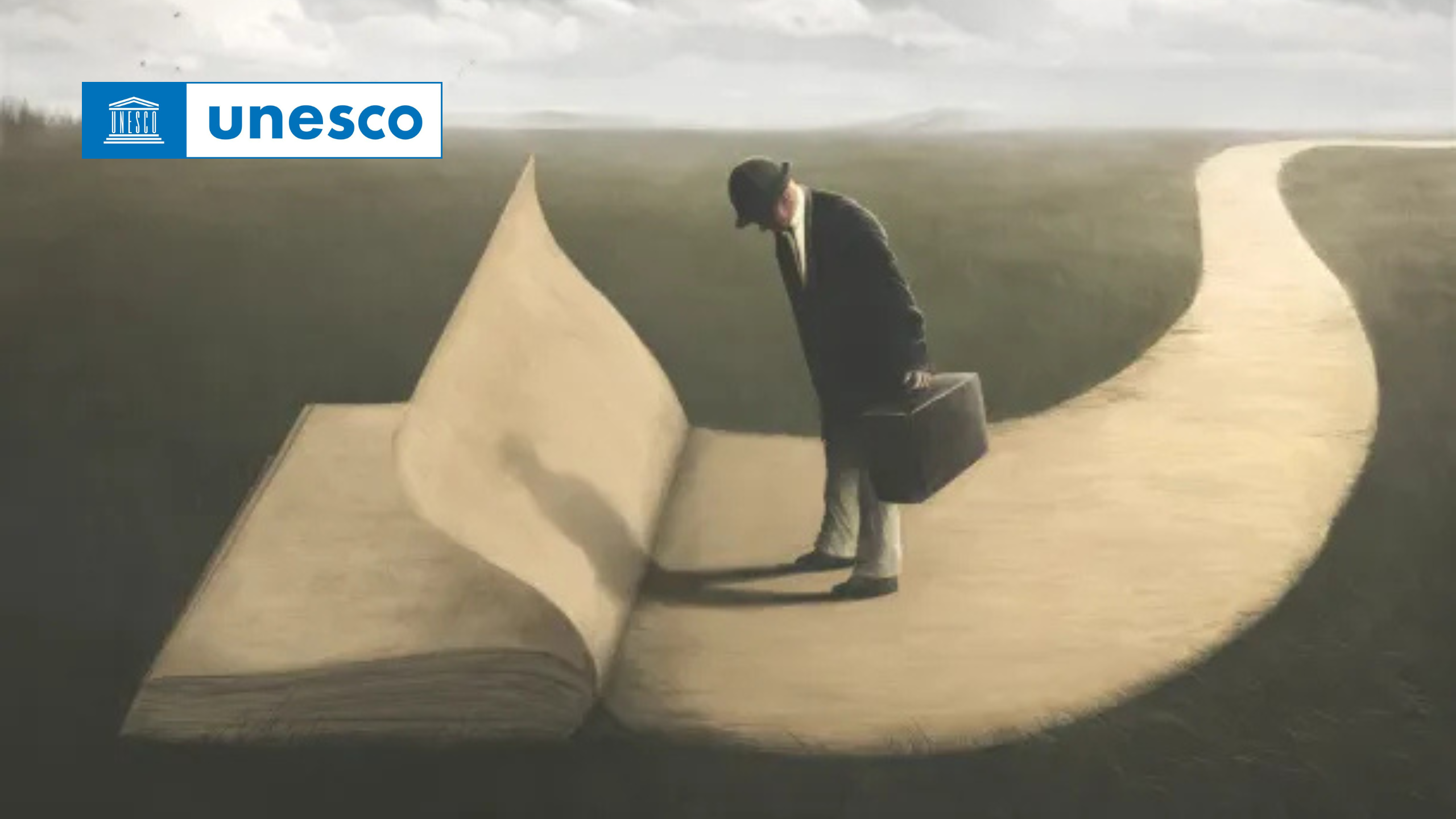
EpiNet at UNESCO Futures Dialogues: Futures of Knowledge
A Contribution towards Clearing the ‘Nasal Passage’ of the Academy
- Sobhi Tawil, Director, Futures of Learning & Innovation, UNESCO
- Guilherme Canela De Souza Godoi, Director for Division for Digital Inclusion and Policies and Digital Transformation (CI/DPT) and Secretary of the Information for All Programme (IFAP), UNESCO
- Zeynep Varoglu, Senior Programme Specialist, Section for Universal Access to Information and Digital Inclusion, Communication and Information Sector, UNESCO
- Stéphanie Boustany, Project, Research and Communications Specialist in Knowledge Project, UNDP Regional Bureau for Arab States
- Sonajharia Minz, Co-Chairholder, UNESCO Chair in Indigenous Knowledge Research Governance (IKRG) and Rematriation, Jawaharlal Nehru University, India
- Daniel Mato, Chairholder, UNESCO Chair on Higher Education and Indigenous and Afro-descendant Peoples in Latin America, Centro Interdisciplinario de Estudios Avanzados (CIEA), Universidad Nacional de Tres de Febrero (UNTREF), Argentina
- Keith Holmes, Research Coordinator/UNITWIN, Future of Learning and Innovation Division, UNESCO
A Need to Rethink
Whatever else may happen in a university, a university is a place where people think. Researchers produce knowledge. Teachers communicate knowledge. Students acquire knowledge skills, values, and professional qualitifications.
Professors turn around the give their insights to policy makers.
If all goes well with everyone in the university community, we end up serving humanity.
But if thinking can plausibly be identified as something central to what universities are about, it can also be identified at this point in history as something in need of rethinking.
It is prudent therefore, to be humble enough to try and figure out:
- not only the points at which thinking might have become knotted up into a seemingly useless ineffective stalemate; or
- the points at which toxic elements entered and ingrained themselves into human thought and thereby actions; or
- those moments in which the academy appears to excuse the inexcusable or overlook the protruding; or
- the points at which disciplines have become alibis for the production of compartmentalised tidbits that simply do not make for an adequate response to society’s challenges at a given time.
It is also clear that on the current default drive of knowledge production, accompanied by the deep exclusionary practices inherent in its practices, thinking will not survive.
Kuhn has long warned us that when stockpiles of unanswered questions heap up outside our door, it is time to undertake some radical actions.
It is therefore hoped that, by unblocking some of those blockages, and releasing some of the knots, we can make a contribution towards clearing the ‘nasal passage’ of the academy.
As to the status quo, we know that it will not survive from the reality of ecological questions that are today confronting society globally.
We have to go beyond the knee-jerk proliferation of conservation projects that happens in the silos of disciplines, important though they are, to the imperative a pluralistic frame of reference covering the wisdom coming from many parts of the world, not only the western one.
Together, in this UNITWIN formation, we have the strength to evoke an understanding of the more complex and advanced ethically sound and ecologically constituted ways of thinking that characterize many indigenous and non-western ways of living.
Together, in this gathering, our affirmation of the multiplicity of worlds and forms of life can have a Copernican effect on the disciplines of education, science, economics and law enough to put a stop to the endless claims to the hegemonisation of non-western forms of knowledge. Epistemic Justice can lead to Cognitive Justice as an action.
Only through cognitive justice as a method for exploring difference and the right to plurality and coexistence among knowledge systems, and by providing for reciprocity and empathy can we turn this hierarchy into a circle.
Frugal and sustainable rural livelihoods are all bundled into a hopeless, eternalised, dehumanized and unrecognizable heap: poverty.
In short, the formula is steady and decisive: structural, long-term dispossession everywhere modernity went, with shallow ameliorative responses as a return hug.
On simplified and weak foundations of philosophy of society in relation to human existence, rambling and towering edifices in education, law, science and economics have been built.
The normative framework of commerce replaces the dense networks of subtle interpersonal obligations with a few deceptively clear and relatively simple rules.
Protect property rights. Comply with contracts. Its principle is: buy cheap and sell dear.
The problem of modernity today therefore resembles an attempt to carry water in a picnic basket meant for carrying bread.
A puzzle for you…
What methodology can we use to transform modernity from the narrow, hierarchised way of seeing the world into a more pluralistic way which is able to take cognizance of the ethics, wisdom from other cultures?