

Event Highlights: Global Refugee Forum Progress Review Linked Side Event: “Teachers at the Frontline: Voices from Refugee Settings on Progress, Challenges, and the Path Forward for GRF Pledges”
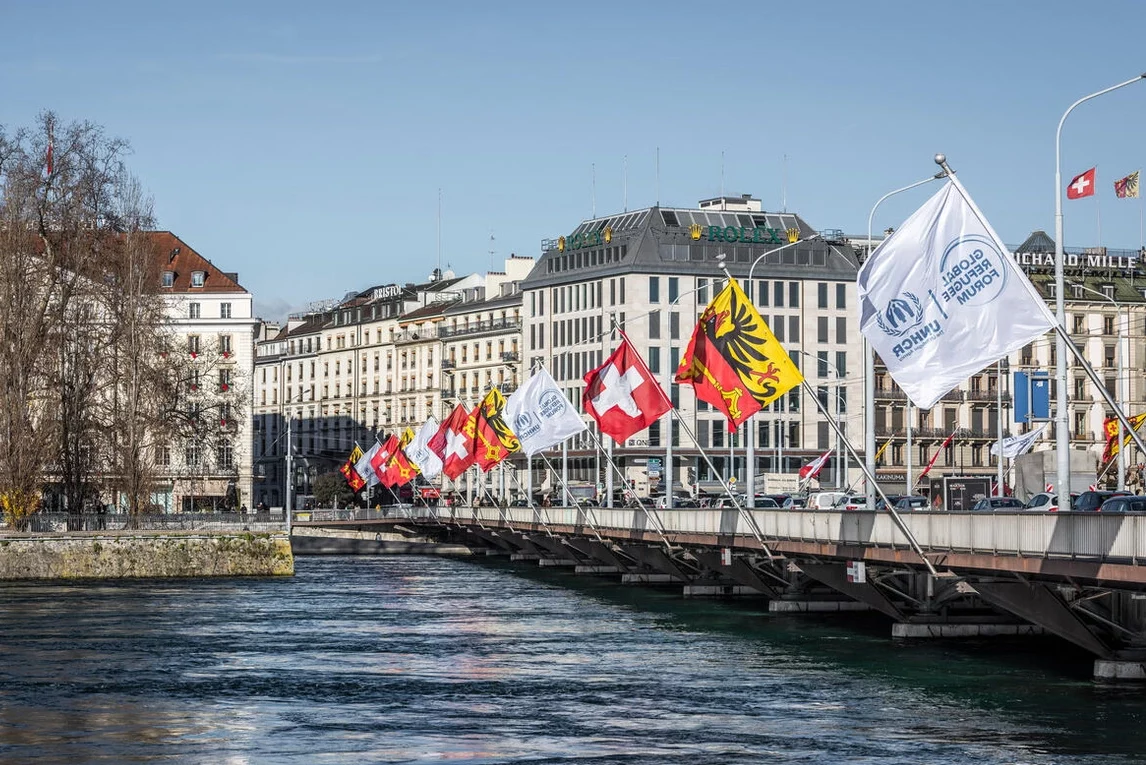
Featured Image: Flags marking the 2023 Global Refugee Forum are hung along the Pont du Mont Blanc in Geneva in December 2023. © UNHCR/Olivier Chamard
Teachers are central to the refugee education response and must be supported. That was the clear message in December’s Global Refugee Forum Progress Review linked side event on teachers. Hosted by Save the Children at the Humanitarian Hub, Geneva, in collaboration with Education International, Jigsaw and UNESCO-IIEP, “Teachers at the Frontline: Voices from Refugee Settings on Progress, Challenges, and the Path Forward for GRF Pledges” brought together teachers, representatives of Ministries of Education, teachers unions, NGOs and donors.
The event highlighted the critical role of teachers at the heart of education systems, including in refugee and crisis-affected settings, resiliently meeting the needs of their students and communities in often extremely challenging conditions. It aimed to: elevate the voice of teachers as frontline responders; reflect on progress made since the Global Refugee Forum 2023 (GRF 2023) in implementing education pledges that directly support teachers; and to share perspectives on potential avenues for progress in the lead up to the Global Refugee Forum 2027.
Sonia Grigt, Education International provided opening remarks in her capacity as Chair of the GRF Education Alliance Task Team on Teachers. She situated the discussion within the work that the Task Team has developed in the lead-up to and following the 2023 Global Refugee Forum. She reminded us of the pledging guidance on teachers and multistakeholder-pledge developed by the Task Team ahead of the GRF 2023, noting that these initiatives helped generate increased attention to teachers within the GRF process, as evidenced by an analysis of the teacher-related pledges made in 2023 and pledge update information available on the GRF dashboard (prepared by Katja Hinz, UNESCO IIEP). According to this analysis, around 26 out of 224 education pledges (out of roughly 1750 pledges overall) made in 2023 focused specifically on teachers. This reflects a growing recognition that education systems ultimately depend on teachers, particularly in crisis settings where education structures are under strain. The pledges were on education delivery (8), research & mapping (5), advocacy (4), funding provision (4), policy efforts (3) and communities of practice (2). 18 progress reports were made on these pledges, to varying degrees of detail and quality. There were some promising examples of government-led progress within the reporting, though limited in number. Many civil society contributions were made, particularly reporting on professional development and well-being. The analysis also reveals that teacher participation was not systematic.
Sophie Lashford (Save the Children) shared the need for accountability and reporting on progress made, and shared an update on Save the Children’s own pledge implementation, including providing competency based training in refugee-hosting areas.
Save the Children had run a parallel stock-taking event to the one in Geneva with Refugee Teacher Communities of Practice in Kenya, as part of their commitment to teacher participation. This was shared through a video of their stock-taking at this side-event and an associated brief. The teachers looked at the GRF pledges on education and reviewed their progress themselves, based on their own observations from their classrooms and communities. They shared signs of progress, and their recommendations on what would unlock further impact, such as formal recognition of their certification, recruitment, and career progression, supporting teachers through curriculum reform and scaling scholarships to meet demand for tertiary education and routes into teaching. As one teacher said, “To you in Geneva, I want you to voice out my voice.”
Abdoul Kadir Bello Mamadou, Jigsaw Education, presented emerging findings from Global Partnership for Education Knowledge and Innovation Exchange (GPE KIX)-funded research Scaling Refugee Teacher Inclusion Models for Enhanced Agency and Well-being in Chad, Uganda and Zambia. A survey of over 500 teachers found that most experience high levels of stress because of insufficient payments, and that their existing qualifications are frequently not recognised in their host country. Discussant Fareeda Miah, UNHCR, closed the presentations with a call for investment in national systems aligning with national policies to support governments to assume recurrent costs, particularly salaries. Strong collaboration, including teachers themselves, needs to be based on robust data and evidence in the creation of national solutions.
In the discussion that followed, Ministry representatives highlighted the macroeconomic pressures that combine with the continued influx of refugees to make the financing of payments for teachers the greatest challenge. Governments assume their responsibilities for training and qualification of refugee teachers, sometimes working in collaboration with international NGOs, to support both pre-service training in teacher training institutions, and in-service training during the holidays. This includes support with adaptation to the host country curricula and a focus on social and emotional learning and psychosocial support.
Other participants highlighted work being done to recognise the prior learning and qualifications of refugee teachers, in order to ‘untrap’ them from informal status, as well as research exploring the critical importance of language in the experience of refugee teachers and learners.
Discussion moved to the central role of teachers as the vehicle for education that counters the effects of fragility. The clear priority was working together with governments, as duty bearers, to find sustainable ways to finance teacher salaries for refugees as well as host country teachers. A recent conference highlighted that on average countries in Africa allocate less than 4% of GDP to education, 75% of which goes on teacher salaries. Teacher training institutions are critical partners in supporting teacher professional development, and local leadership. Training for refugees working as classroom assistants allows them to participate fully as professionals supporting the quality of teaching and learning for all children, whether host community, displaced or refugee.
The event was an important moment to hear from teachers who are refugees, and reflect on both their fundamental role in the provision of quality education in crisis situations, and the huge challenges which remain to be addressed in adequately financing and supporting their role. Progress made since the 2023 GRF must continue to be built upon, particularly in involving refugee teachers themselves in decision making that affects their lives and work.