

Event Highlights: Le Renouveau du Contrat Scientifique pour L'Éducation | Renewing the Scientific Contract for Education
18 February 2026
Paris, UNESCO
In opening the conference, Assistant Director General for Education, Stefania Gianini, highlighted how the Commission for the Futures of Education report Reimagining our futures together: a new social contract for education reaffirmed the right to education for all throughout the life course, and strengthening education as a public endeavour and a common good. She highlighted the role of different types of research in a renewed scientific contract for education and the broader social contract. She was followed by introductions from the conference co-organisers Université Gustave Eiffel and RUNES (an international association supported by researchers from Higher Education and research in the francophone world).
Roundtable 1 | How is AI Transforming Research and Foresight in Education?
Beyond its direct impacts on teaching, learning and assessment, AI technologies are transforming social and education research, and even the concepts of knowledge itself. This session interrogates implications of AI for evidence in education, identifies the ethical issues at stake and asks: what key principles should inform the use of AI technologies for research and foresight in education?
Roundtable 2 | The Future of Interdisciplinary Cooperation in International Research
As complexity increases, the case in favour of supporting interdisciplinary international and comparative research in education is clear. Yet too often, researchers inhabit different fields and sub-fields, with their own professional communities, research traditions, societies and terminologies. Collaboration across academic and national borders can be cultivated through a strong sense of purpose, shared values, mutual respect, and equitable research partnerships. This session asks, what should higher education and research institutions do differently for the future?
Keynote Lecture | The Future of Public Education Policies and Educational Actions
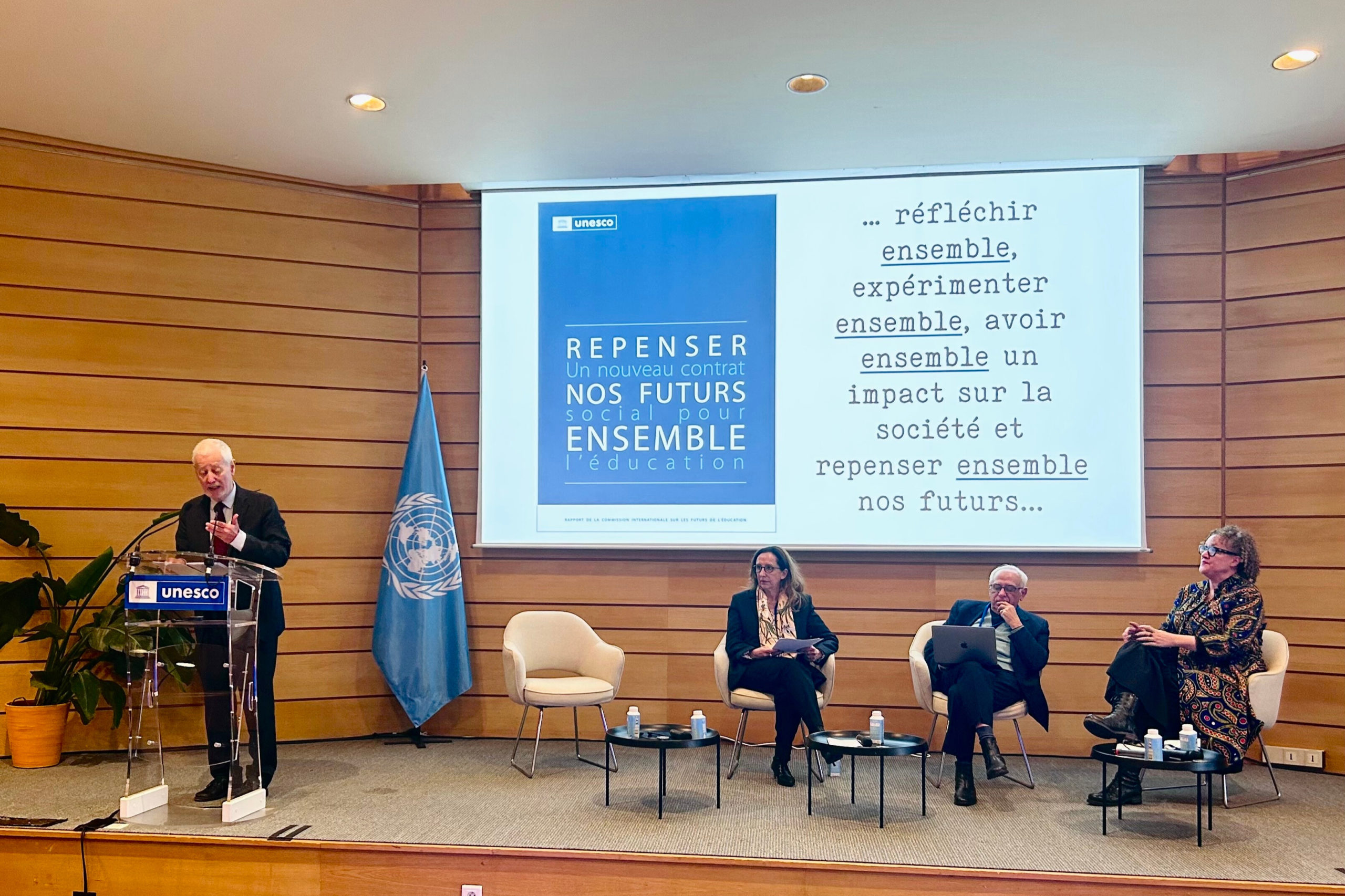
Professor António Nóvoa, Chair of the Commission for the Futures of Education revisited the main messages of the report Reimagining our futures together: a new social contract for education, in the context of today’s challenges, offering reflections on their relevance for the future of public education policies, research and practice. Borrowing from John Dewey and others, the report promotes education as a public project and a common good. The “common” is viewed not as a fixed state, but as a continuous process of communication and community building.
Nóvoa outlined a shift in how educational policy and research should be conducted in an age of uncertainty. He presented the report as an invitation to dialogue and experimentation rather than a conventional document of prescriptions or top-down master plans. It argues that in times of crisis and uncertainty, rigid reforms are less effective than supporting local initiatives.
Nóvoa warned against two major political trends. First, governmentality by indicators: The over-reliance on standardized international comparisons (like those from the OECD) which turn descriptive data into normative prescriptions, often bypassing democratic deliberation. Secondly, technological solutionism: the commercialized belief that technology, particularly Artificial Intelligence, is a “miracle” solution to complex social and educational problems.
He identifies two problematic scientific approaches: First, scientism and distancing: research that betrays an exaggerated trust in the applicability of natural scientific methods and either tries to dogmatically direct educational action or remains completely disconnected from the actual work of schools and teachers. Secondly, external evidence-based models: movements of “sciences in education” (such as neurosciences) that claim to provide “scientific evidence” but often ignore the educational context and are supported by private interests.
For Nóvoa, a new research agenda must prioritize research from within education, valorising the work of millions of educators who are already pioneering new approaches. Public policy should move from governing by injunction to observing and supporting these existing innovations and innovators. He emphasised that teachers must be recognized as holders and producers of knowledge, not just as people who apply results produced by others. Closing the “historical exclusion” of teachers from the field of legitimate knowledge production is described as an act of justice and trust.
Ultimately, Nóvoa frames education as an act of humanization against the “barbarism” of standardization and commodification.
Discussant Moira Faul, Executive Director of NORRAG, was invited as discussant to share some reflections and questions raised.
I completely agree with the political and scientific drifts described by Antonio. Furthermore, I urge you to consider the precipices on which we find ourselves: geopolitical, ecological, social, and democratic. The discussions about ecological, social and democratic effects are well-rehearsed in the education space; the geopolitical less so. We in the Global South have been demanding reform of multilateral and global governance systems since their inception – the League of Nations, the UN Security Council, the IMF, the WTO, and many others – all these global bodies where the principle of “one member, one vote” is not applied. This was a demand from the periphery. Today, it is the centre that is withdrawing, and the physicists tell us what the result will be when the centre collapses.
These have profound effects on university funding; the role of the university in building a different future; and on academic freedoms. Sometimes dismissed as a mere complaint from the elites, academic freedom is in reality fundamental to the right to education, the pursuit of knowledge, and social progress, as well as to the proper functioning of a democratic society.
To these elements of the “polycrisis,” I do not treat technology as an additional item on a list, nor AI as an additional precipice, but rather as an accelerant toward these precipices that are already so close. How do you see that proposition, that technology challenge has a different relationship to the others; it is not simply an addition to the others; there is a different relationship? A relationship of acceleration.
I couldn’t agree more with Antonio’s call to support the agency and actions of teachers as producers of knowledge. And would join to that a call for other marginalised experts: Young people and learners—especially our first-generation students (like myself); those who are the first in their families to go to university. And expertise in the Global South—using this stage to recall Fez and Timbuktu (in addition to—and indeed before—medieval Bologna or Oxford) from our newly approved UNITWIN network on epistemic justice and knowledge commons. My question is: how do those at the tables of power learn to listen to them? Spivak asked us, metaphorically, “Can the subaltern speak?”—they do, they speak. In fact they shout! My question is how to listen to them?