

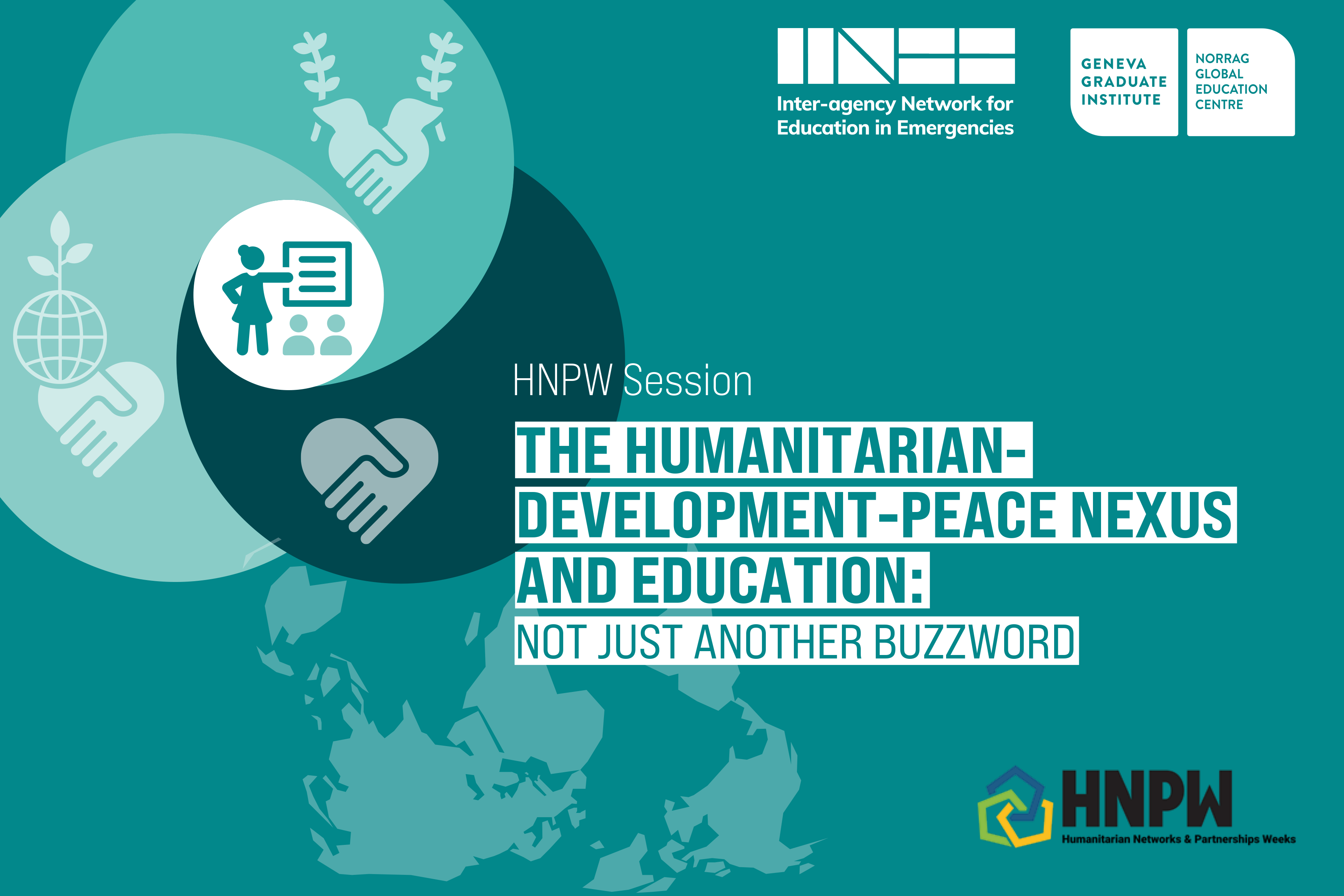
Event Highlights: INEE & NORRAG Session - The Humanitarian-Development-Peace Nexus and Education: Not Just Another Buzzword
Tuesday, 10 March 2026, 16:00-17:30 CET
Hybrid: CICG, Salle 15 and Online
As a platform for collaboration, HNPW offers discussion and dialogue to improve humanitarian preparedness and response with Areas of Common Concern (AOCC): Accountability to affected populations, Climate crisis, Inclusion, Localisation and coordination, Security risk management integration across humanitarian action, Anticipatory action, Organisational culture and power relations, Nexus empowerment. Discussions also cover themes such as information management, data quality, logistics and supply chain, research and innovation, as well as training.
This panel is particularly relevant to the Nexus empowerment AOCC, but links to many others. The Humanitarian-Development-Peace (HDP)–or triple–nexus emphasises the interconnections between humanitarian aid, development, and peacebuilding efforts in order to better serve affected communities, more effectively addressing and anticipating crises while also promoting sustainable development and peace. Naming the HDP Nexus in global policy did not breathe it into being; global action is lagging behind these global promises.
The purpose of this session is to provide answers to the questions:
To what extent is global action keeping up with and supporting local leadership, solutions and effectiveness?
And what are ways forward in a context of increasing levels of crisis globally, and sharply reduced international funding flows?
A year on from the Humanitarian Reset, this panel provides an opportunity to take stock, with a nexus lens, of education in humanitarian response. Panel members (all contributors to a recent NORRAG Policy Insights Education and the Humanitarian-Development-Peace Nexus at 10) will share their experiences of making the nexus a reality. They will provide insights for concrete action to help us move beyond the persistent funding silos, duplication and competition among actors, and the limited coordination across sectors that have hindered its full potential.
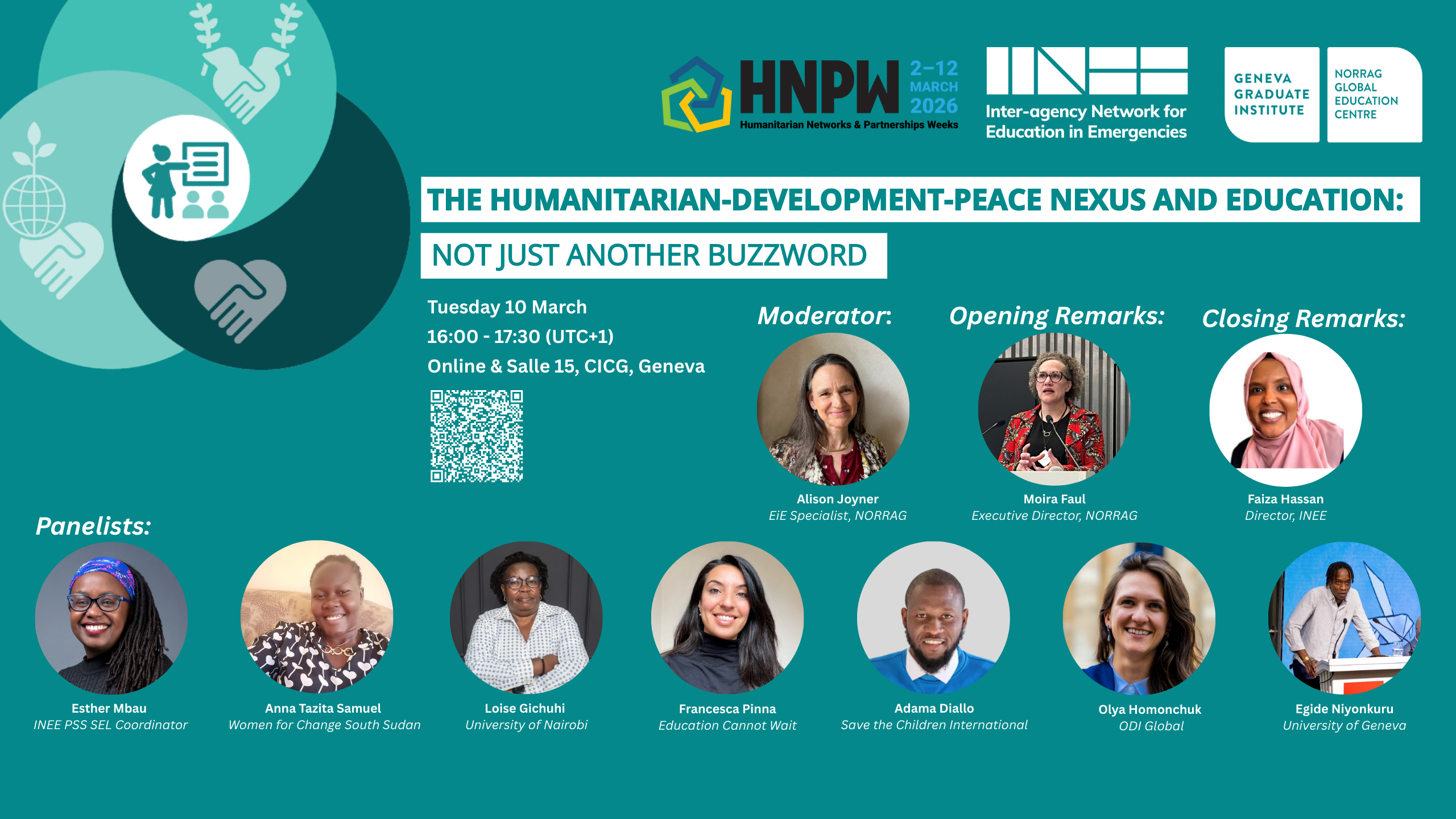
Programme
- Moderator
- Alison Joyner, Education in Emergencies Specialist NORRAG
- Opening Remarks
- Moira Faul, Executive Director, NORRAG
- Panelists
- Esther Mbau, INEE PSS SEL Coordinator
- Anna Tazita Samuel, Women for Change South Sudan
- Loise Gichuhi, University of Nairobi
- Francesca Pinna, Education Cannot Wait
- Adama Diallo, Save the Children International
- Olya Homonchuk, ODI Global
- Questions and Discussions
- Discussant: Egide Niyonkuru, University of Geneva
- Closing Remarks
- Faiza Hassan, Director, Inter-agency Network for Education in Emergencies (INEE)
Panelists Profile
Esther Mbau is the Psychosocial Support and Social and Emotional Learning (PSS-SEL) Coordinator at the Inter-agency Network for Education in Emergencies (INEE). In this role, she leads global initiatives that support the integration of wellbeing, psychosocial support, and social and emotional learning in education systems affected by crisis and displacement. Esther is a counselling psychologist with over a decade of experience across humanitarian, development, and education contexts. Her work focuses on teacher wellbeing, the localisation of PSS-SEL approaches, and strengthening national education systems to support the mental health and resilience of learners, educators, and communities. She is passionate about bridging research, policy, and practice to advance inclusive, context-responsive approaches to mental health, wellbeing, and education.
Anna Tazita Samuel is a renown South Sudanese child and woman rights activist. She is a graduate of Procurement and logistics from Uganda Christian University and pursuing her Masters in Business Administration in Health Care Management from Regent Business School, South Africa. She left her job in 2018 and started working towards eradicating all forms of injustices against women and children in the communities of South Sudan. She is the founder and Executive Director of Women for change (WFC), a nonprofit organization dedicated towards eradication of all of kinds of injustices and poverty on women and children. She is currently the Co-Chair of the localization working group under the SSNGO forum, her organization is the Co lead of the National GBV AOR in South Sudan as a WRO, She is the Grand bargain National reference group (NRG) for South Sudan, She is the co-Chair of South Sudan START Network HUB. she started a campaign ‘Empower the Girl to Raise’ in 2021 to create awareness on women rights and the power of empowerment through life skills training. She is the NGO Women Innovative Initiative Award Winner 2019 for her efforts in empowering women with life skills. She is a WIA54 Laureate for South Sudan in 2020. She is a gender and entrepreneur expert. She seats as the chairperson BOD in two Successful local organizations that are being formed by South Sudan Youth. She features in both local, regional and global platforms which gives her vast experience of working with different kind of individuals in the society. She is a reliable and approachable leader who is as well a mentor to many women and men across the nation.
Professor Loise Gichuhi is a highly regarded scholar and educational leader known for her expertise in teacher professional development. She has significantly shaped evidence-based discussions on Teacher Professional Development (TPD) at the national, African, and global levels through innovative teaching and curriculum leadership in crisis settings. Her extensive transformative research projects have improved educational practices in difficult situations. Her mentorship and dedication inspire education stakeholders worldwide, promoting evidence-based policy discussions for crisis-affected communities.
Francesca Pinna is seconded to Education Cannot Wait by the Government of France, where she leads the Education in Emergencies and Protracted Crises (EiEPC) Financing Observatory, strengthening the visibility and coherence of education financing across humanitarian and development systems. She brings over 15 years of humanitarian experience, including more than a decade focused on education in crisis contexts such as Haiti, Madagascar, and Palestine. Working at the intersection of humanitarian and development actors, she advances evidence-led, locally informed approaches that bridge emergency response and long-term system strengthening to ensure sustained access to safe, quality education in protracted crises.
Adama Diallo is a Child Protection and Education in Emergencies Coordination Specialist with the Global Education Cluster. He has over a decade of experience supporting humanitarian and protracted crisis responses across West and Central Africa, North America and Europe, working with the UN and international NGOs. His work focuses on inter-sectoral collaboration and strengthening coordination in crisis contexts. He provides technical support to national Education Clusters to enhance coordination and help link humanitarian response with longer-term system resilience.
Olya Homonchuk is a Research Fellow at ODI Global Development and Public Finance Programme with expertise in poverty and inequality, education, and financing in protracted conflict settings. As a Policy Lead for the ERICC consortium, she is currently researching education and the politics of donor coordination in Syria, South Sudan, Nigeria, Lebanon, Jordan, and Bangladesh. She also co-leads the Youth and Capabilities Development Domain for the African Cities Research Consortium, where she examines young people’s experiences as both victims and perpetrators of violence. Prior to joining ODI, Olya managed mixed-methods policy evaluations on behalf of the UK government agencies (DWP and DCMS) as part of Ipsos Social Research Institute. Evaluations focused on programmes for vulnerable and disadvantaged youth, including vocational skills training, education, and support through the food banks.
Egide Niyonkuru is a Burundian Asylum Seeker living in Geneva, Switzerland. He is pursuing his master’s degree in Responsible Management at the University of Geneva. He has been an active Youth Representative for EiE context for the past 7 years where he collaborated with organisations such as NORRAG, UNHCR, Red Cross, Geneva Global Hub for EiE, etc.
Dr. Faiza Hassan is the Director of the Inter-agency Network for Education in Emergencies (INEE), since January 2025. She brings 20 years of experience across education, social policy reform, and humanitarian response. She began her career in the extractive industries after completing a PhD in Chemical Engineering at the University of Birmingham, United Kingdom, before pivoting to the education sector. She first volunteered with the Ministry of Education in Somalia and has since worked extensively across East Africa with UNICEF, CARE, and Save the Children. Before joining INEE, Faiza was Chief of Party in Save the Children’s Global Education and Child Protection Department, where she led large-scale programmes advancing children’s right to education and protection. Her work has centred on education systems strengthening, governance, and financing, with a particular focus on advancing equitable and sustainable education in crisis-affected contexts.
Moira V. Faul is the Executive Director of NORRAG, and Senior Lecturer at the Geneva Graduate Institute. Prior to this post, she was Deputy Director of the Public-Private Partnership Centre at the University of Geneva, as well as holding a Visiting Research Fellowship at the UN Research Institute for Social Development (UNRISD). She successfully led a UK Research Councils-funded programme on knowledge exchange between research and policy at the University of Cambridge. She holds a PhD from the University of Cambridge and a teaching qualification from the University of Oxford.
Alison Joyner is a highly experienced in teacher, trainer, manager and researcher, including 12 years living and working in Africa and Asia. Specialised in supporting teachers to facilitate holistic learning approaches, she has particular expertise in Education in Emergencies integrated with Child Protection. Alison is skilled in robust data collection and use from school-level upwards, ensuring the connections between monitoring, evaluation, research and learning. Her doctoral research (EdD, 2021, University College London Institute of Education) was conducted with teachers in a rural primary school in Kenya, focusing on the interaction between social and emotional skills and academic learning. Alison is fluent in French, English and Spanish.
This event is organised in partnership with Inter-agency Network for Education in Emergencies (INEE)