

The KIX EMAP Hub's Year 6 in Review
At the end of March 2026, the GPE KIX EMAP Hub completed its sixth year of activities guided by the overall goal of supporting national experts, institutions, and networks to make sustained use of policy research, evidence, and innovation to advance inclusive and resilient education systems across the EMAP region.
By the Numbers
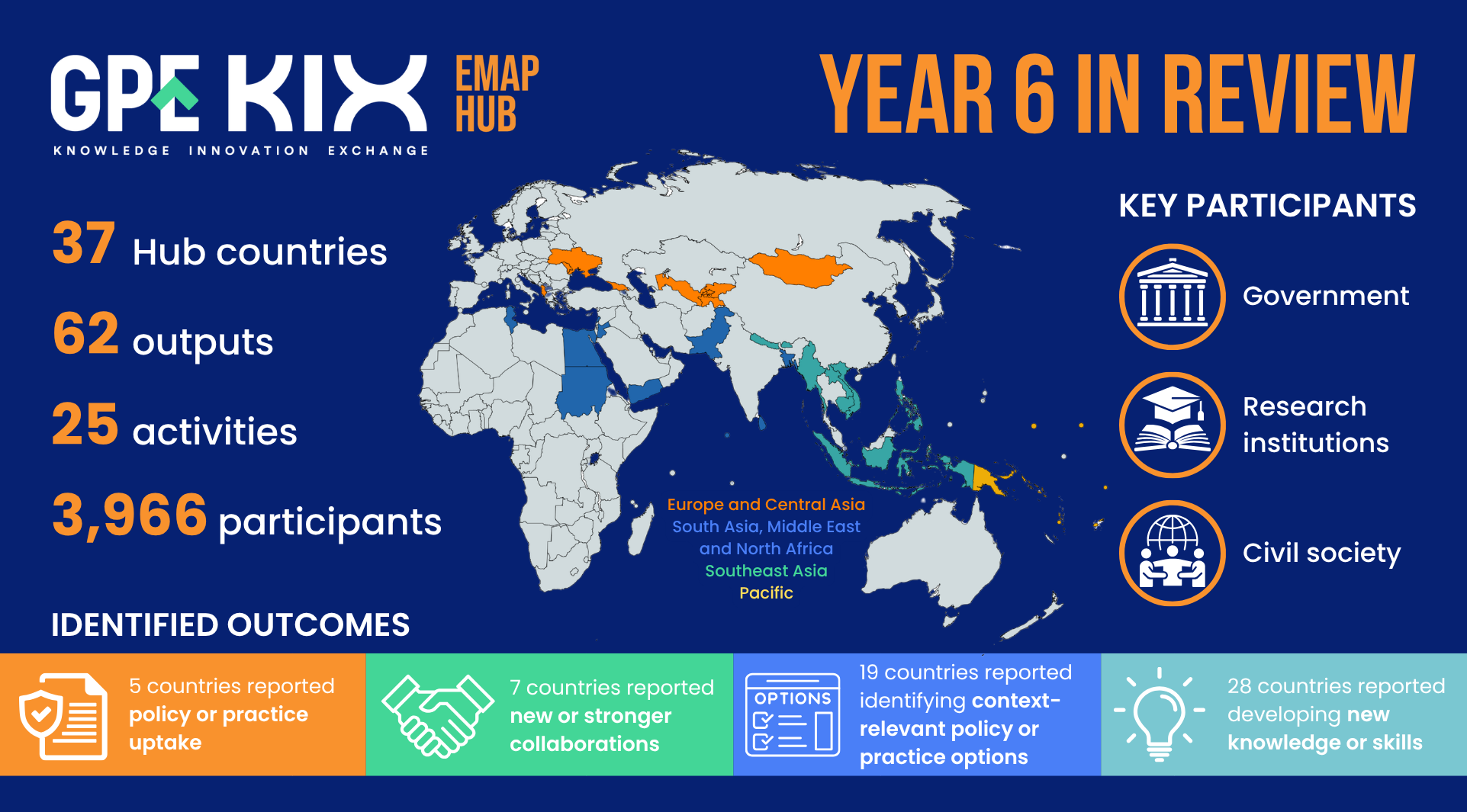
The scale of the Hub’s reach in Year 6 was significant. Two new GPE partner countries joined the Hub – Jordan and Lebanon – totalling 37 countries. Over the year, nearly 4,000 participants from 143 countries participated in KIX EMAP activities. Of these, over 3,000 participants engaged from KIX EMAP countries, including 65% women.
The Hub organised a total of 25 demand-driven knowledge exchange and capacity-strengthening activities, with nearly 50% in person or hybrid and 60% co-organised with national, regional and/or international partners. Furthermore, nearly 80% of the activities organised by the Hub highlighted gender equality and social inclusion (GESI).
Sixty-two outputs were produced in collaboration with national experts. These outputs included country case studies, videos, infographics, and more. Importantly, 21 publications resulted from Learning Cycle and Rapid Customised Country Support activities on women’s representation in school leadership, secondary teacher workforce management and inclusive education. Over 80% of the outputs include GESI content.
Building Outcomes
Following participation in Hub activities, representatives from 28 countries strengthened their knowledge and skills across 11 thematic areas — from scaling innovations and gender equality to education in emergencies, qualitative research, and the use of evidence in policy and planning.
In 19 countries, Hub activities led to the identification of concrete policy and practice options for addressing education system challenges, including integrated education data governance, rights-based monitoring in early childhood care, teacher workforce management, and inclusive school participation. In over 60% of these cases, the policy and practice options focused on advancing GESI.
In 7 countries, the Hub contributed to new or strengthened relationships across government, research, civil society, and development partners. Pakistan particularly stands out for a high number of institutional collaborations for advancing climate education, the right to education, and gender-sensitive school leadership.
Outcomes in Action
The KIX EMAP Hub’s most significant results of the year relate to its contribution to actual changes in policy and practice. The Hub contributed to these outcomes in five countries. In four of these cases, GESI was a primary focus, underscoring the Hub’s commitment to advancing equitable education systems.
In Bangladesh, participation in the KIX EMAP Learning Cycle 6 (LC6): Increasing Women’s Representation in School Leadership has influenced an increase in the proportion of women in primary-level school management committees. Bangladesh’s Ministry of Primary and Mass Education has implemented a new policy to increase the participation of women in education management and school leadership in more than 65,000 primary-level schools across the country. Before this, there were very few women in primary school management committees, but now the 12-member committee must include a minimum of three female members. The policy change is the outcome of a long-term collaborative effort between government organisations and international and national non-governmental organisations, including the LC6 Bangladesh team members who raised their voices regarding the issue of poor representation of women in school councils in different government policy-level meetings, seminars, and workshops.
Bangladesh LC6 policy brief: Advancing Gender Equity in School Leadership: Policies and Pathways for Women Leaders in Bangladesh
In Indonesia, the Hub contributed to two policy changes: the Ministry of Education updated its policy to prevent discrimination against female teachers, and a GPE Climate Smart Education System Framework approach was integrated into a national climate change education project.
Following participation in the KIX EMAP LC6: Increasing Women’s Representation in School Leadership, findings from a policy brief developed by a team of Indonesian experts influenced the design of a new teacher career development policy. During the development of this new policy, a senior bureaucrat within the Ministry of Education, Culture, Research and Technology referred to the findings from the LC6 policy brief. Such insights created awareness of the gender gap in the Indonesian context, generating a discussion on how the existing reform process could address this issue. This increased awareness was reflected in the new policy formulated by the Ministry in May 2025, which emphasises an open recruitment process, with more objective indicators such as years of service. The appointments also now need to be approved by the Ministry, thereby introducing increased accountability. The policy aims to eliminate subjective biases that previously contributed to discrimination against female teachers, thus advancing gender equality for teachers and school principals.
Indonesia LC6 policy brief: Enhancing Gender Inclusivity in Indonesia’s School Leadership Pathway
KIX EMAP activities also contributed to the design of a project in Indonesia. As a result of their participation in KIX EMAP Webinar 21: Climate Change and Education in Southeast Asia and the Pacific, a civil society representative decided to utilise the approach from GPE’s Climate Smart Education System Framework to develop an Index for Plastic Waste Reduction in Schools and self-assessment guidelines, in partnership with the World Wide Fund for Nature (WWF) Indonesia. These guidelines were subsequently piloted with a readability test and a teacher workshop to raise awareness of plastic waste issues in Indonesia. This tool is expected to be launched by WWF in 2026 and will be introduced to the Ministry of Environment for the Indonesia Green School program to undertake joint research.
In Lao PDR, the participation of the Ministry of Education and Sport in the KIX EMAP Webinars on ‘Inclusive Education in Europe and Central Asia’ influenced the design of a six-year primary school reform. During the webinars, KIX EMAP countries shared lessons learned and best practices on dropouts and inclusion within their contexts. The data shared during these webinars illustrated that high dropout rates resulted from a lack of school readiness in Early Childhood Education, thereby underscoring the necessity for a stronger academic foundation prior to the transition from the primary to the secondary levels. The findings shared during the webinars, combined with years of internal study and extensive discussions based on evidence from multiple countries, have informed the decision of Lao PDR in 2025 to transition to a six-year primary school model (6+3+3) from the earlier 5+4+3 model.
In the Maldives and Mongolia, insights from KIX EMAP Learning Cycle 5 (LC5): Teacher Professional Development at Scale (TPD@Scale) materialised into a national reform on teacher professional development and a new teacher policy implementation plan, respectively.
Drawing on a range of inputs, including findings and recommendations from the Maldives policy brief produced as part of LC5, the Maldives Ministry of Education embarked on a significant reform to modernise and strengthen the national TPD ecosystem. A key development is the creation of self-paced, online TPD modules hosted on a dedicated learning management system, which directly responds to a recommendation within the report. This initiative enables teachers across all atolls to access structured, high-quality learning opportunities at their own pace, regardless of school size, staffing constraints, or geographical isolation. The first module under this new system was developed through a GPE System Transformation Grant in mid-October 2025, with a focus on inclusive education. The modules are expected to be rolled out nationwide in 2026, ensuring that all teachers have access to appropriate in-service training in inclusive, learner-centred pedagogical practices. Additional thematic area modules are under development. These modules include one on climate education, informed by insights from the Maldives’ participation in the KIX EMAP Learning Cycle 8 on Education and Climate Change.
Maldives LC5 policy brief: Scaling Teacher Professional Development in the Maldives
In Mongolia, in December 2025, the Ministry of Education approved the National Teacher Policy Implementation Plan (2026–2028), which incorporates approximately 20 specific measures to strengthen the teaching profession. Crucially, three primary measures proposed in the KIX EMAP Learning Cycle 5 report were officially adopted into this national plan: i) an induction plan for new teachers to support early-career retention; ii) advocacy initiatives designed to improve the reputation and status of the teaching profession; and iii) provisions for gender equity for teachers within the workforce.
Mongolia LC5 policy brief: Teacher Professional Development in Mongolia
Looking Ahead
In Year 7, the KIX EMAP Hub continues to deepen its country-level engagement in close alignment with GPE processes. Priorities include the rollout of Rapid Customised Country Support activities across all four sub-regions; the completion and publication of Learning Cycle national policy analyses on climate change and AI in education; and the organisation of sub-regional learning exchanges. In parallel, the Hub will continue to deliver demand-driven knowledge exchange and capacity strengthening activities. These efforts aim to position the Hub for the next phase of KIX, strengthening integration with GPE, regional and national policy research institutions and Ministries of Education to facilitate the use of relevant evidence for better education policy and practice across the EMAP region.