

Reflections on the Session: Has “Sustainable Development” had its Day?
This blog post, cross-posted with Education for Planetary Futures, questions how the idea of “sustainable development” shapes and limits what futures we can imagine, reinforcing systems of measurement, growth, and unequal power rather than transforming them.
Has “sustainable development” had its day or has it quietly shaped the limits of what we are able to imagine as a future? This question sat at the heart of a recent session we attended at the Comparative and International Education Society (CIES) conference, exploring the role of education in a world facing deepening ecological and social crises. But rather than offering a familiar critique of the Sustainable Development Goals (SDGs) – their metrics, their implementation gaps, or their lack of political traction – the conversation moved in a different direction. It asked what sustainable development does to our imagination: how its language, assumptions, and frameworks may be narrowing, rather than expanding, the horizons of what we think is possible. In this sense, the problem is not only that sustainable development is insufficient, but that quietly organizes what we are able to think and what remains out of reach.
Interconnected, but divided
You can see this tension in something as seemingly uncontroversial as “interconnectedness.” This word is becoming quite widespread and familiar. The SDGs themselves acknowledge “deep interconnections,” yet operationalize them through discrete goals, targets, and indicators. Complexity is recognized but governed through fragmentation. Additionally, interconnectedness or “systems thinking” is being rediscovered and celebrated as if it were new, as if relational ways of knowing had not existed long before they became “legible” to the West. So the question is not simply how to better represent interconnectedness. It’s who gets to define the system and whose ways of knowing are folded into it or erased by it (Buckner et al., 2025).
Measured, therefore valued
A similar pattern emerges around measurement. Moira Faul’s opening line adds another layer to this tension: we don’t measure what we treasure, we treasure what we can measure at a certain time. Her phrase points to an important problem: measurement reorganizes attention, value, and even care. Measurement has become a key determinant in deciding what matters and what we should be focusing our attention on. What can be counted becomes visible, actionable, and worthy of investment. What resists quantification – relationships, dependencies, forms of care, more-than-human life – slips to the margins. Over time, entire worlds of value are either amplified or erased, depending on whether they can be rendered legible within existing metrics.
The result is not only a technical narrowing, but an ethical one. We begin to orient ourselves toward what can be measured, even when we know that what truly matters often cannot be.
Growth without limits
Nowhere is this more visible than in the role of economics within sustainable development. If sustainability rests on three pillars – environmental, social, and economic – it is the economic pillar that remains least questioned. But how can we speak of sustainability while maintaining a model of endless growth? How can “policy space” coexist with demands for global macroeconomic coherence?
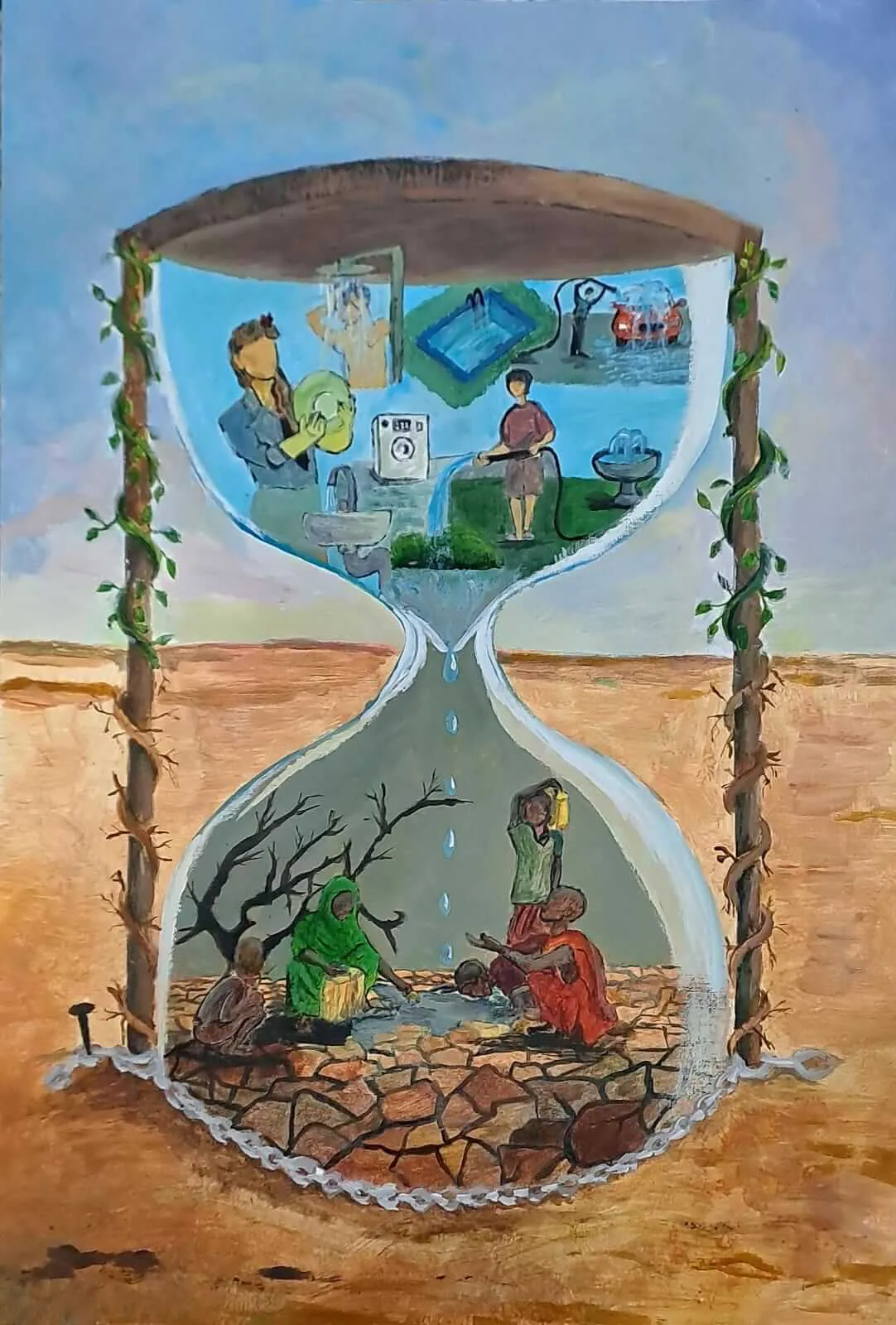
As Nigel Brissett provocatively suggested, development can be understood as a Ponzi scheme: a model of growth that depends on continuous expansion, where some lives and lands are always already positioned as expendable. In other words, it is widely recognized – if not always openly acknowledged – that the sustainable development agenda still rests on the logic that the prosperity of some depends on the sacrifice of others.

Who names the world
This leads to a more uncomfortable question about power. Who gets to name the world? Who gets to speak for the “global” and define the future? The SDGs are framed as “global,” but this globality is uneven. Knowledge from the Global North is treated as universal, while knowledge from the Global South is positioned as local and contextual. This matters because it shapes not only whose knowledge counts, but what kinds of futures become imaginable. The SDGs, as some of the presenters noted, carry a very specific story about what it means to be human and how life should be organized.
In this regard, Benjamin Scherrer brought Wynter into the room in a way that shifted the tone. Modernity produces a particular version of the human – Man – as rational, economic, and self-interested (Wynter, 2003). Development has largely been about reproducing that figure. Homo economicus is the horizon of our current development systems. But Wynter reminds us that humans are not only biological beings (bios), but also storytelling beings (logos): we are made through the worlds we imagine and enact. So, what happens if we take that seriously? Moving beyond homo economicus is taking the mythos and logos part of us seriously, which means embracing the instability of being humans.
Benjamin Scherrer used the language of ceremony, which gestures toward a way of relating to the planet, to each other, and to knowledge, that is less instrumental, less extractive and not easily translated into targets or indicators.
Not a new language
At this point, the temptation is to search for alternatives: to replace “sustainable development” with new terms — planetary futures, regeneration, resilience. But as Roxana Chiappa cautioned, the problem is not simply the language we use. Substituting one concept for another risks leaving the underlying structures intact. So, the problem is not so much which language we use, but that we are able to disrupt the underpinning dynamics. Drawing on Andreotti (2021), she pointed to the “denials” that sustain modernity and that we need to challenge more:
- denial of complicity
- denial of limits
- denial of entanglement
- denial of the scale of the crisis
The shift away from development is meaningful only if it also changes how we sit with these denials. Otherwise, it risks becoming another layer of vocabulary over the same arrangements.
A different kind of education
Which brings us back to education. If current education systems are embedded in unsustainable logics – individualism, competition, consumption – can they truly prepare us for planetary futures? What does it mean to “educate” in that space?
Several presenters pointed at the familiar gap that exists between what we know and what we are willing to do. Bridging this gap requires more than knowledge. It may require what was described, evocatively, as re-storying and as ceremony. How might we live differently if life itself were treated as a ceremony?
Tristan McCowan ended the session with the question: How do we respond to an urgent polycrisis and still pause? It’s a difficult question. The urgency tends to push us toward acceleration, solutions, and action. But rushing often reproduces the same frames we are trying to move beyond. So, maybe the pause is not inaction, but a different kind of attention. One that Roxane also invited us to do when she opened her presentation with a pause, with closing our eyes, with feeling the space and the time that we often rush over. A pause that we usually do not find in spaces like education conferences or the university. And yet, it may be precisely here – within this interruption of pace, this refusal to rush – that the possibility of imagining and living otherwise begins.
References
Andreotti, V. M. de O. (2021). Hospicing modernity: Facing humanity’s wrongs and the implications for social activism. North Atlantic Books.
Buckner, E., McCowan, T., Faul, M. V., Welply, O., Jiménez, J., & Denton, F. (2025). Charting the path after 2030: What should higher education’s role be in the future of the sustainable development agenda? Compare: A Journal of Comparative and International Education. https://doi.org/10.1080/03057925.2025.2571462
Wynter, S. (2003). Unsettling the coloniality of being/power/truth/freedom: Towards the human, after man, its overrepresentation—An argument. CR: The New Centennial Review, 3(3), 257–337.