

Event Highlights: Beyond 2030: What Role for Higher Education in the New Global Agenda?
Wednesday 13 May
15:00 – 17:00 CET
Online (Zoom)
The guest editors, Elizabeth Buckner and Tristan McCowan, and the time and expertise of all the contributors. Buckner began the event by thanking all the contributors to the After 2030 project, supported by the University of Toronto / University College London Strategic Partnership Fund, from which the publication draws. Higher education is strongly implicated in this agenda (Buckner et al. 2025), by forming the professionals who will drive forward development agendas and also as spaces for rethinking what universities should be (McCowan 2025).
McCowan summarised the discussions (as part of the After 2030 project) that pointed to four potential scenarios: postponement, amendment, replacement and abandonment. First, we could simply propose an extension on the current agenda, leaving the 17 existing goals in place and setting a new due date, say 2050. Second, we could adjust the current set of goals, leaving the basic structure in place, but creating new targets or goals, or amending existing ones. For example, Brazil has proposed an 18th SDG focusing on racism. Next, there are more radical proposals for replacing the agenda with an entirely new one. New ideas have included a nexus approach, with the diverse goals revolving around some key intersecting clusters, e.g. water, energy and food. Some have proposed removing the notion of sustainable development altogether, and replacing it with ideas of justice, repair and the pluriverse (McCowan, 2025). Finally, there is a scenario in which the world will be left without a global agenda.
Buckner then summarised the main themes addressed by the diverse range of contributors, from seasoned academics to early career researchers and students, and from varied contexts in Africa, Asia, Europe, North and South America, and Oceania. Their reflections are grouped into five thematic areas in the publication: rethinking global governance, universities as agents of change, pedagogy, learning, and community, equity, justice, and power, and rethinking the status quo and calls for epistemic plurality.
In the first set of presentations, Rowena Shivam identifies five schools of thought shaping the post-2030 agenda, namely integrated scientific frameworks, governance reform, localisation, digital and circular transitions, and ethical paradigm shifts, and argues for a leaner and more enforceable system. Maryna Lakhno summarised her contribution with Patrick Montjouridès and Christian Ydesen addressing the declining legitimacy of the United Nations and the widening gap between scientific research and global policy, arguing that universities must be positioned as central agents for transforming new knowledge into action. Maia Chankseliani defends the positive impacts of international student mobility on students’ countries of origin, conceptualised beyond narrow human capital formation and acknowledging the complexity of their post-graduation pathways. Finally, Savo Heleta and Logan Cochrane argue that international aid to higher education should be reallocated to prioritise support for domestic higher education systems and countries in greatest need. A Q&A session focused on:
- Broadening the Debate: Is it time to take the debate to the general public and look for their views rather than focusing solely on academic literature?
- Donor Criteria: As a donor agency, how would you select partner countries to work with, and what criteria would you suggest to a donor seeking advice?
- Scholarship Impact: Were those scholarships also paying attention to the development of higher education within those recipient countries?
- The Quality of the Welcome inside higher education institutions for international students, and how can these institutions rethink their environments through a future global agenda?
- Risk and Aid: How can aid to higher education institutions based on needs address issues of risk aversion and due diligence, particularly when dealing with countries that have “problematic politics”?
- Practical Transformation: How might universities practically achieve moving beyond the “ivory tower” to address societal questions like climate change and pandemics?
The second set of presentations began with Matt Witenstein discussing the key role that higher education can play in processes of just transitions; movements towards decarbonization that are in concert with those for social justice. Miah Dionne Sears presented her contribution with Shikha Diwakar and Emma Harden-Wolfson, showing the need to tackle the structural oppression of groups disadvantaged by caste, race and other factors in widening participation to higher education. Finally, Andrea Velásquez Butrón asserts the central importance of epistemic justice in higher education through the case of Peru, and the need for colonial, modernist paradigms to give way to recognition of indigenous and ancestral knowledge traditions. The Q&A session focused on:
- Regional Policy Impact: How will politics and policies in the United States, Latin America, and the Caribbean change higher education and opportunities for universities in that region?
- Structural Transformation: Does framing the SDGs or the post-2030 agenda as a “just transition” successfully capture the structural transformations necessary to move away from patriarchal racial capitalism?
- Case Study Lessons: What are the key ideas from case studies that should be kept in mind when taking the agenda forward beyond 2030?
- Knowledge Production: What needs to be considered regarding knowledge production and what types of knowledge will be useful for the Beyond 2030 agenda? E.g. AI
- Epistemic Justice: How can a 2030 agenda be created that truly incorporates epistemic justice frameworks and diverse worldviews into actual decision-making processes and outcomes?
Our first discussant, Tafadzwa Tivaringe, higher education scholar and Spencer Foundation Programme Officer, addressed the dual nature of higher education as an institution facing significant political and financial pressure while remaining a vital space for connecting public purpose with imagination. He emphasised that universities should move beyond “checkbox governance” and technocratic optimism to confront deep-seated issues like epistemic violence, ecological collapse, and global inequality. His intervention highlighted the importance of epistemic diversity, arguing that African-centred and Indigenous knowledge systems are indispensable intellectual resources, not merely ornamental additions to Western paradigms. Ultimately, Tivaringe called for a shift toward “disciplined hope,” inviting a serious rethinking of what universities are for and how they might transform themselves to address an era of democratic and planetary uncertainty.
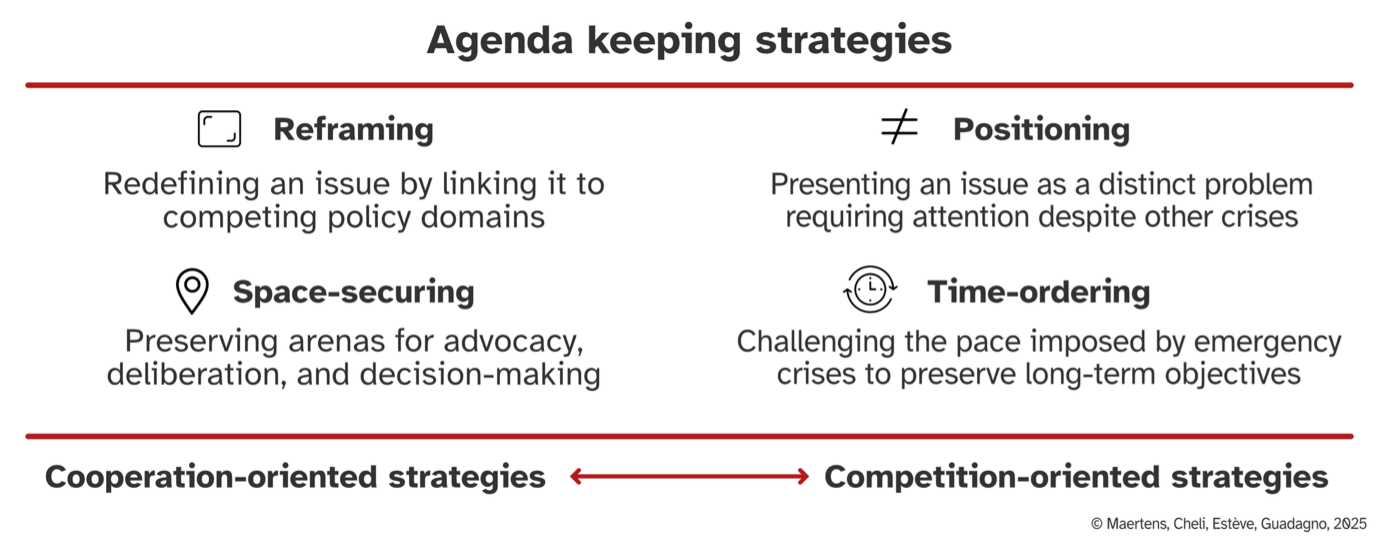
Finally, Lucile Maertens, Geneva Graduate Institute presented her work on “agenda keeping” (Maertens et al., 2026), the process of maintaining an issue as a priority for action despite the competition and polarization brought on by multiple crises. She identified four key strategies: reframing problems to link them with current crises, positioning issues as meta-problems, securing spaces for advocacy, and ordering time to protect long-term priorities from being overshadowed by short-term emergencies. She emphasised that agenda keeping is not conservative but is a logic of adaptation and contestation designed to ensure that the design of global policy agendas is not dominated solely by powerful actors. While the success of these strategies depends on organizational mandates and audience resonance, Maertens concluded that agenda keeping is a vital tool for staying relevant and ensuring that essential issues like education are not forgotten.
References
Buckner, E. and McCowan, T. (2026) (eds.). Beyond 2030: What role for higher education in the new global agenda? Policy Insights#07. NORRAG. https://resources.norrageducation.org/resource/1025/beyond-2030-what-role-for-higher-education-in-the-new-global-agenda
Buckner, E., McCowan, T., Faul, M. V., Welply, O., Jimenez, J., & Denton, F. (2025). Charting the path after 2030: What should higher education’s role be in the future of the sustainable development agenda. Compare. https://doi.org/ 10.1080/03057925.2025.2571462
McCowan, T. (2025). Universities and climate action. UCL Press. https://doi. org/10.14324/111.9781800088290
Maertens, L., Cheli, Z., Estève, A., & Guadagno, L. (2026). Agenda-keeping in International Geneva. Geneva Policy Outlook. https://www.genevapolicyoutlook.ch/agenda-keeping-in-international-geneva/