


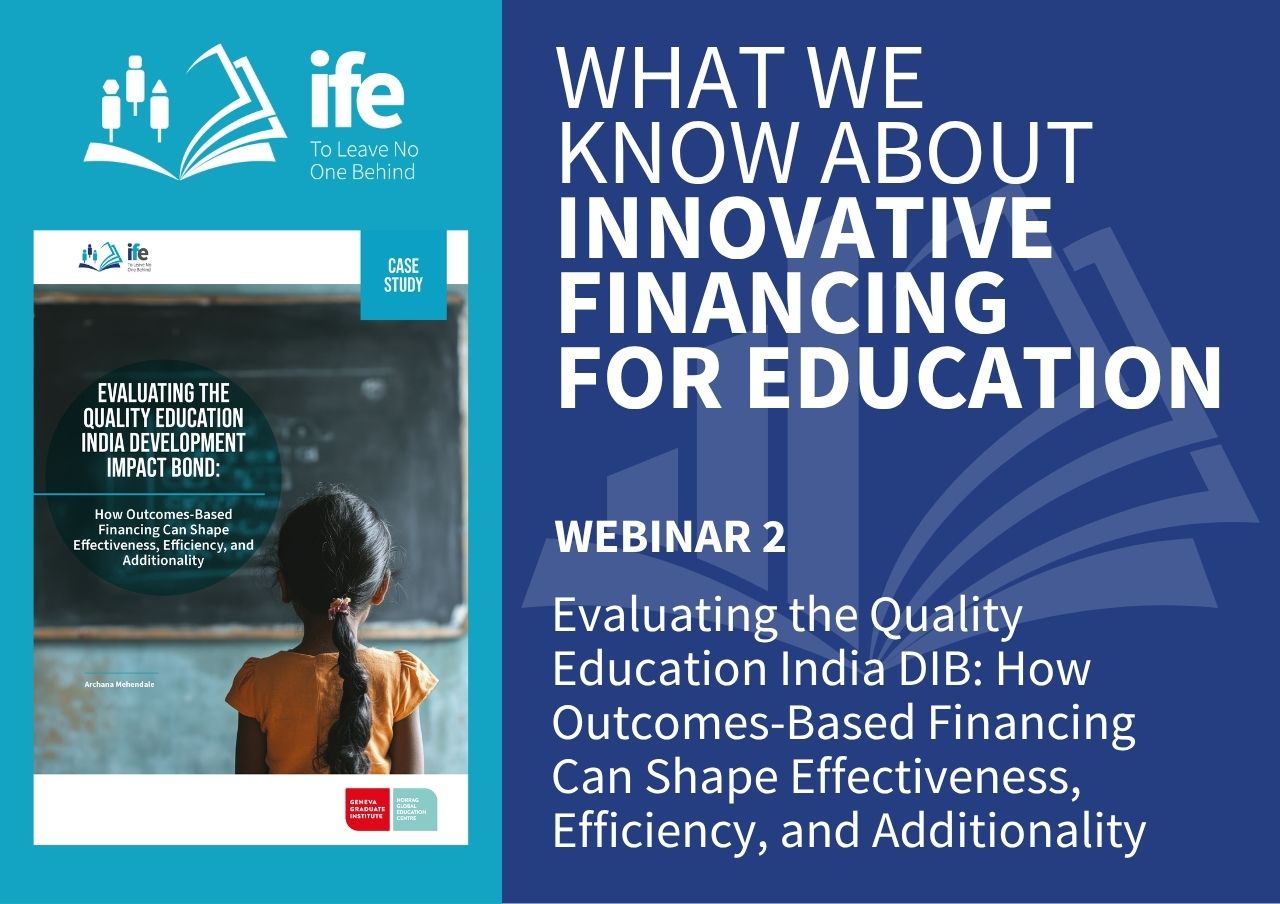
Event Highlights: Evaluating the Quality Education India DIB: How Outcomes-Based Financing Can Shape Effectiveness, Efficiency, and Additionality
Tuesday, 27th October 2026
12:00-14:00 CET // 16:30-18:30 IST
Online
NORRAG’s Innovative Financing for Education (IFE) to Leave No One Behind team hosted the second webinar of its series What We Know About Innovative Financing for Education on 27 October 2026, in partnership with the KIX EMAP Hub. The session focused on the Quality Education India Development Impact Bond (QEI-DIB), which at its launch in April 2018 was the world’s largest education-focused development impact bond (DIB).
Findings from NORRAG’s case study of the QEI-DIB, conducted with the Tata Institute of Social Sciences and supported by the UBS Optimus Foundation, opened the discussion. Those involved in designing, financing, managing, and implementing the DIB—the investor, an outcome funder, the outcomes convenor, the performance manager, and an implementing partner—shared reflections on their experience with the DIB. Speakers on global education finance and Indian education policy joined them to consider what the case means for future outcomes-based financing (OBF) and impact bonds in education.
Archana Mehendale, Independent Researcher and Consultant at NORRAG (formerly, Tata Institute of Social Sciences), who led the research, presented the key findings from the research. Over four years, including the COVID-19 school closures, the QEI-DIB reached more than 200,000 children and achieved all of its payment-linked learning outcomes at the portfolio level, with outcome funders paying only once results had been independently verified. On the study’s four research questions, she reported the following:
- Effectiveness: clearly defined outcomes, external performance management, and operational flexibility drove results, helped by careful selection of experienced implementing partners.
- Efficiency: partners exceeded their targets while spending less than budgeted, although performance management was funded outside the core budget.
- Additionality: the impact bond drew in funders new to education financing in India, yet the evidence cannot show that the DIB structure itself brought entirely new money into education.
- Inclusion: underserved children were not systematically excluded, but without disaggregated data the study could not tell whether the most marginalised benefited equitably.
Future programmes, she suggested, should treat OBF as a tool rather than an end in itself, budget for performance management and evaluation, simplify where they can, and bring government in from the start.
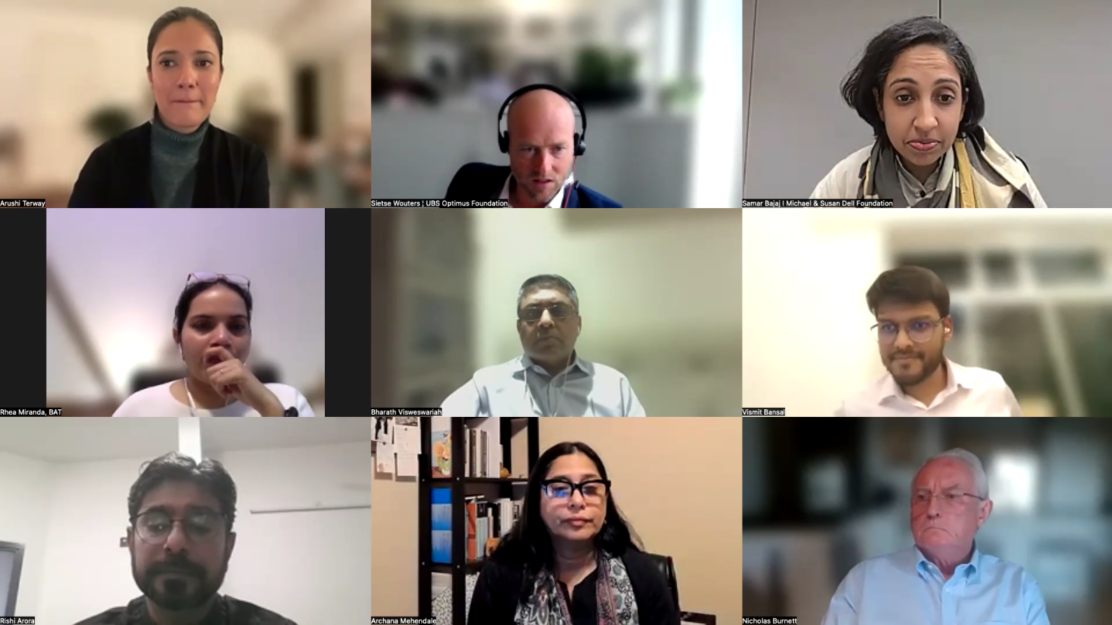
Arushi Terway, Education Finance Team Lead at NORAG, then turned to a panel of stakeholders from across the QEI-DIB and the wider field:
- Sietse Wouters: Programme Director, UBS Optimus Foundation
- Samar Bajaj: Head of Education, India, Michael & Susan Dell Foundation
- Bharath Visweswariah: Executive Director, India, British Asian Trust
- Rhea Miranda: Manager, Social Finance, British Asian Trust
- Vismit Bansal: Associate Partner, Dalberg Advisors
- Rishi Arora: President, Kaivalya Education Foundation
- Nicholas Burnett: Chair of the International Advisory Committee, IFE-2-Leave No One Behind, and Senior Fellow, Results for Development
- Archana Mehendale: Independent Researcher and Consultant, NORRAG
Investing to Test Outcomes-Based Financing
Why would a foundation invest in an impact bond rather than fund the implementers through a direct grant? For UBS Optimus Foundation, the sole investor, the aim was to test whether philanthropic capital could demonstrate a more effective way of using public money, which remains the main source of education financing. The outcome-based financing approach used played a critical role in shifting the focus from financing inputs – which remains the norm in education financing – from paying for verified results. Sietse Wouters explained how this logic, where upfront capital is repaid only on verified outcomes, created accountability and gave implementers room to adapt, and the price eventually paid per outcome came in well below the price expected at design (46% lower, according to the study). Still, Sietse Wouters cautioned that early impact bonds like the QEI-DIB are pilots with more “bells and whistles” than an established programme would need, and that not every programme needs an impact bond. In his view, the bigger risk is overstructuring OBF, so that complex, costly programmes remain isolated pilots.
Lessons From an Outcome Funder
For the Michael & Susan Dell Foundation (MSDF), which had funded education in India for some 20 years mostly through grants, the QEI-DIB was its first impact bond in India. Samar Bajaj’s advice to countries where impact bonds are newer was to make sure organisations are ready, and to build on interventions with existing evidence, as several QEI-DIB partners did. Flexibility and trust within the group let partners with very different models adjust both delivery and targets when schools closed. Looking ahead, she called for outcomes that are simple to define and transparent communication around them, to avoid creating seemingly complex structures. She admitted that it is easier with job placement in skilling than with school learning, where MSDF has since tried more than one metric without finding a perfect one. Contributing to financial additionality, for example by encouraging more new funders to come into the sector, she added, has proven harder than expected. She reminded that much multilateral funding is still tied to outputs rather than outcomes.
Bringing Multiple Outcome Funders Together
Convening the outcome funders fell to the British Asian Trust (BAT), which brought together various entities to commit to paying for outcomes achieved. With MSDF committed as anchor funder, BAT raised the rest from Comic Relief, the Mittal Foundation, the Larry Ellison Foundation, and British Telecom. Rhea Miranda recalled that this took a tailored, one-to-one approach and much explanation of how an impact bond differs from a grant, and that paying only for independently verified learning gains was what brought funders on board. This process took long and had to navigate differing views on the choice of the best approach.
The sharpest divergence came over the outcomes framework: the investor wanted it simple to understand, while MSDF wanted rigorous, credible measurement. Setting targets as learning gains on a common scale let the different education models be compared on the same yardstick.
For Bharath Visweswariah, the main disappointment was with the level of government’s engagement. BAT had hoped government would become a buyer of outcomes, which did not happen in the QEI-DIB. Skilling offers a contrast: the Skill Impact Bond has grown into the Skills Outcomes Fund, a programme four times larger in which government provides half of the outcome funding, partly because government already buys skilling services from private providers. He also named implementing partners’ capacity as a precondition, which led BAT to build an outcomes readiness assessment tool for non-profits.
Tailoring Performance Management to Each Implementing Partner
Dalberg, which helped design the QEI-DIB, also served as its performance manager. According to Vismit Bansal, the support it gave differed from partner to partner, depending on where decisions about adapting the programme were made and how strong each organisation’s own monitoring, evaluation, and learning systems were. In practice, the performance manager took on one or more of three roles:
- Diagnosing gaps as they emerged in a partner’s programme.
- Problem-solving as a thought partner where the gaps were already known.
- Building systems that partners could use to spot and address problems themselves.
Building a Culture of Measurement
Asked what changed most at Kaivalya Education Foundation, one of the implementing partners, Rishi Arora pointed to a culture of measurement. The organisation began tracking how, in what context, and at what speed children learn, down to how many conversations a head teacher needs before acting on poor learning results. Kaivalya now matches learning data with classroom practice and has carried this approach into more than 100 aspirational districts.
Impact Bonds and the Global Education Financing Challenge
Nicholas Burnett placed the QEI-DIB within a difficult global picture of falling aid to education and rising debt service. Two features of DIBs could help: an outcomes orientation that may appeal to new sources of funding, such as future debt relief or new philanthropy, and a culture of adaptive management, visible in the QEI-DIB’s decision to drop an intervention that underperformed in its first year. He reminded that this culture change to focus on outcomes has a price. The study puts the costs not covered by outcome funding, including performance management, evaluation, and legal fees, at USD 1.8 million, against up to USD 9.2 million in outcome funding.
Even so, he argued that the core problem in education is underfunded public systems, which DIBs are poorly placed to fix. He sees a continuing case for DIBs where non-state actors deliver or support education, but warned that treating them as the primary solution could distract from sustained system reform and public financing.
Outcomes-Based Governance and Outcomes-Based Financing in India
Bringing the discussion back to India, Archana Mehendale suggested the question is less whether India adopts DIBs at scale than whether public education systems can absorb the principles that made OBF work: performance management, use of data, implementation support, and accountability for learning. Government may be more at ease with outcomes-based governance than with outcomes-based financing, which raises harder questions for the state: how it fits public procurement, whether public funds should pay returns to private investors, and how outcomes should be verified. Public education also pursues equity, inclusion, all-round development, and children’s well-being, which a handful of quantifiable indicators may struggle to capture.
Q&A
More than 120 participants joined, and the chat stayed active throughout. Questions put to the panel included:
- How was the price per outcome calculated in the QEI-DIB?
- Where data are fragmented and budgets tight, how can programmes run data-driven performance management without losing the disaggregation needed to protect marginalised and rural institutions?
- If teachers and other actors come to depend on financial incentives, how can motivation and ownership be built to last?
- Does anything in an impact bond specifically push it towards equity?
This webinar was convened under the framework of the applied research project IFE-2-Leave No One Behind, which examines evidence from innovative financing approaches used in the education sector to explore whether and how such mechanisms can contribute to more and better financing for the sector.
The panellists’ answers can be found in the recording above.
Read more about the Webinar Series: What We Know About Innovative Financing for Education.
Webinar Partners



The IFE-2-Leave No One Behind project would like to thank the KIX EMAP Hub for partnering in this event.