

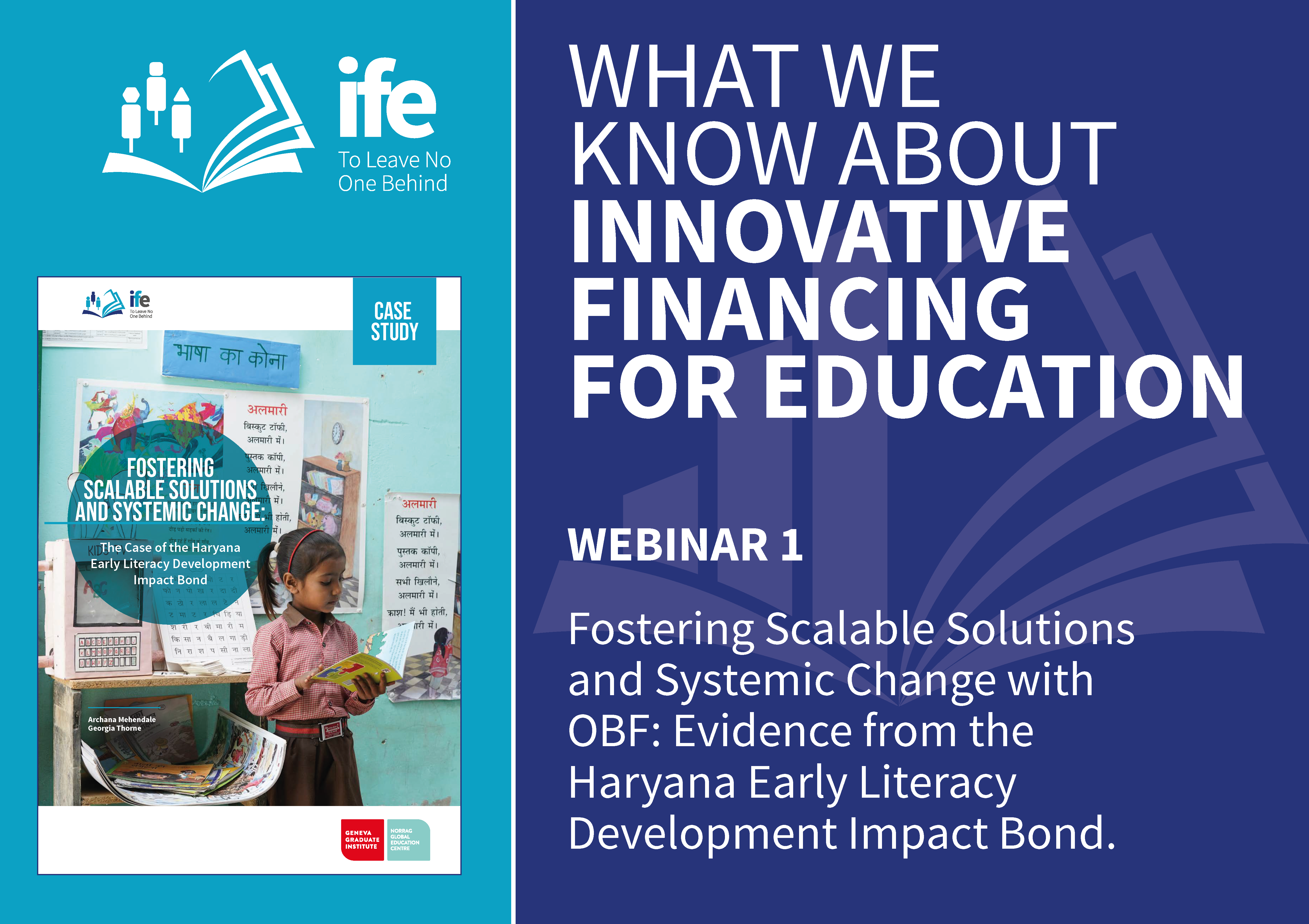
Event Highlights: Fostering Scalable Solutions and Systemic Change with OBF: Evidence from the Haryana Early Literacy Development Impact Bond
Tuesday 8th September 2026
13:00-15:00 CEST / 16:30-18:30 IST
Online
On 8 September 2026, the Innovative Financing for Education (IFE) to Leave No One Behind project team at NORRAG kick-started their new webinar series What We Know About Innovative Financing for Education with the Webinar 1: Fostering Scalable Solutions and Systemic Change with OBF: Evidence from the Haryana Early Literacy Development Impact Bond, co-organised in partnership with Language and Learning Foundation and the KIX EMAP Hub.
The webinar presented findings from an independent impact evaluation of the Haryana Early Literacy Development Impact Bond (DIB)—India’s first outcomes-based financing (OBF) mechanism for education to mobilise Corporate Social Responsibility (CSR) funding. It brought together researchers, practitioners, policymakers, funders, and corporate and philanthropic actors for a discussion on what the Haryana DIB can teach us about applying outcomes-focused approaches to achieve more and better financing for education.
The webinar was moderated by Arushi Terway (Project Director: IFE-2-Leave No One Behind, NORRAG) who first introduced Archana Mehendale, Independent Researcher and Consultant at NORRAG (formerly Tata Institute of Social Sciences), to present the project’s research. Archana Mehendale presented a brief overview of the Haryana Early Literacy DIB which, between 2019 and 2022, aimed to improve foundational literacy for children in Grades 1 and 2 across 3,500 government schools in Haryana, India. She then summarised some key takeaways from the research, sharing that 1) the DIB’s focus on outcomes enabled flexibility to adapt the intervention to emerging needs, 2) the financial structure tapped into CSR funds, bringing two new funders to education programming; 3) the DIB enabled LLF to scale its intervention from 175 schools in one district to 3,300 schools across seven districts ultimately reaching 164,000 children in Haryana, and 4) early government ownership and deliberate embedding of systemic goals into the project design was central to the programme’s success.
Next, Shivakshi Rana, Strategy Manager at Language and Learning Foundation (LLF) presented reflections from the implementer’s perspective, i.e. how the outcomes-based financing structure impacted their programme. She recounted how the DIB mechanism created the room and flexibility to act on the government’s ambition to scale LLF’s intervention. She went further to share that scaling was made possible because of working with – not in parallel to – the public education system.
Following these two presentations, Arushi Terway facilitated a moderated discussion with a range of stakeholders connected to the Haryana DIB. The panellists were:
- Aman Bhaiya: Vice President & Head (Strategy & Growth), SBI Foundation
- Ridhi Bhatia: Senior Vice President CSR, Kotak (formerly, Strategic Lead for CSR at IndusInd Bank)
- Ishmeet Singh: CEO, Central Square Foundation
- Parmod Kumar: State Programme Officer, Haryana State Ministry of Education
- Dhir Jhingran: Founder and Executive Director, Language and Learning Foundation
- Amrita Patwardhan: Deputy Head of Programmes and Head of Education, Tata Trusts
- Sumit Chauhan: Head of CSR, IndusInd Bank
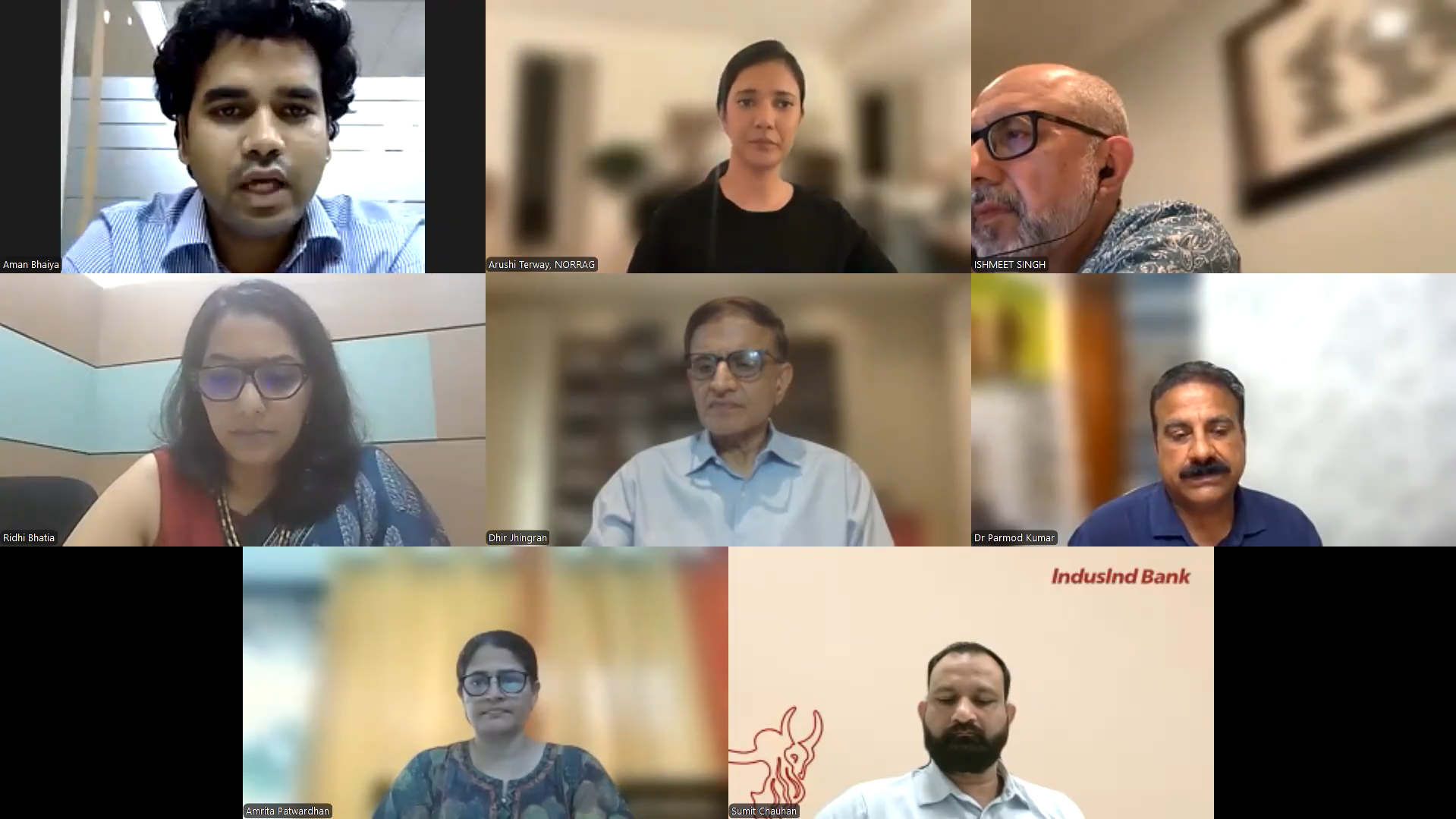
The following section summarises the key points from the discussion.
Using CSR Funding in OBF Projects
When asked about SBI Foundation’s experience of disbursing corporate social responsibility (CSR) funding in an outcomes-based financing (OBF) project, Aman Bhaiya noted that since their involvement in the DIB, they have a higher focus on outcomes, most evidently demonstrated by moving from measuring only shorter-term outputs to also including longer-term outcomes. Nevertheless, he also expressed the difficulty of defining outcomes, especially in getting consensus between donors and implementing agencies, a sentiment echoed by other panellists. Additionally, the Haryana DIB showed the value of results verification, with SBI Foundation now setting aside budgets for third-party assessments. Overall, he shared that the success of the Haryana DIB showcases the power of collaboration, collective wisdom and a community of like-minded people coming together to solve a complex challenge.
Role of a Risk Guarantor
Unlike a typical impact bond model, the Haryana DIB contracted Central Square Foundation (CSF) as a risk guarantor, who would pay up to 20% of the grant amount if the predefined outcomes were not achieved. Ishmeet Singh, CSF’s CEO, saw the risk guarantor role as more than financial backing, putting both capital and institutional credibility behind an intervention it believed had potential to scale. This financial and reputational guarantee gave CSR funders greater confidence to support LLF and enter the OBF structure.
Catalysts and Inhibitors of this Financing Model
Ridhi Bhatia, who worked closely on the Haryana DIB during her time at IndusInd Bank (now at Kotak) shared some of what she believes are the catalysts and barriers for engaging in an OBF model:
Catalysts
- Evidence before scale: Once there is evidence, engaging becomes easier. In the case of the Haryana DIB, it did not start at scale. It began with a demonstration project in 175 schools and provided evidence that the intervention model and government partnerships worked.
- Verified results: Funders need confidence that results will be measured objectively. The Haryana DIB had an independent evaluator with a clearly defined outcome matrix and measurement framework, meaning that the success was never subjective.
- Sustainability: A successful project is not the sole aim; the focus should also be on building sustainability beyond the funding timeframe. The Haryana DIB had the objective to strengthen the system and create a pathway for adoption and scale through partnering with the government.
Barriers
- Long-term commitment and risk appetite: Short-term grants are very different to financial models such as the Haryana DIB. They often require multiple stakeholders, robust measurement systems, independent evaluation, strong governance, long-term commitment, shared value and high transaction costs. These aspects, and a company’s risk appetite, may act as barriers to uptake.
Using the phrase “it takes a village to raise a child”, Ridhi Bhatia concluded by inferring the stakeholders of the Haryana DIB were the “village” needed to improve learning outcomes for children, signalling that a successful application of OBF, such as this one, does not take place in a silo, rather as a collaborative approach towards a common goal.
Working with the Government
As the implementing partner in the Haryana DIB, LLF’s Dhir Jhingran presented six principles that they took away from the DIB experience and continue to apply in all aspects of their work for government-led impact:
- Trust: The foundational principle of trusting their institutional expertise in early literacy and their commitment to supporting and working with, not in parallel to, the government.
- Relationships: Building relationships at all levels of government for clear communication and governmental recognition that LLF are supporting them to succeed.
- Government leadership: Encouraging government officials to lead activities, e.g. reviewing data and chairing meetings.
- Capacity building: of system actors, for example, through training programmes.
- Continuous professional development: of LLF staff to maintain the rigour and quality of work and increase the system’s acceptance of their input and capability.
- Early literacy “buzz”: Boosting the importance and recognition of early language and literacy learning through dialogues with state and district-level officials.
Engaging NGOs in the State Education System
Parmod Kumar from the Haryana State Ministry of Education offered thoughts on working with NGOs, recognising that they can demonstrate best practices and offer space for flexibility and innovation. He also recognised that CSR funding invested in the government system can increase learning outcomes. Nevertheless, Dr Kumar cautioned that this should not be a parallel delivery system. Rather, partners should work to strengthen the existing education system: work with the government to jointly set agendas and work towards handover to the public system.
Challenges in the Indian Education System and the Role of CSR and OBF
Concluding the moderating discussion, Amrita Patwardhan stressed that one of the biggest challenges in education in India is the need for more funding across all areas of education, from pre-school to secondary education and beyond. She also stressed the need for funding in historically neglected areas such as teacher professional development.
When discussing the role that OBF could play, she recognised the “buzz” that OBF tends to receive in terms of its potential to unlock additional funding and improve programme efficiency, agreeing that if this is the case, it could play an important role in education financing. However, she also advocated for more evidence, particularly on the sustainability of results and stressed that striving for shorter-term outcomes should not detract from system strengthening and addressing complex challenges.
Reflecting on the use of CSR in OBF, Sumit Chauhan reiterated that this is a fairly new approach that does not currently have sufficient advocacy or pressure to influence significant uptake.
Q&A
The webinar concluded with a Q&A session with the audience. The Q&A answered questions including:
- Is a DIB structure better than a simple conditional grant?
- How did the COVID19 pandemic impact the intervention?
- What did not work so well with the DIB structure, and what would you have done differently?
- How can children with disabilities be considered in OBF planning to ensure that they are not excluded?
You can listen to all of the panellists’ responses in the recording above.
Useful Links
Read the full Case Study, Fostering Scalable Solutions and Systemic Change with OBF: Evidence from the Haryana Early Literacy Development Impact Bond.
Read more about the Webinar Series What We Know About Innovative Financing for Education.
Webinar Partners
This webinar is co-organised by NORRAG and the Language and Learning Foundation as part of the Innovative Financing for Education to Leave No One Behind project.



The IFE-2-Leave No One Behind project would like to thank the KIX EMAP Hub for partnering in this event.
Research partner.