IFE Publications

IFE Research Papers
The IFE Research Papers present the results of research projects examining the conceptualisation and implementation of various innovative financing approaches within the education sector.
2026
Guidance Note: Aligning Outcomes-Based Financing to Early Childhood Care and Education Systems in Sub-Saharan African Countries
 This guidance note examines how outcomes-based financing (OBF) can be applied to early childhood care and education (ECCE) systems in Sub-Saharan Africa. OBF links funding to verified results, but its effectiveness depends on how well it aligns with system realities.The note focuses on four key areas: national priorities, governance and financing, service delivery and workforce, and data systems. It highlights common challenges such as gaps between policy and provision, fragmented systems, reliance on non-state providers, and limited data.Rather than promoting a one-size-fits-all approach, the guidance emphasises designing OBF initiatives that are context-sensitive and aligned with existing systems. When well designed, OBF can support better coordination, equity, and quality in ECCE.
Suggested Citation: Terway, A. and Ossai, E. (2026). Guidance Note: Aligning Outcomes-Based Financing to Early Childhood Care and Education Systems in Sub-Saharan African Countries. Collective Learning Initiative on Outcomes-Based Finance for Early Childhood Care and Education, Government Outcomes Lab, Blavatnik School of Government, University of Oxford.
Following the Money: Where Education Impact Bond Financing Actually Flows
 This factsheet presents analysis of data on 140 education impact bond projects totalling USD 184 million in upfront capital and USD 445 million in maximum committed outcome payments. The data shows extreme geographic and economic concentration, with projects in high-income countries accounting for 92% of upfront capital and 73% of maximum committed outcome payments.
Education Impact Bonds: Picking Low-Hanging Fruit or Reaching for the Stars?
Impact bonds, a mechanism with the potential to improve and generate more financing towards educational outcomes, have gained traction over the past 15 years; however, empirical evidence regarding their use remains limited. This paper intends to contribute to this knowledge gap by examining the intended impact of education impact bonds (EIBs), which tie the achievement of predetermined targeted results to outcome payments. The analysis addresses critiques that navigating the diverse motivations of different stakeholders may result in concentrating on low-hanging fruit (setting easy-to-achieve targeted results), increasing the risk of perverse incentives and simplifying complex educational challenges.
2025
Who Gets in and Who’s Left Out? Determinants of Selection in a Social Lending Scheme for Higher Education in Kenya
In Sub-Saharan Africa and other low- and middle-income countries, obstacles to securing education financing often hinder students from accessing post-secondary education (Wanti, Wesselink, & Biemans, 2022). In Kenya, where financial barriers often impede students from pursuing higher education (Oketch, 2022), innovative financing initiatives from private sector actors, such as the Lending for Education in Africa Partnership (LEAP), have emerged as a complementary solution to government financing schemes. This paper sheds light on the factors influencing student selection for LEAP financing, ultimately aiming to contribute to the enhancement of equitable access to financial aid for tertiary education.
2024
Evidence Review of Outcomes-Based Finance for Early Childhood Care and Education
This evidence review takes stock of 22 documented, existing experiences of OBF4ECCE by surfacing, collating, and analysing available documents. Bilateral interviews, the convening of expert stakeholders, and the collective experience of the research team supplement the analysis. The review presents existing evidence and identifies substantial gaps in existing knowledge to inform the design of future programmes and research.
Practice Note: Measuring Outcomes in Outcomes-Based Financing for Early Childhood Care and Education
This practice note provides insights into the prominent issues and important considerations that need to be made for measurement in outcomes-based financing (OBF). It draws upon existing experience from OBF4ECCE projects at various stages of development, from design to implementation and completion.
2021
Results-based financing in education for sub-national government and school administrators: A conceptual framework and practical recommendations
The study contributes to the global evidence base on Results-based Financing (RBF) and provides lessons on the use of RBF in the meso-level of the education sector, as well as recommendations for strengthening the link between results and funding. Ultimately, it is part of NORRAG’s effort to build empirical evidence on what works and what does not work in using innovative financing for improving equitable and inclusive quality education.
2020
Innovative financing for education: A systematic literature review
 The NORRAG team conducted a comprehensive literature review of both grey and academic literature on IFE, which included over 150 individual articles. The publication includes an analysis of the types of mechanisms that have been researched, disciplinary approaches, definitions, rationales, along with a discussion on the identified benefits and challenges. A typology and description of the most prevalent innovative financing mechanisms discussed in education will also be published.
IFE Cases
Different mechanisms of innovative financing for education have been implemented in diverse contexts, with various purposes and involving many stakeholders.
The case studies here displayed explore and illustrate how these mechanisms work in practice. The cases tell the story behind the design and implementation of various mechanisms, shedding light on the financing challenges they address. The case studies fall into two different categories – short cases and in-depth case studies.
In-depth case studies
 |
 |
|
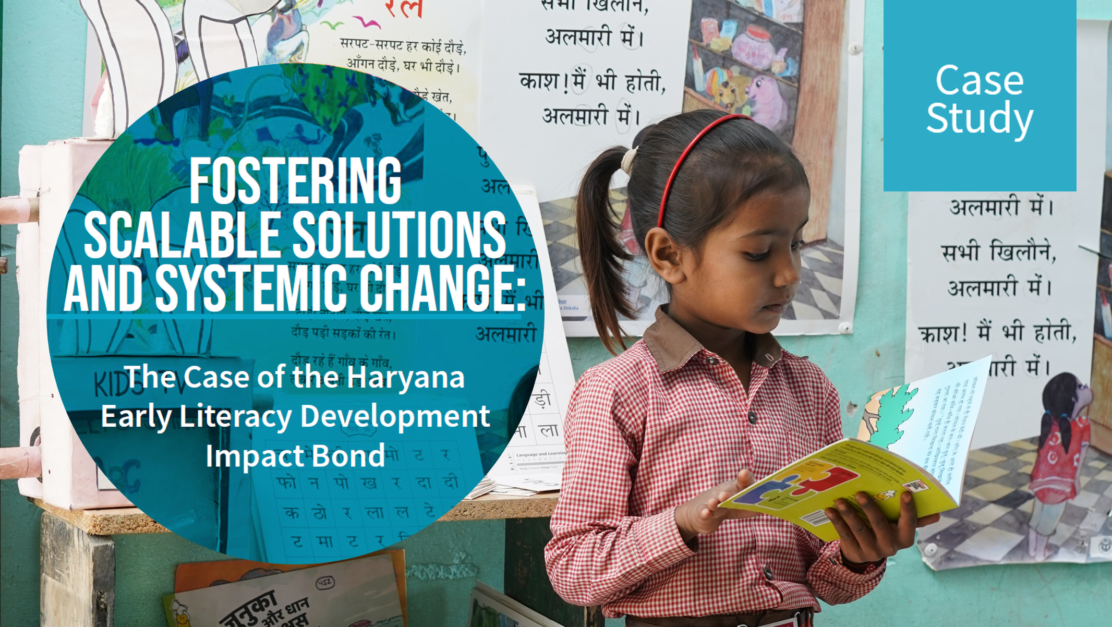
This case study examines the Haryana Early Literacy Development Impact Bond to contribute to our understanding of how innovative financing mechanisms bring more and better financing or help create educational outcomes.
|
Evaluating the Quality Education India DIB: How Outcomes-Based Financing Can Shape Effectiveness, Efficiency, and Additionality Coming Soon – This report examines the Quality Education India Development Impact Bond as a case study to assess whether and how this financing mechanism contributed to (a) additionality in education financing, (b) improvements in effectiveness and efficiency and (c) the inclusion of hard-to-reach populations. |
 |
 |
|
Financing Early Childhood Development: The Impact Bond Innovation Fund, South Africa This case study details the design, development, and implementation of the Impact Bond Innovation Fund in South Africa where a group of diverse partners came together to launch a social impact bond with the expectation that it could deliver more efficient and effective funding for early childhood development. |
Proyectá Tu Futuro: A Social Impact Bond for Education and Employability Training in Buenos Aires This case study discusses how the “Proyectá Tu Futuro” (PTF) Social Impact Bond (SIB) in Buenos Aires, Argentina, was developed, borrowing the SIB idea from other contexts. It analyses its achievements and challenges in aiming to simultaneously tackle low graduation rates in secondary education and unemployment among young adults. |
 |
 |
|
This case study showcases the process for designing and developing the India Education Outcome Fund (IEOF) of Social Finance India (SF-IND), aimed at providing sustainable and innovative funding at scale to deliver educational outcomes. |
This case study examines the evolution of Zaya Learning Labs, in India, from its initial work as a non-profit organisation to its current format as a for-profit social business. It focuses on how its funding has changed over time, leveraging the impact investing ecosystem. |
|
The Skills and Knowledge for Youth (SKY) Project This case study explores the Skills and Knowledge for Youth (SKY) project in Ethiopia, which uses results-based financing (RBF) in education to increase employability and labour market insertion of disadvantaged youth, to create more jobs (self-employment), and to empower youth in order to escape the ‘low/no skill – no job – no income’ poverty trap. |
|
Short case studies
Please contact us:
- If you would like to develop workshops or talks for education and finance professionals on innovative financing for education using IFE project material.
- If you would like to develop additional case studies on an innovative financing project or partner with NORRAG on additional research on the topic.