
Education Impact Bonds
Impact bonds are among the most popular and widely discussed innovative financing approaches for social development. This page introduces impact bonds and presents NORRAG’s research outputs on their application in the education sector. Education impact bonds are defined here as both projects principally operating in the education sector and projects operating under another policy sector but with at least one outcome payment tied to education and/ or training. A full list of identified education impact bonds can be found in the database below.
What are Impact Bonds?
Impact bonds are a form of results-based financing that brings together diverse stakeholders to strive towards a common set of targeted social results. Depending on the context in which they operate, they are also known as “social benefit bonds” (Australia) and “pay for success” projects (United States). While the design of impact bonds varies significantly, the following figure illustrates their prototypical structure.
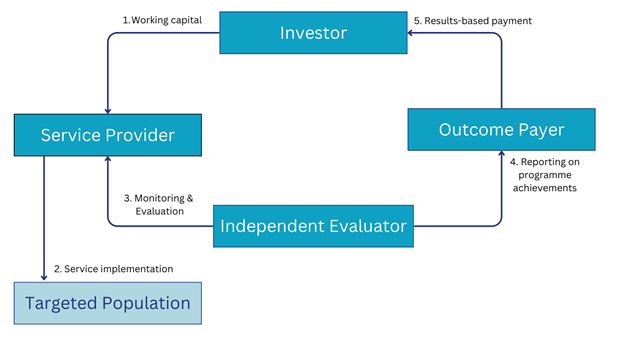
In a prototypical impact bond, private investors provide upfront working capital to service providers (commonly non-profit or for-profit social enterprises) who use these funds to implement interventions focused on achieving specific pre-agreed social outcomes for a targeted population. An independent evaluator assesses the progress made and reports their findings to the outcome payer. Only when the achievement of the predefined targeted results has been verified will the outcomes payer repay the investor as per contract stipulations – typically the principal amount plus a pre-agreed return, proportionate to the results achieved. An outcomes payer may be a domestic government entity (thereby distinguishing the project as a social impact bond, SIB) or a third-party entity, e.g. philanthropies, charities, international government aid agencies or multilateral agencies (constituting a development impact bond, DIB).
For further key terms and working definitions, we recommend visiting the Government Outcomes Lab’s Glossary.
Publications
Following the Money: Where Education Impact Bond Financing Actually Flows
2026
 This factsheet presents analysis of data on 140 education impact bond projects totalling USD 184 million in upfront capital and USD 445 million in maximum committed outcome payments. The data shows extreme geographic and economic concentration, with projects in high-income countries accounting for 92% of upfront capital and 73% of maximum committed outcome payments.
Education Impact Bonds: Picking Low-Hanging Fruit or Reaching for the Stars?
2026
 Impact bonds, a mechanism with the potential to improve and generate more financing towards educational outcomes, have gained traction over the past 15 years; however, empirical evidence regarding their use remains limited. This paper intends to contribute to this knowledge gap by examining the intended impact of education impact bonds (EIBs), which tie the achievement of predetermined targeted results to outcome payments. The analysis addresses critiques that navigating the diverse motivations of different stakeholders may result in concentrating on low-hanging fruit (setting easy-to-achieve targeted results), increasing the risk of perverse incentives and simplifying complex educational challenges.
Financing Early Childhood Development: The Impact Bond Innovation Fund, South Africa
2021
 This case study details the design, development, and implementation of the Impact Bond Innovation Fund in South Africa where a group of diverse partners came together to launch a social impact bond with the expectation that it could deliver more efficient and effective funding for early childhood development.
Proyectá Tu Futuro: A Social Impact Bond for Education and Employability Training in Buenos Aires
2021
 This case study discusses how the “Proyectá Tu Futuro” (PTF) Social Impact Bond (SIB) in Buenos Aires, Argentina, was developed, borrowing the SIB idea from other contexts. It analyses its achievements and challenges in aiming to simultaneously tackle low graduation rates in secondary education and unemployment among young adults.
Educate Girls Development Impact Bond
2020
 This case study presents the Educate Girls Development Impact Bond, the world’s first development impact bond (DIB) in education that ran between 2015 and 2018.
Education Impact Bonds Database
Suggested Citation: NORRAG. (2025). IFE-2-Leave No One Behind: Education Impact Bonds Database (Version 03, Prepared by Thorne, G. & Guo, X.). NORRAG.
Help us to improve our database: Contact us if you have updates, clarifications, and/or corrections to the data included in this database, as well as to share information about new initiatives or additional documents or sources.
Education Impact Bond Evaluations Collection
This collection collates publicly available evaluations conducted on education impact bonds (EIBs) worldwide. It is a companion to the existing Education Impact Bond Database and brings together, in one place, the evidence base on how EIB projects have been assessed.
A built-in Glossary and Definitions page accompanies the Collection, explaining the evaluation terminology used throughout. For first-time users, a short navigation guide walks through how to search, filter, and read each tab of the Collection.
Disclaimer: The Collection is limited to publicly accessible reports identified through the Education Impact Bonds Database project’s systematic search; six of the 75 evaluations are in languages other than English. The development of this database is an ongoing activity, and several of the underlying impact bond projects and outcome funds are themselves ongoing. Therefore, data may be incomplete, inaccurate, and/or not updated. Please verify any data before using it.
Suggested Citation: NORRAG. (2025). IFE-2-Leave No One Behind: Education Impact Bonds Evaluations Collection (Prepared by Guo, X., & Thorne, G.). NORRAG.