



Navigating the Waters of Devolved Education: Sindh’s Policy Capacity Post-18th Amendment
In this blog post, Kashfia Latafat contends that the increased autonomy introduced by Pakistan’s 18th Constitutional Amendment has not led to better learning outcomes. Focusing on Sindh, she exposes a gap between expanded authority and institutional capacity.
Introduction
The 18th Constitutional Amendment (2010) was enacted to address structural weaknesses in Pakistan’s highly centralised governance system, particularly the inability of federal policymaking to respond to provincial diversity and deliver social services effectively. By devolving education to the provinces, the reform aimed to bring decision-making closer to citizens, strengthen accountability, and enable locally grounded solutions. In Sindh, this shift granted full autonomy over education policy, planning, and implementation.
This brief analyses Sindh’s education governance since the 18th Amendment using a policy capacity stack framework. It argues that while aspirations have expanded through constitutional rights, sector plans, and increased fiscal space implementation, capacity has lagged behind. The resulting mismatch helps explain why greater autonomy has not yet translated into improved learning outcomes.
Background: The 18th Amendment and the Logic of Devolution
The 18th Amendment fundamentally restructured Pakistan’s federal system by devolving authority over 17 ministries, including education, to provincial governments. This reform was driven by the belief that decentralisation would improve service delivery by aligning policymaking more closely with local needs and political accountability. Article 25-A further elevated education from a policy goal to a constitutional right, mandating free and compulsory education for children aged 5–16.
In Sindh, the Right of Children to Free and Compulsory Education Act (2013) represented a landmark legislative response to this mandate. However, its uneven implementation has underscored a broader challenge of devolution: authority has been transferred more rapidly than the institutional capacity required to exercise it effectively (Naviwala, 2016).
The Policy Capacity Stack: An Analytical Framework
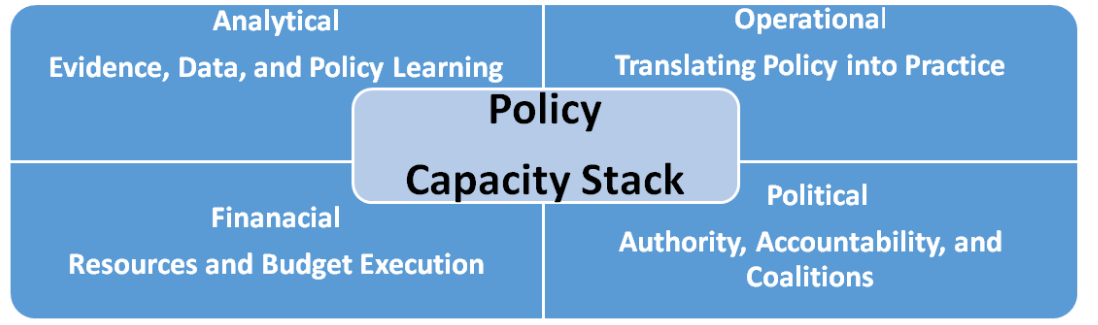
To understand why expanded autonomy has not yielded commensurate improvements in education outcomes, this brief adopts a policy capacity stack framework. The framework conceptualises policy capacity as a set of interdependent layers (analytical, operational, financial, and political), each of which must function effectively for reforms to succeed. Weakness in any layer limits the impact of the others, especially in devolved systems like Sindh’s. The sections that follow are structured around this framework, allowing for a systematic assessment of where Sindh’s education reform aspirations encounter practical constraints.
Analytical Capacity: Evidence, Data, and Policy Learning
Following devolution, Sindh invested in planning and monitoring instruments, including Education Sector Plans, assessment reforms, and administrative data systems such as SEMIS and HRMIS. These developments signal an aspiration toward evidence-informed and locally responsive policymaking.
In practice, however, analytical capacity remains limited. Data systems are often used for reporting rather than learning, and research findings are weakly integrated into decision-making processes. Dependence on donor-driven analysis further limits local ownership and institutional memory (Reform Support Unit, 2020; Global Partnership for Education, 2019).
Aspiration vs Reality: While evidence is generated, it rarely drives core policy decisions.
Operational Capacity: Translating Policy into Practice
The Sindh Education & Literacy Department (SELD), supported by district administrations, is responsible for implementing education policies. Despite ambitious programmes such as teacher recruitment, girls’ stipends, and public–private partnerships, implementation capacity is undermined by bureaucratic fragmentation, politicised postings, and frequent leadership turnover.
Donor-funded initiatives have delivered short-term gains, but these are often project-bound and insufficiently embedded within permanent administrative systems (World Bank, 2021; Alif Ailaan, 2018).
Aspiration vs Reality: Reform design outpaces the system’s ability to deliver consistently and at scale.
Financial Capacity: Resources and Budget Execution
Devolution was accompanied by increased fiscal transfers following the 7th National Finance Commission Award, raising expectations that provincial autonomy would enable greater investment in education quality. While education allocations have increased, budget execution remains weak. Around 80% of spending is absorbed by salaries, leaving limited space for infrastructure, innovation, or learning improvements.
Persistent underutilisation of development budgets reflects low planning and procurement capacity rather than a lack of financial resources (Pakistan Institute of Education & I-SAPS, 2023; Institute of Social and Policy Sciences, 2016).
Aspiration vs Reality: Increased funding has not translated into strategic or flexible spending.
Political Capacity: Authority, Accountability, and Coalitions
Education enjoys strong rhetorical and constitutional support in Sindh. However, governance practices such as patronage in teacher appointments, weak enforcement of the 2013 Act, and frequent reshuffling of senior officials undermine reform effectiveness.
Coalitions with civil society and development partners play an important role in sustaining reform efforts, but they often compensate for, rather than strengthen, state capacity. Reform continuity remains vulnerable to shifts in political leadership and priorities.
Aspiration vs Reality: Rights-based commitments coexist with weak enforcement and misaligned political incentives.
Conclusion
Introducing the policy capacity stack early clarifies why Sindh’s experience with devolved education is best understood not as a failure of intent, but as a mismatch between expanded authority and limited institutional capacity. More than a decade after the 18th Amendment, legislative ambition and reform design have outpaced investments in analytical, operational, financial, and political capacity.
Bridging this gap requires reorienting reform efforts toward long-term capacity-building strengthening evidence use, stabilising implementation systems, improving budget execution, and aligning political incentives with learning outcomes. Without such investments, devolution risks reinforcing dependence on external actors rather than consolidating a capable and accountable provincial education system.
The Author
Kashfia Latafat is an education policy research scholar at the Aga Khan University Institute for Educational Development. Her work centers on education policy, with a specific focus on its intersections with social justice and innovative teaching and learning practices. Contact: kashfia.latafat@scholar.aku.edu