

Social Justice Is Localisation: What Refugee-Led Education Initiatives Teach Us
In this blog post, cross-posted with Inter-agency Network for Education in Emergencies, Lila Raouf draws on their master’s dissertation research at the UCL Institute of Education to examine Sudanese refugee-led education initiatives in Egypt, based on qualitative fieldwork with community educators, parents, and school leaders.
Recent evidence syntheses, including INEE’s ERICC report on localisation in education in conflict and protracted crises, affirm that communities are already sustaining education systems and that localisation requires redistributing power—not just resources. Drawing on research with Sudanese refugee-led education initiatives in Egypt, this article offers a justice-centred framework for understanding what meaningful localisation demands.
Localisation has become a defining principle of education in emergencies (EiE). Across the sector, agencies and donors emphasise shifting resources “closer to communities” to increase efficiency, relevance, and sustainability. Yet in practice, localisation often narrows to questions of who implements projects and manages grants.
My research with Sudanese refugee-led education initiatives in Egypt shows that true localisation cannot be reduced to funding pipelines or administrative decentralisation. Localisation only becomes transformative when it addresses power, recognition, and representation—not just delivery.
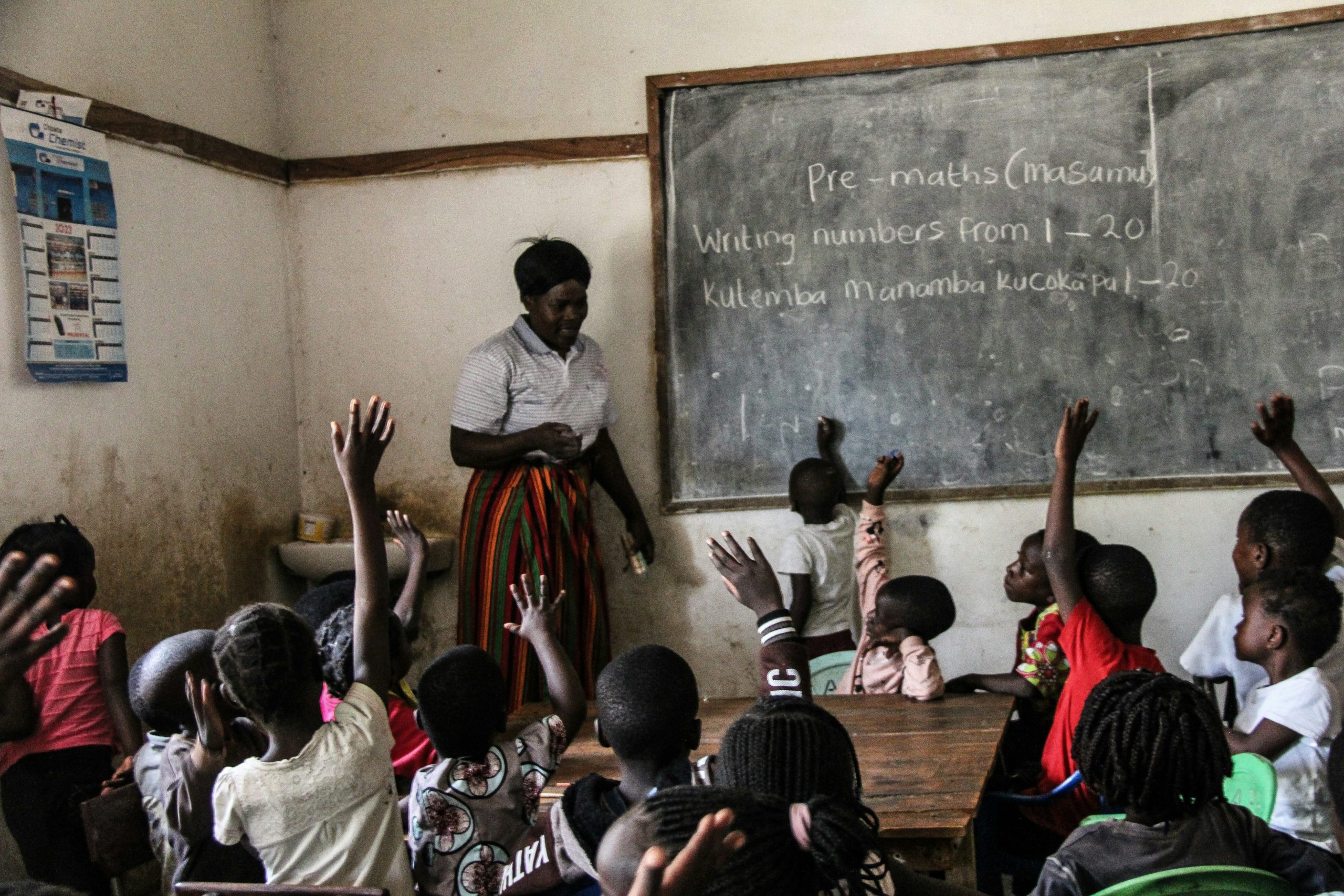
Refugee educators are not waiting for services to arrive. They are already building education systems.
What “Quality” Looks Like from the Frontline
Humanitarian policy frameworks often define education quality through standardised curricula, certified teachers, and formal learning outcomes. These indicators matter, but inside refugee-run classrooms, quality is experienced far more relationally.
Parents and teachers in community schools described success in terms of:
- Safety and belonging.
- Emotional stability in otherwise uncertain lives.
- Cultural and linguistic recognition.
- Continuity of learning despite displacement.
For families navigating legal precarity and interrupted schooling pathways, education’s first purpose is protection and dignity—not certification alone.
This gap reveals a deeper misalignment between bureaucratic metrics of quality and lived realities of education in displacement. A justice-centred understanding of quality must therefore go beyond technical standards to include epistemic and relational dimensions—valuing community knowledge, culturally grounded pedagogy, and relationships of care that sustain learning.
Until these dimensions are recognised institutionally, refugee-led education remains invisible despite sustaining thousands of learners.
Participation Without Power
Across Egypt, refugee-led schools operate with remarkable sophistication. Teachers design curricula aligned to international systems, mentor junior educators, manage budgets, coordinate exams, and provide psychosocial support. Communities govern their own education ecosystems with minimal resources.
Yet structurally, refugee-led organisations remain excluded from formal decision-making spaces—including Education Working Groups, program planning consultations, and donor dialogues. Participation typically depends on legal registration or institutional partnerships, barriers that most refugee organisations cannot surmount.
As a result:
- Refugee educators govern classrooms but lack voice in policy arenas.
- Curricular priorities are set without frontline educators.
- Monitoring frameworks measure outcomes without community authorship.
This creates a troubling paradox: refugee leadership sustains service delivery but is absent from governance. Participation exists—but without power. Localisation becomes operational relocation rather than political transformation.
Localisation without representation is not empowerment—it is the redistribution of responsibility without the redistribution of authority.
Localisation as Recognition
While current localisation frameworks increasingly call for power shifts and participatory governance, they rarely specify how legitimacy, authority, and professional recognition are redistributed. The 4A+2R framework responds to this gap by making power, legitimacy, and voice visible as core dimensions of localisation in education provision.
To make sense of this gap, I adapted the familiar 4As framework of the right to education—Availability, Accessibility, Acceptability, and Adaptability—by adding two justice dimensions: Recognition and Representation.
The 4As explain what refugee-led education already provides:
- Availability: learning spaces where none exist.
- Accessibility: culturally familiar, affordable schooling.
- Acceptability: trust-based environments rooted in community values.
- Adaptability: curricula responsive to displacement realities.
But the missing 2Rs explain why localisation remains incomplete:
- Recognition: Validating refugee educators as legitimate professionals—teachers, administrators, system designers—not temporary volunteers.
- Representation: Ensuring meaningful participation in coordination bodies, consultation mechanisms, and funding decisions.
Without recognition and representation, refugee educators continue operating parallel to—but never within—the systems that govern their work.
Localisation, understood as recognition, shifts the focus from “including communities” to centring community knowledge as policy input.
Systems Already Exist—They Are Just Unrecognised
Localisation discourse often frames communities as lacking capacity to engage meaningfully in governance. Refugee-led schools reveal the opposite: communities have already created functioning governance systems in the absence of formal support.
Teachers coordinate school calendars, negotiate with landlords, supervise staff, ensure safeguarding, and maintain learning continuity. These aren’t informal stopgaps—they are durable education systems operating under insecurity.
What they lack is legitimacy within humanitarian and national policy frameworks.
Quality does not follow recognition; recognition enables quality to be strengthened and sustained at scale.
What This Means for Localisation Practice
If localisation is to become a pathway to justice rather than logistics, several shifts are required:
1. Donors: Fund governance, not just implementation
Localisation requires financing community participation in:
- Coordination bodies
- Policy advocacy platforms
- Teacher certification and leadership development pathways
Power flows through governance, not exclusively through projects.
To support this shift, donors and implementing agencies should develop and use indicators that capture recognition and representation—such as who holds decision-making authority, whose knowledge informs programme design, and who participates meaningfully in coordination and governance spaces—alongside existing localisation metrics.
2. INGOs: Shift from subcontracting to co-design
Rather than using refugee educators solely as service providers, agencies should:
- Include refugee leaders in program design
- Build evaluation frameworks with community input
- Share ownership of learning standards and quality metrics
3. Coordination mechanisms: Open representation pathways
Education Working Groups must address structural barriers to refugee participation by:
- Creating observer or advisory seats for refugee educators
- Waiving registration requirements for technical involvement
- Translating policy documentation to enable meaningful engagement
4. Policymakers: Recognise professional expertise
Education authorities should pilot accreditation pathways recognising refugee teachers’ experience, including hybrid or community-autonomous school models that allow oversight without erasure of leadership.
Localisation Is a Justice Project
Humanitarian discourse frequently treats localisation as a technical challenge solvable through better contracting or risk management. Refugee-led education demonstrates that its true heart is justice.
Localisation succeeds only when refugee educators are recognised as legitimate knowledge holders and represented as co-governors of education systems—not just as beneficiaries or subcontractors.
Communities do not wait for policy solutions. They create them.
The question now is whether global and national actors are willing to move beyond rhetoric to share power with the educators already building localised systems on the ground.
Social justice is not an optional add-on to localisation. It is localisation.
The Author
Lila Raouf is an education practitioner and researcher focused on refugee-led education and the politics of knowledge in international development. Her work examines how lived experience is recognized—and often overlooked—as expertise in crisis-affected education systems. She holds an MA in Education and International Development from UCL as a Fulbright Scholar.