
Student Financing
Student financing mechanisms — including income-contingent loans, income share agreements, and non-banking financial institution lending — represent some of the oldest and most established forms of innovative financing in education, dating back to Australia’s introduction of income-contingent loans in 1989. As public funding for tertiary education shrinks and students increasingly rely on self-financing or private-sector lending, access to affordable, equitable student finance has become a pressing challenge — particularly for low-income students in the Global South. Traditional loan models have struggled with high default rates, reaching as high as 36% in Chile and 17% in Colombia (Bellinger, Terway & Burnett, 2016), driving the search for more innovative approaches that better reflect students’ ability to repay based on their future earnings.
Publications
November 2025
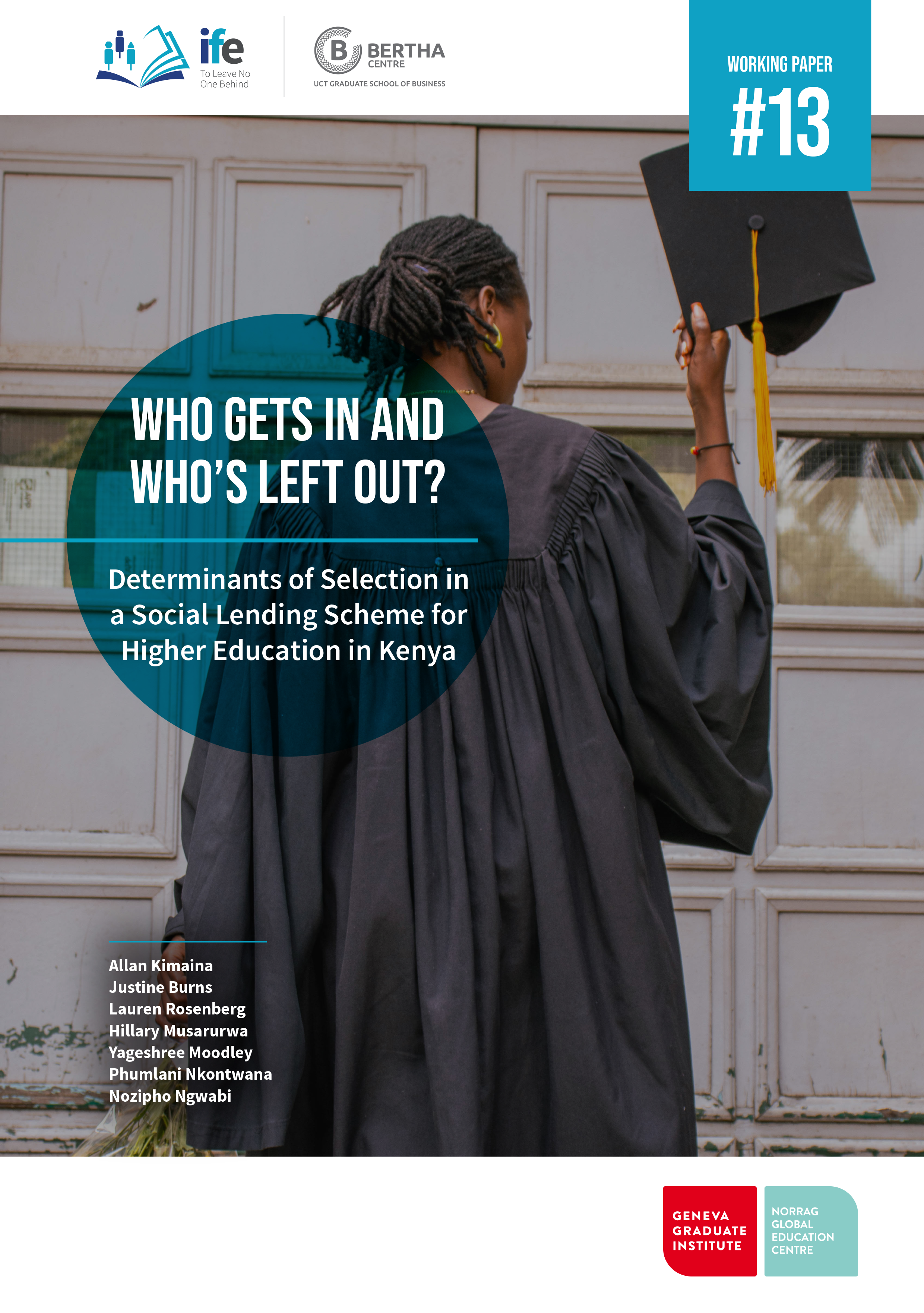 In Sub-Saharan Africa and other low- and middle-income countries, obstacles to securing education financing often hinder students from accessing post-secondary education (Wanti, Wesselink, & Biemans, 2022). In Kenya, where financial barriers often impede students from pursuing higher education (Oketch, 2022), innovative financing initiatives from private sector actors, such as the Lending for Education in Africa Partnership (LEAP), have emerged as a complementary solution to government financing schemes. This paper sheds light on the factors influencing student selection for LEAP financing, ultimately aiming to contribute to the enhancement of equitable access to financial aid for tertiary education.
Blended finance: The Regional Education Finance Fund for Africa
July 2022
This case brief describes the Regional Education Finance Fund for Africa (REFFA), initiated in 2012 by the German Development Bank (KFW), which uses a blended finance model to channel funding through local financial intermediaries — offering loans and savings products to education providers, students and their families across nine African countries. Its innovative three-tranche fund structure blends public, development finance, and private capital to de-risk investment and mobilise private sector funding.
February 2022
This case brief examines Prodigy Finance, a UK-based FinTech that provides loans to international postgraduate students based on their predicted future earnings rather than their credit history or financial background, removing the need for collateral or a guarantor. Operating across multiple countries and disciplines, Prodigy Finance raises capital through a bond programme attracting institutional and private investors, offering an innovative alternative to traditional student lending that aims to widen access to postgraduate education for students from low- and middle-income countries.
Crowdsourcing student loans: Student financing in Kenya with Kiva and Strathmore University
July 2020
This case brief examines the partnership between micro-lending platform Kiva and Nairobi’s Strathmore University, which from 2012 to 2018 used crowdfunded loans to support low-income, high-achieving Kenyan students who would otherwise have been unable to afford university tuition.
July 2020
This case brief examines Lumni, an organisation founded in Colombia in 2002 that finances university fees through Income Share Agreements (ISAs), whereby private investors provide students with upfront capital for higher education in exchange for a fixed percentage of their future income for a predetermined period after graduation. Operating across Latin America and the US, Lumni connects students, universities and investors through a rigorous selection process and personalised contracts, offering an alternative to traditional student loans that shifts repayment risk away from students and towards investors.
Student Financing Resource Database
Suggested Citation: University of Cape Town. (2024). IFE-2-Leave No One Behind: Student Financing Resource Database (Version 01, prepared by Moodley, Y.). NORRAG.
Help us to improve our database: Contact us if you have updates, clarifications, and/or corrections to the data included in this database, as well as to share information about new initiatives or additional documents or sources.