


Relational Ecologies of Knowledge and Practice
In this blogpost, Moira V. Faul, Keith Holmes, Catherine Odora Hoppers, Prachi Srivastava, and Leon Tikly summarize the discussions of the Epistemic Justice Network Workshop, held at the 2025 UKFIET Conference in Oxford. The discussions revealed that struggles for cognitive justice continue to shape everyday practice in education and research. Participants envisioned new, reparative ways of knowing and being together that prioritize community knowledges and contextual epistemologies, equitable resource distribution, and ethical funding and publication pipelines. This blog post is cross-posted on UKFIET’s website.
Introduction
Transformative Futures and Education, Keith Holmes, Research Coordinator, UNITWIN/UNESCO Chairs Programme, Future of Learning and Innovation Division, UNESCO.
In this challenging global context, education is integral to the co-construction of just and sustainable futures. Several colleagues in this workshop have been engaged in UNESCO’s Futures of Education Programme. Our collective work on transforming knowledge and the epistemic justice network (EpiNet) are responding to global, regional, and national agendas with concrete steps and actions. So far, members have undertaken interventions in Addis Ababa, Barcelona, Cornell, Oxford and Paris, in the follow up to the AU-UNESCO International Forum on Transforming Knowledge for Africa’s Future. We are also seeking approval for a potential UNESCO UNITWIN Network, with founding members in Australia, Canada, India, South Africa, Uganda and UK, and global network partner NORRAG and regional partners.
Epistemic Justice, Epistemic Humility, and the Challenge of Opposition, Prachi Srivastava, Associate Professor, University of Adelaide
This workshop is framed within a paradoxical moment where global social justice movements coexist alongside rising authoritarian extremism. These disjunctures demand that we confront our position as academics, researchers, and knowledge stewards.
Building on epistemic humility, that is, acknowledging the limits and sociopolitical contexts of all knowledges, this moment calls for transformational change – where collective societal action, not the state – becomes the only reliable means for just survival. Just survival requires more than mere existence; it demands epistemic justice. As scholars of Black, Indigenous, and subaltern studies demonstrate, epistemicide violently erases ways of knowing and being, destroying the ‘threads that tie generations.’
This workshop engages Chakravorty Spivak’s call for ‘epistemic overhaul’ against the obliteration of the traces of the ‘Other’. The irony of meeting at Oxford highlights our own hybridised and privileged positions, and extends the opportunity to deconstruct, decentre, and learn from ‘othered’, marginalised, and new voices confronting institutionalised epistemic injustices.
The Urgency of Why These Questions Matter, Catherine Odora Hoppers, Canadian Research Chair in Pluralistic Societies – Transdisciplinarity, Cognitive Justice and Education, University of Calgary.
We have to face the elephant in the room and focus on the “ethical space” imperatives coined by Ermine (2007), to overcome tension-riddled enterprise of cultural border crossing the West had monopolized without any ambition to dialogue, or reciprocity, or respect, or courtesy, or valorization, or recognition of the “Other”. We see indigenous scholars today providing leadership out of the toxic cultural impasse that has generated resentment on a global plane. We see in the ethical space a precarious and fragile window of opportunity that exists for critical conversations about race, gender, class, freedom and community. It is a space with a moment of possibility to create substantial, sustained and ethical moral understanding between cultures. Any kind of humiliation is a relational violation that profoundly damages one’s sense of connection and triggers social pain. Social pain, including social pain inflicted by humiliation – as Evelin Lindner (2009) stated – overlaps with the physical pain processing-systems of the brain and can endure throughout one’s life-span decreasing self awareness – with multiple consequences.
One way out of this is for education to build on what people have, and thus interrupt the deficit self-perception in many children from non-western origins in terms of the knowledge they possess. The role of education in either building or depreciating this knowledge base, some of which are key to sustainable development, needs to be re-examined with a view to building education systems of the future that respect cultural diversity and promote cognitive justice without losing sight of the global needs of progress and co-existence.
Workshop
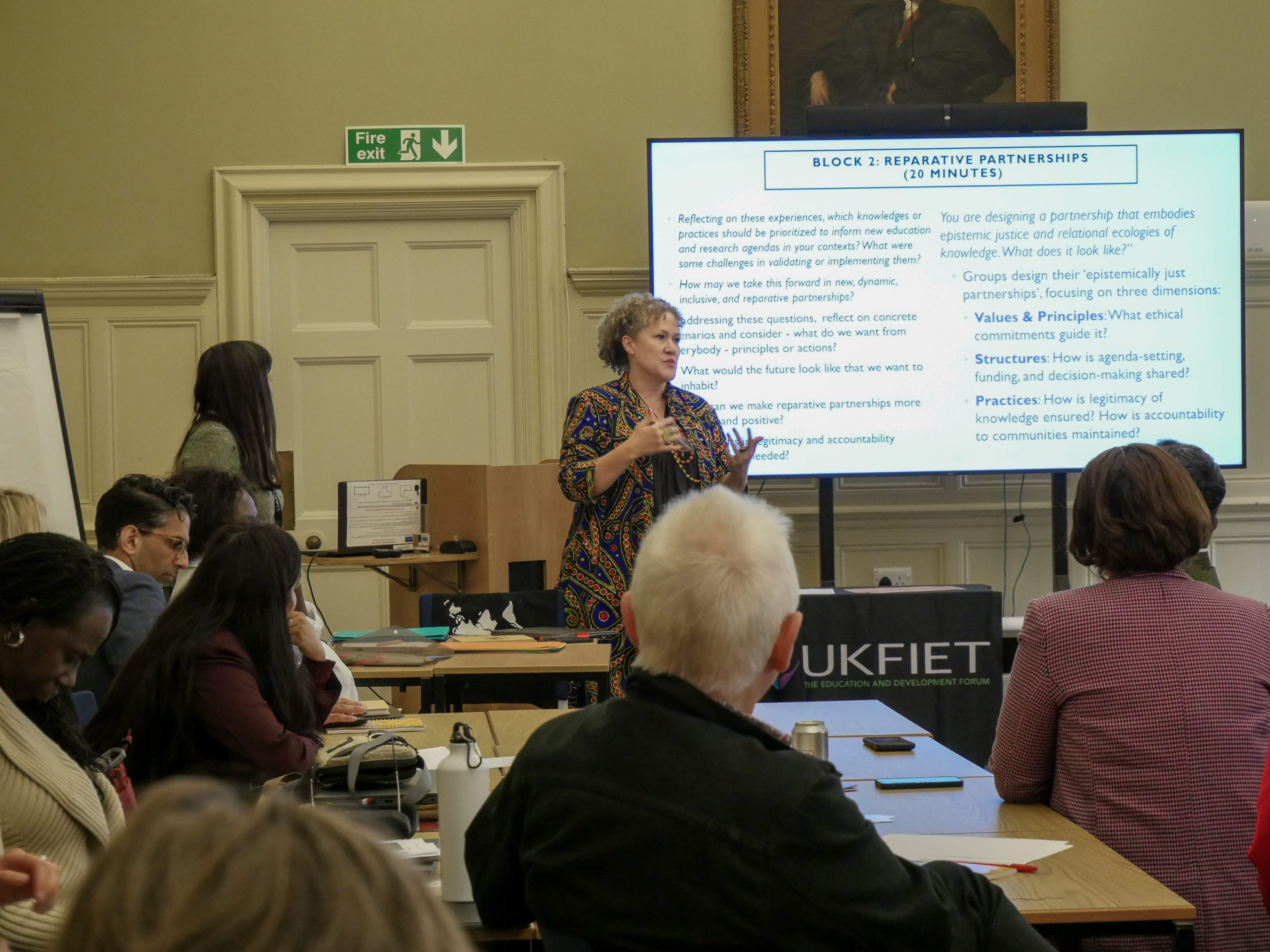
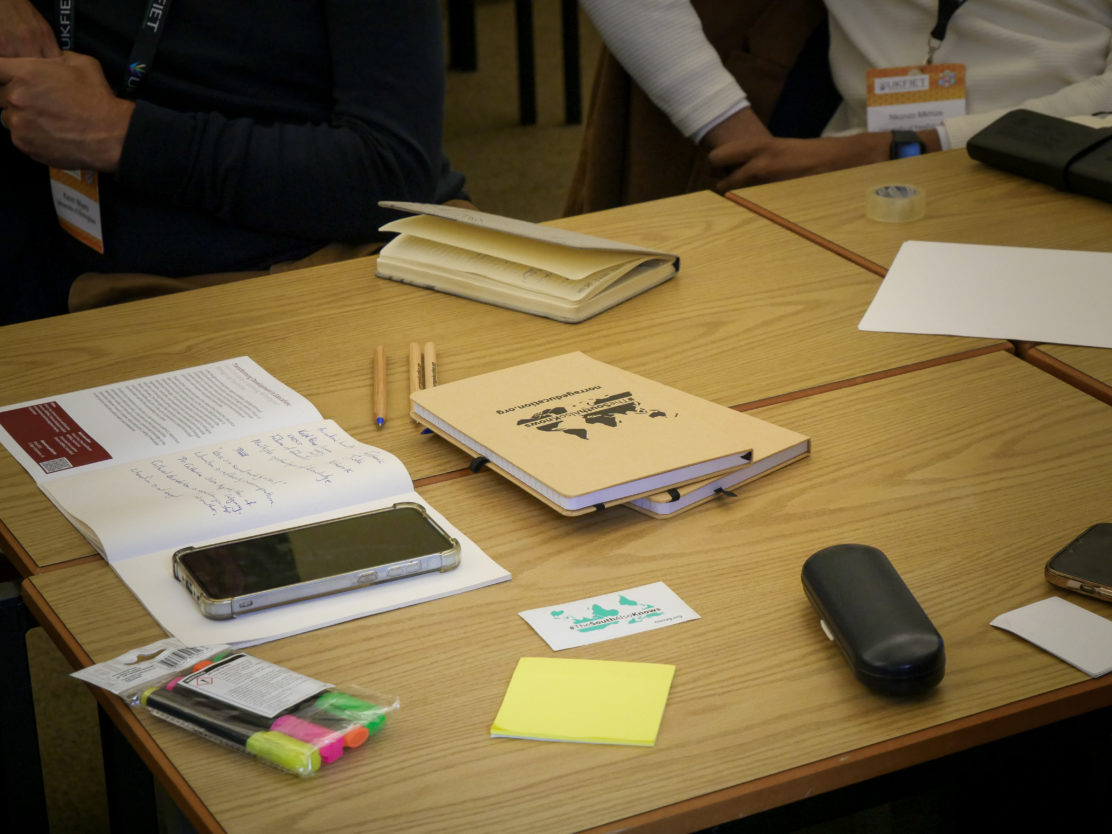
Moira V. Faul, Executive Director, NORRAG then facilitated two rounds of table-based discussion, first on Mapping Knowledge Hierarchies and then Reparative Partnerships. Leon Tikly, UNESCO Chair in Transforming Knowledge and Research for Just and Sustainable Futures, University of Bristol, UK then summarised the discussions.
1. Mapping Knowledge Hierarchies: Experiences of Cognitive Justice
Unequal Relations and Struggles for Cognitive Justice
Participants emphasised that struggles for cognitive justice continue to shape everyday practice in education and research. Knowledge production was described as operating “like a currency,” in which technical and ostensibly objective knowledge is valued as neutral, while lived, oral, spiritual and Indigenous ways of knowing are routinely discredited or made invisible. These dynamics were not only structural but also personal, enacted through interpersonal interactions in which individuals with positional authority silence or marginalise alternative perspectives.
Reflecting on their work within North–South partnerships, participants described persistent asymmetries in which Northern universities dominate agenda-setting, funding governance and definitions of legitimate knowledge. Yet, examples of resistance were also shared, including community-led research, participatory methodologies and relational forms of inquiry that reposition marginalised groups as co-creators rather than subjects of research. These were noted as important acts of reclaiming epistemic agency.
Patterns of Exclusion
Concrete experiences highlighted multiple forms of exclusion that reinforce epistemic hierarchies. Participants noted that travel costs and restrictive visa regimes routinely prevent Global South researchers from participating in conferences, including the very event at which the workshop was being held. Several described the paradox of engaging in decolonial conversations within the highly colonial visual and architectural landscape of Oxford, which carries its own histories of exclusion and trauma.
Within institutions, similar hierarchies persist. Feedback loops between students and teachers or teachers and principals, for example, were described as formal but rarely reciprocal: those in power can easily disregard critical dialogue. Participants also highlighted the marginalisation of university staff such as cleaners, whose contributions often go unrecognised despite their essential roles.
Mapping Ecologies of Knowledge
The mapping exercise invited participants to visualise flows of knowledge, resources and legitimacy within their own partnerships. Most maps revealed a vertical pattern—from funders, to Northern institutions, to Southern institutions, to communities—rather than a reciprocal or networked ecology. In many cases, community actors, local archives and grassroots educators were missing from the maps entirely, or appeared only at the periphery.
Participants described the exercise as both revealing and uncomfortable. It illuminated structural constraints such as funder reporting requirements, conference access barriers and institutional reward systems that privilege Eurocentric forms of output. Importantly, it also fostered reflexive accountability: a recognition that many researchers, even those committed to decolonial work, hold power and sometimes inadvertently reproduce the hierarchies they seek to transform.
2. Reparative Partnerships: Designing Epistemically Just Futures
Prioritising Knowledge and Practice
Participants emphasised that future research and education agendas must be grounded in community knowledges and contextual epistemologies. Communities, they argued, should be recognised as credible authors of knowledge, not only as sources of data. Examples included incorporating relational understandings of nature, cosmologies and local pedagogical traditions into curricula and collaborative research.
However, validating these epistemologies within dominant academic systems remains difficult. Linear, conclusive and quantifiable standards of evidence often clash with plural, relational and evolving forms of knowledge. Participants acknowledged that some disciplines may struggle more than others to accommodate these shifts, but emphasised that opportunities also exist to build alliances across methodological divides.
Designing Epistemically Just Partnerships
Participants developed models of reparative partnership working that were structured around shared values, reconfigured governance structures and ethical practices.
Participants highlighted the importance of humility, care, reciprocity and openness to dissent. Several stressed the need to create spaces for dialogue that do not force consensus, particularly when engaging with communities whose ontologies or temporalities differ from those of the academy. Participants also questioned homogenised notions of “the future,” highlighting the need to make space for multiple futures—or the rejection of futurity entirely.
Participants proposed concrete structural changes to support these values, including establishing ethical funding pipelines, ensuring equitable resource distribution to Southern and community partners, rotating leadership and authorship roles and creating community advisory boards for oversight and accountability. They also discussed the political economy of conferences and research networks, arguing that meaningful change requires confronting how funding, mobility and access shape whose knowledge is heard and valued.
Proposed practices included participatory and companion-based research approaches; embedding care and dignity within research relationships; validating knowledge based on community-defined relevance; and establishing a living archive of successful reparative partnerships to support collective learning. Participants emphasised the need to shift from “doing” to “being”—engaging with people as whole human beings rather than as instruments of research systems.
Envisioning a Reparative Future
Participants collectively imagined futures rooted in relationality, justice and the co-construction of knowledge. They envisioned partnerships where legitimacy derives from ethical relations rather than institutional prestige, and where universities, communities and practitioners form interconnected ecologies of learning rather than hierarchical chains of expertise.
This future is characterised by a commitment to the knowledge commons, equitable governance, mutual accountability and sustained interdependence across diverse epistemic traditions. In these futures, epistemic justice becomes not a theoretical aspiration but a lived practice embedded in everyday structures and relationships.
Conclusion: Towards Relational Ecologies of Knowledge and Practice
The workshop discussions highlighted that achieving epistemic justice requires a shift from transactional to transformative partnership working. Participants’ reflections—grounded in concrete experiences of exclusion, resistance and innovation—underscore the importance of humility, care, reciprocity and long-term relational engagement.
The idea of relational ecologies of knowledge offers a powerful way of conceptualising this shift. It recognises that knowledge is produced within dynamic, co-evolving networks of people, institutions, communities and environments. Transformative partnership working is therefore less about reforming existing hierarchies and more about cultivating new, reparative ways of knowing and being together.
The Authors
Moira V. Faul, Executive Director, NORRAG
Keith Holmes, Research Coordinator, UNITWIN/UNESCO Chairs Programme, Future of Learning and Innovation Division, UNESCO.
Catherine Odora Hoppers, Canadian Research Chair in Pluralistic Societies – Transdisciplinarity, Cognitive Justice and Education, University of Calgary.
Prachi Srivastava, Associate Professor, University of Adelaide
Leon Tikly, UNESCO Chair in Transforming Knowledge and Research for Just and Sustainable Futures, University of Bristol, UK