

Event Highlights: INEE & NORRAG Session - The Humanitarian-Development-Peace Nexus and Education: Not Just Another Buzzword
On 10 March 2026, alongside hosting a booth and showcasing NORRAG’s Education and SDGs exhibition , NORRAG co-hosted with the Inter-Agency Network for Education in Emergencies (INEE) a hybrid session during Humanitarian Networks and Partnerships Week (HNPW) titled “The Humanitarian-Development-Peace Nexus and Education: Not Just Another Buzzword.” Drawing on insights from the recent NORRAG Policy Insights publication Education and the Humanitarian-Development-Peace Nexus at 10, the session explored how education in all contexts, including humanitarian ones, can be strengthened through a nexus approach.
Moira V. Faul (NORRAG), Executive Director of NORRAG and co-editor of the Policy Insights collection, opened the session by introducing NORRAG’s work to advance knowledge equity and amplify underrepresented expertise. She highlighted how the Policy Insights series aims to bridge research, policy, and practice in education in emergencies.
Alison Joyner (NORRAG), Education in Emergencies Specialist and lead editor of the publication, presented the report’s five thematic sections and illustrated cross-cutting themes. These include the importance of local leadership, the central role of teachers, and the need for flexible, long-term financing. She also foregrounded the relationships that underpin a nexus approach—amongst teachers, learners, communities, and local and international actors—and the role of trust and flexibility in enabling effective collaboration.
Esther Mbau (INEE), Psychosocial Support and Social and Emotional Learning Coordinator, stressed the importance of a psychosocial and systems lens in education responses. She called attention to the importance of centring the dignity and well-being of crisis-affected populations, noting that crises affect mental health, relationships, and everyday functioning. Mbau argued that psychosocial support and social and emotional learning offer practical entry points for the nexus by strengthening teacher well-being, fostering safe learning environments, and reinforcing school–community relationships.
Anna Tazita Samuel (Women for Change South Sudan) demonstrated the critical role played by local organisations—particularly women-led organisations—in operationalising the triple nexus. Drawing on experience in South Sudan, she underlined the fact that local actors are often the first to respond during crises despite receiving limited resources. She made the point that women-led organisations frequently integrate humanitarian, development, and peacebuilding dimensions in their programmes even if they do not use the term ‘nexus’, and called for stronger support for locally-led initiatives to ensure sustainable responses.
Loise Gichuhi (University of Nairobi) focused on the central role of teachers within a nexus approach: teachers often provide stability for children and communities during crises while navigating humanitarian, development, and peacebuilding dimensions in their daily work. Gichuhi spotlighted the need to strengthen teachers’ agency through policies that support their participation in decision-making, and the co-development of professional development initiatives.
Francesca Pinna (Education Cannot Wait) reflected on whether the HDP Nexus is “just another buzzword” by presenting findings from Education Cannot Wait’s analysis of international funding flows to education in crisis contexts. A significant share of education funding in such contexts comes through development channels and is therefore not captured in traditional humanitarian tracking systems such as the United Nations Office for the Coordination of Humanitarian Affairs’ Financial Tracking Service. Pinna remarked that improving transparency and the accessibility of funding data is essential for enabling governments and practitioners to identify gaps and align resources.
Adama Diallo (Save the Children International) discussed how anticipatory action can strengthen the nexus by shifting responses from reactive to proactive approaches. He showed how early warning systems and pre-agreed triggers can enable education actors to act before crises disrupt learning, for example by protecting school infrastructure ahead of floods. Diallo illustrated how programme design mechanisms such as ‘crisis modifiers’ can allow development programmes to adapt quickly when crises intensify.
Olya Homonchuk (ODI Global) examined the political economy of coordination across crisis contexts. While many actors already work across humanitarian and development activities, she pointed out that institutional structures often reinforce fragmentation. Research shows that humanitarian and development actors sometimes implement similar interventions in parallel systems. Homonchuk observed that local actors frequently bridge these gaps informally, cautioning that nexus approaches framed as simple “handovers” to governments can fail when national stakeholders are not involved from the outset.
Egide Niyonkuru (University of Geneva), Youth Advocate for Education in Emergencies and a Masters student, shared reflections from his story as a refugee student. He described the linguistic, social, and psychological challenges displaced learners face when navigating unfamiliar education systems. Drawing on his experience during the COVID-19 pandemic, he explained how the shift to online learning exposed structural gaps such as limited electricity and internet access, for students who had to leave university class teaching to study in refugee settlements, underscoring the need for more resilient education systems.
During the Q&A, participants noted challenges in translating nexus commitments into sustainable practice. One described experiences from refugee settlements in Uganda where early childhood centres built by international organisations were transferred to local actors and government institutions without sufficient resources or previous involvement in their design. This, she argued, led to service disruptions and underscored the importance of genuine local ownership. Participants also pointed to the need for stronger coordination and advocacy among humanitarian, development, and peace actors, along with greater involvement of local organisations and communities in programme design, implementation, and financing decisions.
Panelists concluded with key recommendations for advancing the nexus in and through education. These included investing in national education systems to integrate psychosocial support and social and emotional learning into everyday teaching; strengthening local leadership and access to funding for local organisations; recognising teachers as central actors in crisis response; improving transparency in education financing; leveraging coordination platforms such as education clusters; and addressing funding incentives that discourage collaboration.
In her closing remarks, Faiza Hassan, Director of the Inter-Agency Network for Education in Emergencies (INEE), emphasised that the humanitarian-development-peace (HDP) nexus reflects the lived realities of crisis-affected communities – it goes beyond a purely conceptual framework. People’s lives do not unfold across separate humanitarian, development, and peace tracks, but across all three simultaneously. The challenge, she argued, is whether global systems of funding, coordination, and partnership can adapt to this reality. Hassan concluded by highlighting the unique role of education in connecting humanitarian response, long-term development, and peacebuilding, and called for stronger support to local leadership and solutions emerging from crisis-affected contexts.
For those who wish to continue the conversation, NORRAG has launched a blog series on the HDP Nexus, which examines how the HDP Nexus can inform, and has informed, education programming in diverse geographies. Contributions may respond to or challenge our thematic priorities, including centring humanity, teaching at the heart of the Nexus, leading locally, and making the connections across coordination and evidence systems.
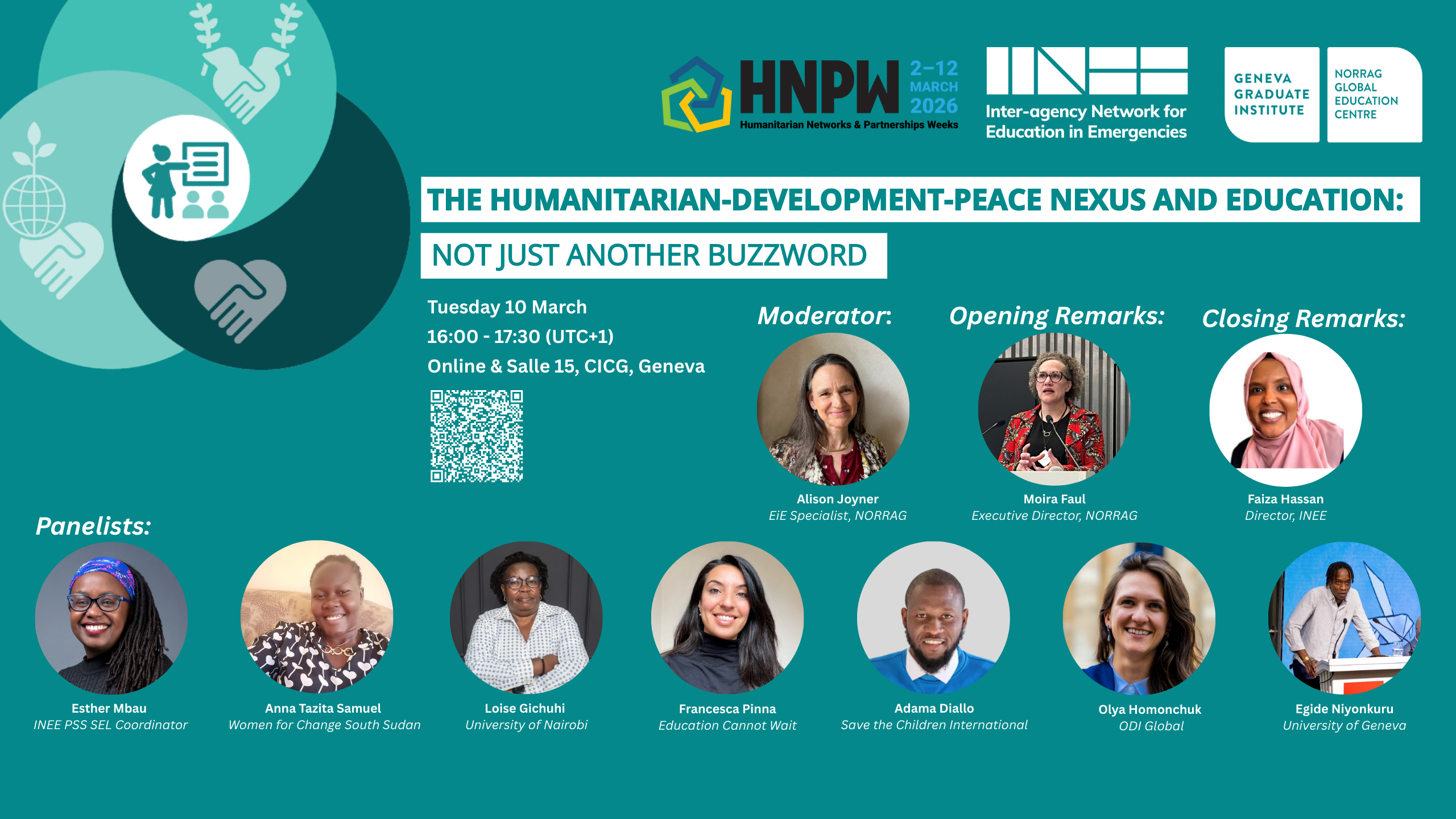
Programme
- Moderator
- Alison Joyner, Education in Emergencies Specialist NORRAG
- Opening Remarks
- Moira Faul, Executive Director, NORRAG
- Panelists
- Esther Mbau, INEE PSS SEL Coordinator
- Anna Tazita Samuel, Women for Change South Sudan
- Loise Gichuhi, University of Nairobi
- Francesca Pinna, Education Cannot Wait
- Adama Diallo, Save the Children International
- Olya Homonchuk, ODI Global
- Questions and Discussions
- Discussant: Egide Niyonkuru, University of Geneva
- Closing Remarks
- Faiza Hassan, Director, Inter-agency Network for Education in Emergencies (INEE)
Panelists Profile
Esther Mbau is the Psychosocial Support and Social and Emotional Learning (PSS-SEL) Coordinator at the Inter-agency Network for Education in Emergencies (INEE). In this role, she leads global initiatives that support the integration of wellbeing, psychosocial support, and social and emotional learning in education systems affected by crisis and displacement. Esther is a counselling psychologist with over a decade of experience across humanitarian, development, and education contexts. Her work focuses on teacher wellbeing, the localisation of PSS-SEL approaches, and strengthening national education systems to support the mental health and resilience of learners, educators, and communities. She is passionate about bridging research, policy, and practice to advance inclusive, context-responsive approaches to mental health, wellbeing, and education.
Anna Tazita Samuel is a renown South Sudanese child and woman rights activist. She is a graduate of Procurement and logistics from Uganda Christian University and pursuing her Masters in Business Administration in Health Care Management from Regent Business School, South Africa. She left her job in 2018 and started working towards eradicating all forms of injustices against women and children in the communities of South Sudan. She is the founder and Executive Director of Women for change (WFC), a nonprofit organization dedicated towards eradication of all of kinds of injustices and poverty on women and children. She is currently the Co-Chair of the localization working group under the SSNGO forum, her organization is the Co lead of the National GBV AOR in South Sudan as a WRO, She is the Grand bargain National reference group (NRG) for South Sudan, She is the co-Chair of South Sudan START Network HUB. she started a campaign ‘Empower the Girl to Raise’ in 2021 to create awareness on women rights and the power of empowerment through life skills training. She is the NGO Women Innovative Initiative Award Winner 2019 for her efforts in empowering women with life skills. She is a WIA54 Laureate for South Sudan in 2020. She is a gender and entrepreneur expert. She seats as the chairperson BOD in two Successful local organizations that are being formed by South Sudan Youth. She features in both local, regional and global platforms which gives her vast experience of working with different kind of individuals in the society. She is a reliable and approachable leader who is as well a mentor to many women and men across the nation.
Professor Loise Gichuhi is a highly regarded scholar and educational leader known for her expertise in teacher professional development. She has significantly shaped evidence-based discussions on Teacher Professional Development (TPD) at the national, African, and global levels through innovative teaching and curriculum leadership in crisis settings. Her extensive transformative research projects have improved educational practices in difficult situations. Her mentorship and dedication inspire education stakeholders worldwide, promoting evidence-based policy discussions for crisis-affected communities.
Francesca Pinna is seconded to Education Cannot Wait by the Government of France, where she leads the Education in Emergencies and Protracted Crises (EiEPC) Financing Observatory, strengthening the visibility and coherence of education financing across humanitarian and development systems. She brings over 15 years of humanitarian experience, including more than a decade focused on education in crisis contexts such as Haiti, Madagascar, and Palestine. Working at the intersection of humanitarian and development actors, she advances evidence-led, locally informed approaches that bridge emergency response and long-term system strengthening to ensure sustained access to safe, quality education in protracted crises.
Adama Diallo is a Child Protection and Education in Emergencies Coordination Specialist with the Global Education Cluster. He has over a decade of experience supporting humanitarian and protracted crisis responses across West and Central Africa, North America and Europe, working with the UN and international NGOs. His work focuses on inter-sectoral collaboration and strengthening coordination in crisis contexts. He provides technical support to national Education Clusters to enhance coordination and help link humanitarian response with longer-term system resilience.
Olya Homonchuk is a Research Fellow at ODI Global Development and Public Finance Programme with expertise in poverty and inequality, education, and financing in protracted conflict settings. As a Policy Lead for the ERICC consortium, she is currently researching education and the politics of donor coordination in Syria, South Sudan, Nigeria, Lebanon, Jordan, and Bangladesh. She also co-leads the Youth and Capabilities Development Domain for the African Cities Research Consortium, where she examines young people’s experiences as both victims and perpetrators of violence. Prior to joining ODI, Olya managed mixed-methods policy evaluations on behalf of the UK government agencies (DWP and DCMS) as part of Ipsos Social Research Institute. Evaluations focused on programmes for vulnerable and disadvantaged youth, including vocational skills training, education, and support through the food banks.
Egide Niyonkuru is a Burundian Asylum Seeker living in Geneva, Switzerland. He is pursuing his master’s degree in Responsible Management at the University of Geneva. He has been an active Youth Representative for EiE context for the past 7 years where he collaborated with organisations such as NORRAG, UNHCR, Red Cross, Geneva Global Hub for EiE, etc.
Dr. Faiza Hassan is the Director of the Inter-agency Network for Education in Emergencies (INEE), since January 2025. She brings 20 years of experience across education, social policy reform, and humanitarian response. She began her career in the extractive industries after completing a PhD in Chemical Engineering at the University of Birmingham, United Kingdom, before pivoting to the education sector. She first volunteered with the Ministry of Education in Somalia and has since worked extensively across East Africa with UNICEF, CARE, and Save the Children. Before joining INEE, Faiza was Chief of Party in Save the Children’s Global Education and Child Protection Department, where she led large-scale programmes advancing children’s right to education and protection. Her work has centred on education systems strengthening, governance, and financing, with a particular focus on advancing equitable and sustainable education in crisis-affected contexts.
Moira V. Faul is the Executive Director of NORRAG, and Senior Lecturer at the Geneva Graduate Institute. Prior to this post, she was Deputy Director of the Public-Private Partnership Centre at the University of Geneva, as well as holding a Visiting Research Fellowship at the UN Research Institute for Social Development (UNRISD). She successfully led a UK Research Councils-funded programme on knowledge exchange between research and policy at the University of Cambridge. She holds a PhD from the University of Cambridge and a teaching qualification from the University of Oxford.
Alison Joyner is a highly experienced in teacher, trainer, manager and researcher, including 12 years living and working in Africa and Asia. Specialised in supporting teachers to facilitate holistic learning approaches, she has particular expertise in Education in Emergencies integrated with Child Protection. Alison is skilled in robust data collection and use from school-level upwards, ensuring the connections between monitoring, evaluation, research and learning. Her doctoral research (EdD, 2021, University College London Institute of Education) was conducted with teachers in a rural primary school in Kenya, focusing on the interaction between social and emotional skills and academic learning. Alison is fluent in French, English and Spanish.
This event is organised in partnership with Inter-agency Network for Education in Emergencies (INEE)