

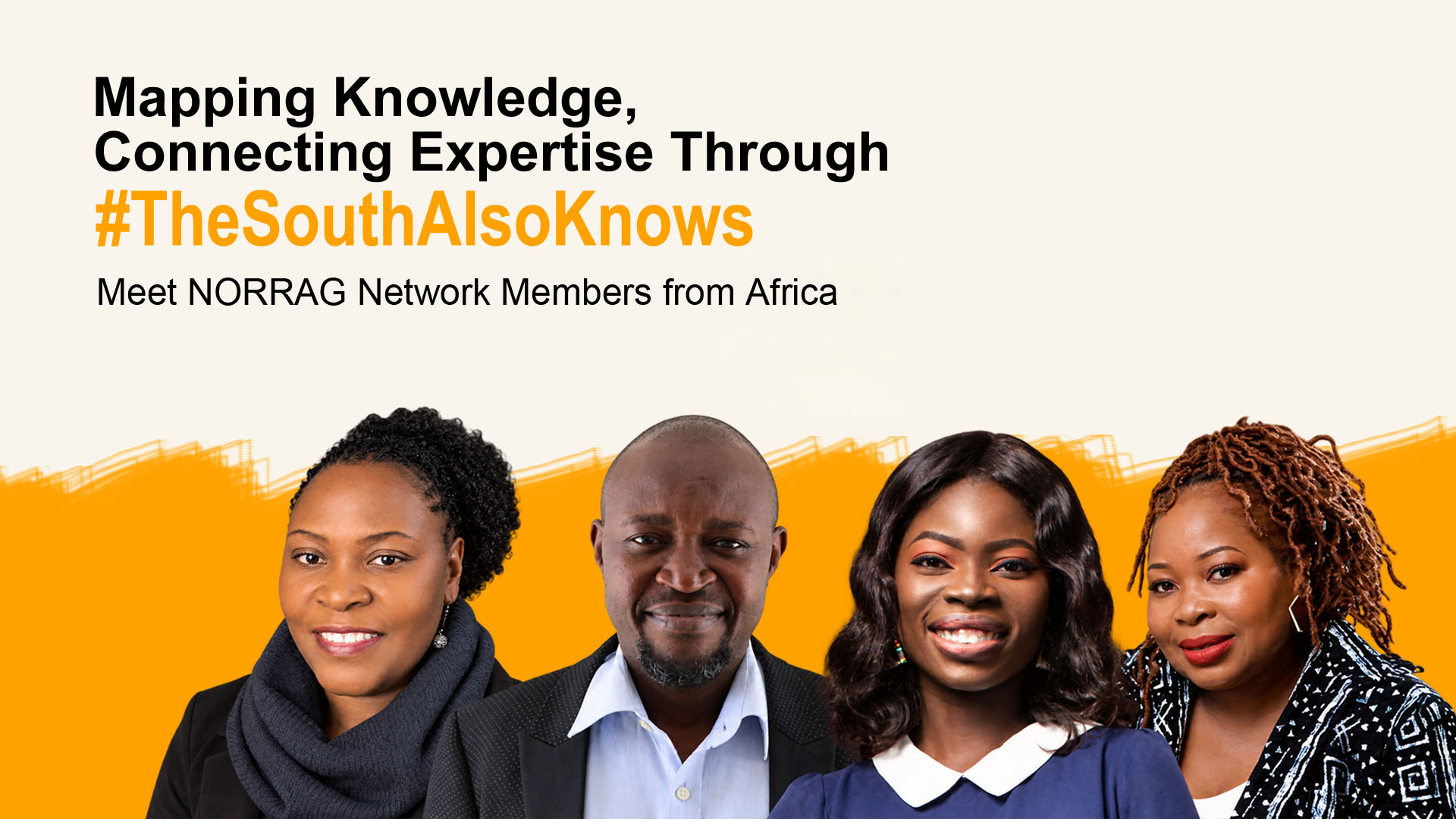
Mapping Knowledge, Connecting Expertise Through #TheSouthAlsoKnows: Meet NORRAG Network Members from Africa
Across Africa, education challenges are increasingly shaped by questions that cut across traditional disciplinary and geographic boundaries, from girls’ transitions and social protection to digital transformation, artificial intelligence and the future of work. Addressing these questions requires more than expertise in individual fields, it requires spaces where different forms of knowledge, experience and perspectives can connect, travel and inform one another. Imagine what happens when education experts across Africa connect not only around shared challenges, but around the knowledge, perspectives and experiences that can help shape solutions!
This is central to #TheSouthAlsoKnows, NORRAG’s initiative to amplify under-represented expertise from the Global South and strengthen access to locally grounded knowledge in education research, policy and practice. Across the vast NORRAG Network, members bring expertise from diverse disciplines and professional worlds, reflecting the breadth of knowledge being generated across their regions and the importance of creating spaces where this expertise can be shared, connected and brought into wider education policy conversations. Rather than simply asking what the Global South can learn from elsewhere, the initiative creates opportunities to recognise what the South itself is researching, developing and contributing to global education debates.
Four NORRAG members from Zimbabwe, Kenya, Zambia and Nigeria illustrate this diversity particularly well. Their areas of expertise differ, but their experiences point to a common thread, which is the value of intellectual communities that allow knowledge to travel across borders, disciplines and contexts.
Pamhidzayi Mhongera (Zimbabwe): Connecting education, social protection and young people’s transitions
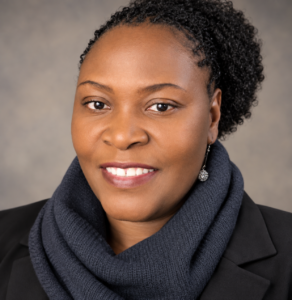 A Zimbabwean social work scholar, development practitioner and researcher, Dr Pamhidzayi Berejena Mhongera works across education, social protection, child and youth transitions, gender, agency, livelihoods and inclusive digital transformation. She is currently a researcher at the University of Johannesburg and previously served as a Senior Lecturer in Social Work at Lupane State University.
With more than two decades of experience spanning academia, research, development practice, government and the financial services sector, Dr Mhongera has long focused on the experiences and agency of young people. As a 2012 Echidna Global Scholar, she examined the coordination of education transition services for adolescent orphan girls in Zimbabwe. She is also a founding member of Blossoms Children Community and Youth in Transition Trust Zimbabwe and a member of the International Research Network on Transitions to Adulthood from Care.
Her engagement with NORRAG has reinforced her belief in the importance of bringing different contexts into conversation:
“Meaningful educational change is not produced by research in isolation. It emerges through conversations across contexts. NORRAG has provided an important space for these connections.”
For Mhongera, the NORRAG network is therefore not simply a platform for sharing research, but a space where connections can help turn knowledge into more meaningful educational change.
Anthony Luvanda (Kenya): Bringing technology and innovation into education conversations
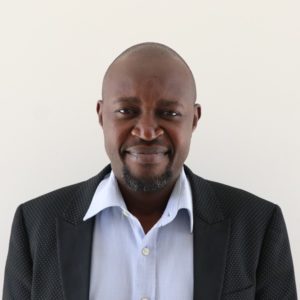 From a different disciplinary starting point, Dr Anthony Luvanda brings expertise in cybersecurity, digital transformation and applied artificial intelligence to the network.
A scholar, higher education administrator and digital innovation strategist, Dr Luvanda has more than two decades of experience in academic governance, technical consultancy and research. He is currently an Adjunct Research Scientist at the African Institute for Capacity Development (AICAD) and a Senior Lecturer in the Department of Information Technology for Defence Systems at the National Defence University–Kenya. A fellow of the Emerging African Innovation Leadership programme at the Politecnico di Milano, and an Echidna Global Scholar alumnus of the Brookings Institution, he brings a strong interest in translating technological expertise into collaboration, policy and practice.
Having joined the NORRAG Network in 2026, he sees opportunities for collaboration through joint workshops, scaling, sustainable strategies and policy advocacy.
“Cross border partnerships don’t only enable impact, they are also an eye opener into other areas of possible collaboration, sustainable strategies, and policies, among others.”
His interests also highlight the breadth of questions now emerging at the intersection of education and technology—and the importance of bringing these conversations into spaces that connect researchers and practitioners across contexts.
Racheal Kalaba (Zambia): Placing Indigenous knowledge and girls’ agency at the centre
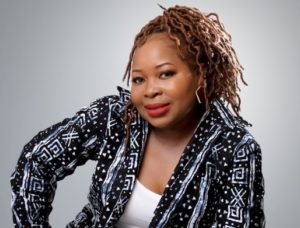 In Zambia, Dr Racheal Kalaba brings another dimension to these conversations: the relationship between Indigenous knowledge, Ubuntu philosophy, leadership and girls’ participation in decision-making.
Dr Kalaba is the founder and CEO of the Zambia Women Institute of Leadership and Learning (ZAMWILL) and the AfricaWILL Foundation in Canada. A 2025 Echidna Global Scholar at the Brookings Institution, her work spans research, policy and practice, with a particular focus on African Indigenous knowledge frameworks and the epistemology of Ubuntu philosophy. Her approach informs both her research and the leadership programmes developed through ZAMWILL. She currently leads a policy initiative focused on adolescent girls’ participation in decision-making in Zambia. Dr Kalaba holds a PhD in Adult Education and Community Development from the Ontario Institute for Studies in Education at the University of Toronto, with collaborative specialisations in Women and Gender Studies and Comparative International Development Education. She joined the NORRAG Network in 2026 and describes the network as an important source of access to knowledge produced across the continent:
“It is one of the few spaces where I reliably read education research and practice from across the continent rather than about it, and it keeps me in contact with members working on the same questions in other countries.”
Her observation captures an important dimension of #TheSouthAlsoKnows, creating opportunities not simply to study education in the Global South, but to encounter the research, practice and ideas being generated from within the region.
Oluwayemisi Ojo (Nigeria): Reimagining education futures through AI and African perspectives
 For Oluwayemisi (Yemisi) Ojo, the question of whose knowledge shapes education futures is particularly visible in the rapidly evolving field of artificial intelligence. A doctoral researcher in Educational Sciences at Universidade Católica Portuguesa and a Junior Visiting Fellow at the Geneva Graduate Institute, Ojo researches the politics and governance of AI in education. Her work examines how sociotechnical imaginaries, policy networks and competing forms of expertise shape educational futures in Africa. Her wider research interests include critical edtech, global education governance and decolonial approaches to imagining and shaping education futures from the Global South.
For Ojo, finding the right intellectual community for this interdisciplinary work was itself a challenge. Her engagement with NORRAG helped bridge that gap:
“Through the network, I have found institutional support and developed meaningful collaborations that have grown into ongoing intellectual and research relationships. These connections have broadened both the community in which I do my research and the possibilities I see for it.”
Her experience speaks to another important function of a knowledge network: creating the relationships and intellectual infrastructure that allow emerging areas of research to develop.
Different disciplines, a shared knowledge ecosystem
The four members come from different countries and disciplinary backgrounds, and their work addresses very different questions. Yet their experiences converge around the importance of connection, connecting research with practice, disciplines with one another, and locally grounded knowledge with wider education debates.
Mhongera’s work on young people’s transitions, Luvanda’s expertise in digital transformation and AI, Kalaba’s work on Indigenous knowledge and girls’ leadership, and Ojo’s research on AI governance and African education futures demonstrate that there is no single form of expertise that can capture the complexity of education systems today.
They also illustrate why #TheSouthAlsoKnows matters. Knowledge from the Global South should not be understood simply as evidence about local contexts or as material for others to interpret. It is knowledge that is produced by researchers, practitioners and institutions in the global south, grounded in their own intellectual traditions, experiences and questions, and capable of informing education debates well beyond their immediate contexts.
NORRAG’s network provides one space where these connections can happen. By bringing together experts across countries, disciplines and generations of scholarship and practice, it creates opportunities for knowledge to circulate in multiple directions. In the end, mapping expertise is about more than knowing who is working on what and where. It is about making visible the relationships, ideas and possibilities that emerge when that expertise is connected.
The South does not only have knowledge to share, #TheSouthalsoknows, and its knowledge is already shaping the future of education.