


Why Education Data Systems Matter for the World’s Most Excluded Children
In this blog post, Noor Muhammad Ansari examines how gaps in education data systems contribute to the exclusion of the world’s most marginalised children, and argues that stronger learner-level data systems are essential for ensuring every child is visible, reachable, and supported.
In 2024, 273 million children, adolescents, and youth were out of school globally as per the UNESCO Institute for Statistics. While that is a staggering number, the figure is incomplete. The 2026 Global Education Monitoring report warns that the global out of school population may be undercounted by at least 13 million once humanitarian sources are used to correct data gaps in conflict-affected contexts.
When education data fails, the children most likely to be excluded are not just the ones out of school. There are also those who are completely missing from the systems meant to find them.
This is why data gaps are not simply a technical issue; they are a structural driver of exclusion. If a child is not in the dataset, they are less likely to appear in school planning processes, teacher-allocation formula, textbook procurements systems, transport route, or targeted social protection programmes that could have kept them enrolled.
The 2026 GEM Report highlights the depth of the challenge. In primary and secondary education, one in three countries does not report disparities by urban–rural location and one in two does not report disparities by wealth1. When such information is missing, education policies that rely on national averages mask the children who are furthest behind.
Why Children Disappear From Education Data
An Education Above All Foundation Occasional Paper on counting out-of-school children3 explains how administrative enrolment figures can diverge from reality in predictable ways. Systems may undercount children who attend but are not registered; undercount late registrants when data are captured only once at the start of the year; or overstate participation by counting registered children who never attend.
And, these are not minor measurement errors. They are precisely how children slip through institutional cracks, especially those affected by poverty, displacement, disability, language barriers, and gender discrimination.
Finding the Children Who Are Missing
Consider what happens when programmes treat identification as seriously as instruction.
In our joint project with Educate Girls in rural Rajasthan in India we found that official child-tracking data often missed children in remote hamlets5. To address this, community volunteers conducted door-to-door surveys at scale, across more than three million households in over 9,000 villages to identify out of school girls.
The effort enabled the programme to identify, enrol, and retain tens of thousands of girls who had previously been absent from official records. The lesson from this exercise was straightforward: it is hard to serve children you cannot see. But when systems invest deliberately in identification and verification, those learners can be found.
The same challenge applies to children with disabilities, who are too often hidden by stigma and undercounted by systems that do not measure disability consistently. In our ten-country inclusive education programme implemented with Humanity & Inclusion across Africa, we sought to “bring children out of the shadows”, through community outreach, disability-sensitive identification tools, and sustained tracking of participation, the programme successfully enrolled more than 32,000 out of school children with disabilities and supported strong retention outcomes.
These experiences show that exclusion is not only about access to education. It is also about whether systems can identify and track children who face multiple barriers to participation.
What Stronger Education Data Systems Can Do
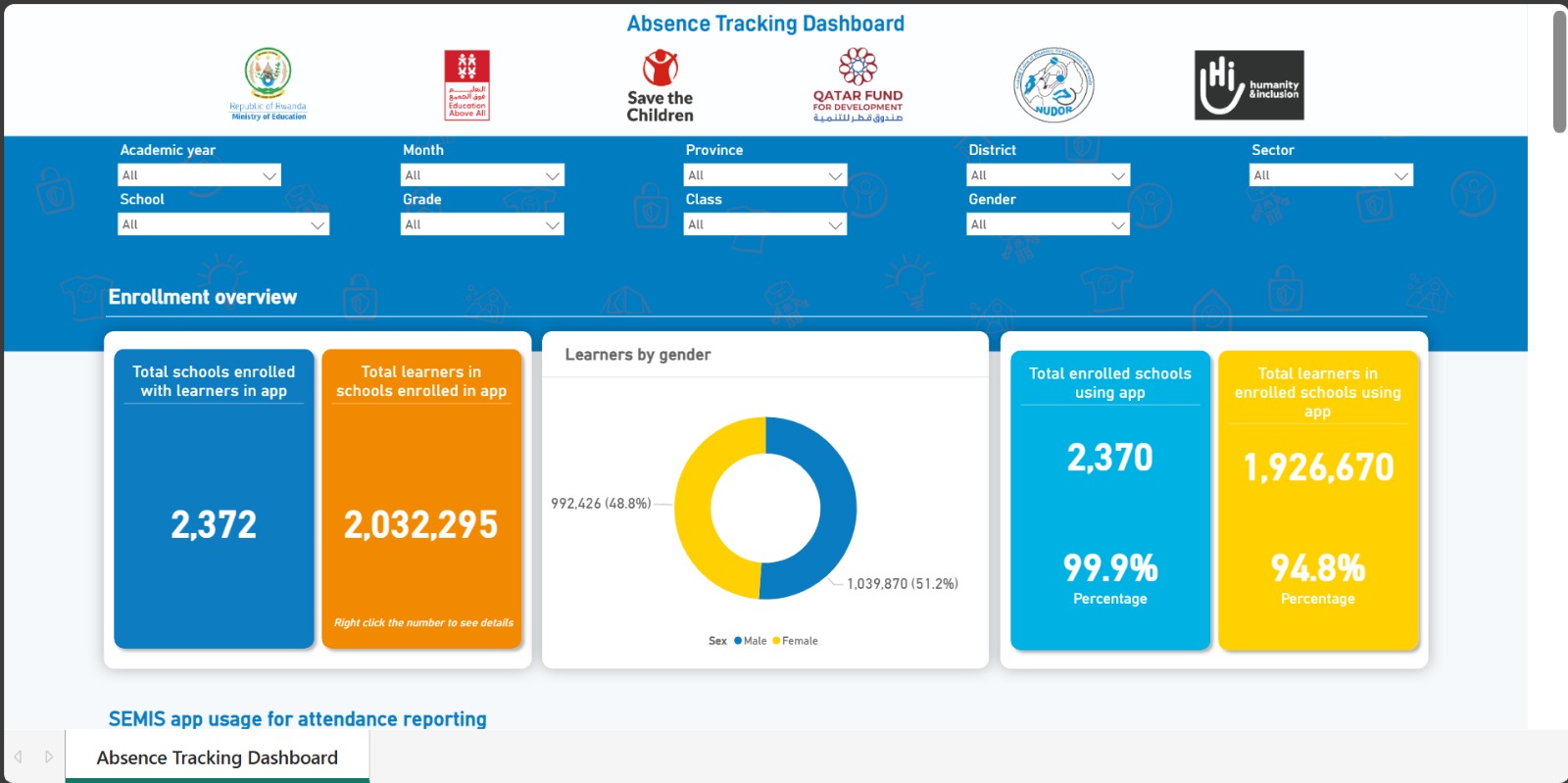
Across many countries, governments and partners are beginning to recognise that stronger education data systems are essential to identifying and supporting the most excluded learners. For instance, in Rwanda, our Zero Out of School Children initiative4 uses the Waliku application, a digital monitoring tool developed with partners including Save the Children and the Ministry of Education.
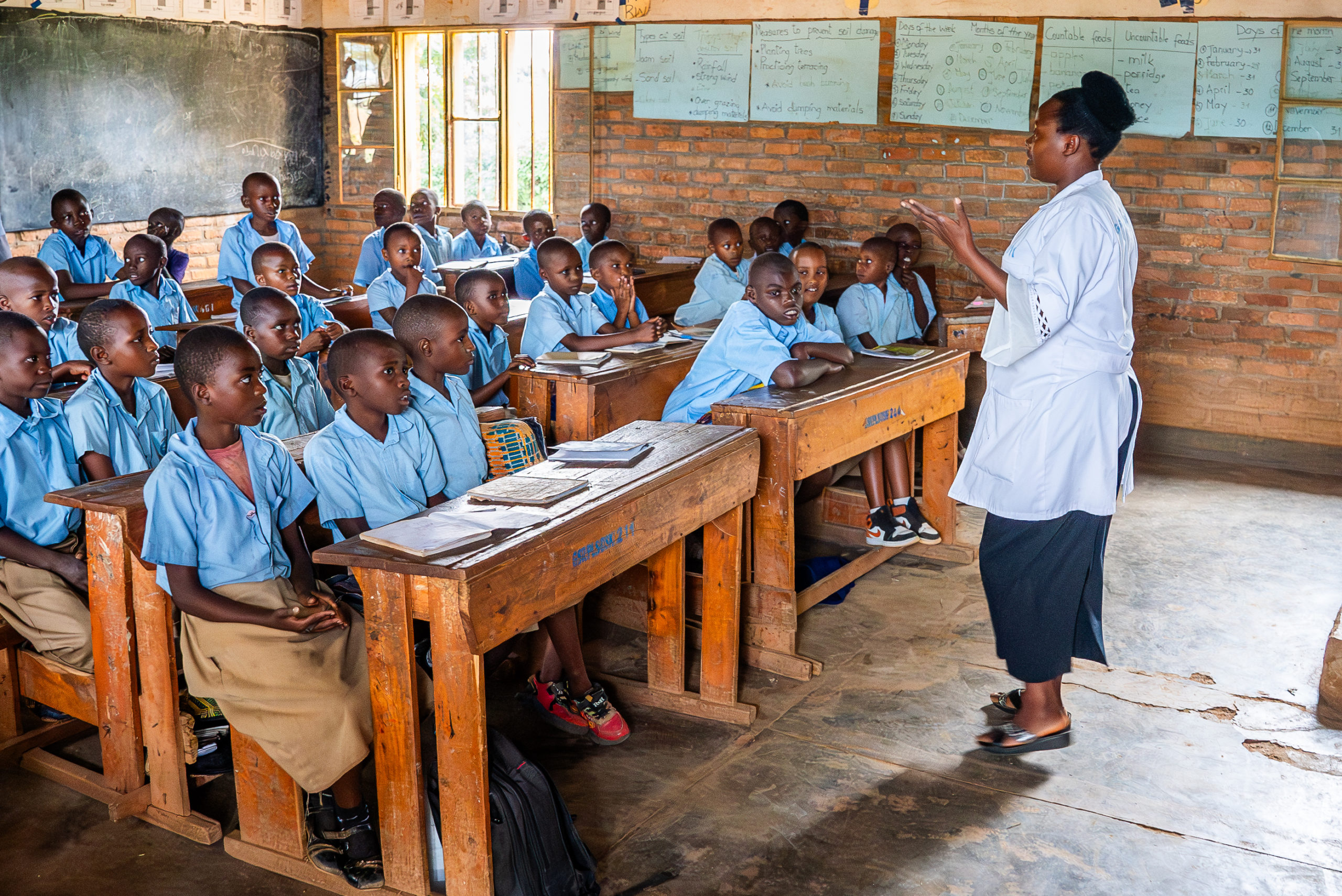
USE RWANDA PIC 2: Source: Education Above All Foundation
Caption: At a school in Kicukiro district in Rwanda where a digital monitoring tool is helping track attendance and track patterns of absence.
Teachers use the mobile platform to register out of school children, record attendance, and track patterns of absence. When repeated absences occur, the system generates follow-up alerts so schools or community workers can contact families and support re-enrollment.
USE RWANDA PIC 1: Source: Education Above All Foundation
Caption: When repeated absences occur, the system generates follow-up alerts so schools or community workers can contact families and support re-enrollment.
Similar approaches are also emerging in other contexts, including Nigeria, Kenya, Syria, Zanzibar, and Djibouti, where governments and partners are using digital monitoring tools, attendance tracking systems, and community-level data collection to identify children at risk of exclusion and support their retention in education.
Taken together, these initiatives illustrate an important shift: Education systems are moving from periodic aggregate reporting toward child-level identification, real-time monitoring, and early-warning systems.
Yet stronger education data systems are not without challenges. Many low-income and crisis-affected countries continue to face fragmented databases, weak civil registration systems, limited technical capacity, and inconsistent reporting mechanisms. Concerns around data privacy, interoperability, and the ethical use of predictive analytics also require careful attention. In displacement and conflict settings, high population mobility can make it particularly difficult to maintain accurate learner-level records. As education systems increasingly adopt artificial intelligence and automated risk-detection tools, safeguards will be essential to ensure existing inequalities are not reproduced through biased or incomplete datasets.
As these systems evolve, particularly with advances in analytics and artificial intelligence, they offer the potential to predict dropout risks and guide targeted interventions, helping ensure that every child remains visible within the education system.
So, How Do We Include Everyone?
Governments must treat education data as an inclusion tool, not only a reporting obligation. This means investing in learner-level education information systems that can uniquely identify learners, track attendance and progression, and safely link education data with civil registration, health, and social protection systems where appropriate. Governments should also routinely combine administrative data from across the board (health, education etc) with household surveys and humanitarian sources to correct blind spots in national statistics.
Secondly, donors should fund data systems as core public infrastructure. It is illogical to finance classrooms, teachers, and learning materials while leaving ministries without the capacity to know which children are missing, where they are, and what barriers they face.
Results-based financing should also reward governments and implementers for verified inclusion outcomes, not only aggregate enrolment.
Education agencies and partners should standardise how the world counts ‘excluded.’ Globally tested tools already exist. For example, the UNICEF–Washington Group Child Functioning Module6, provides a standardised approach for identifying children with disabilities in surveys and administrative systems. For displaced learners, stronger coordination between education and humanitarian data systems is essential. According to UNHCR, there are 12.4 million7 refugee children of school age worldwide, and nearly 46% of them out of school.
The takeaway is straightforward: The most excluded children are often the least counted.
Closing the education gap requires closing the education data gap, so that every child is visible, reachable, and supported well before exclusion becomes permanent.
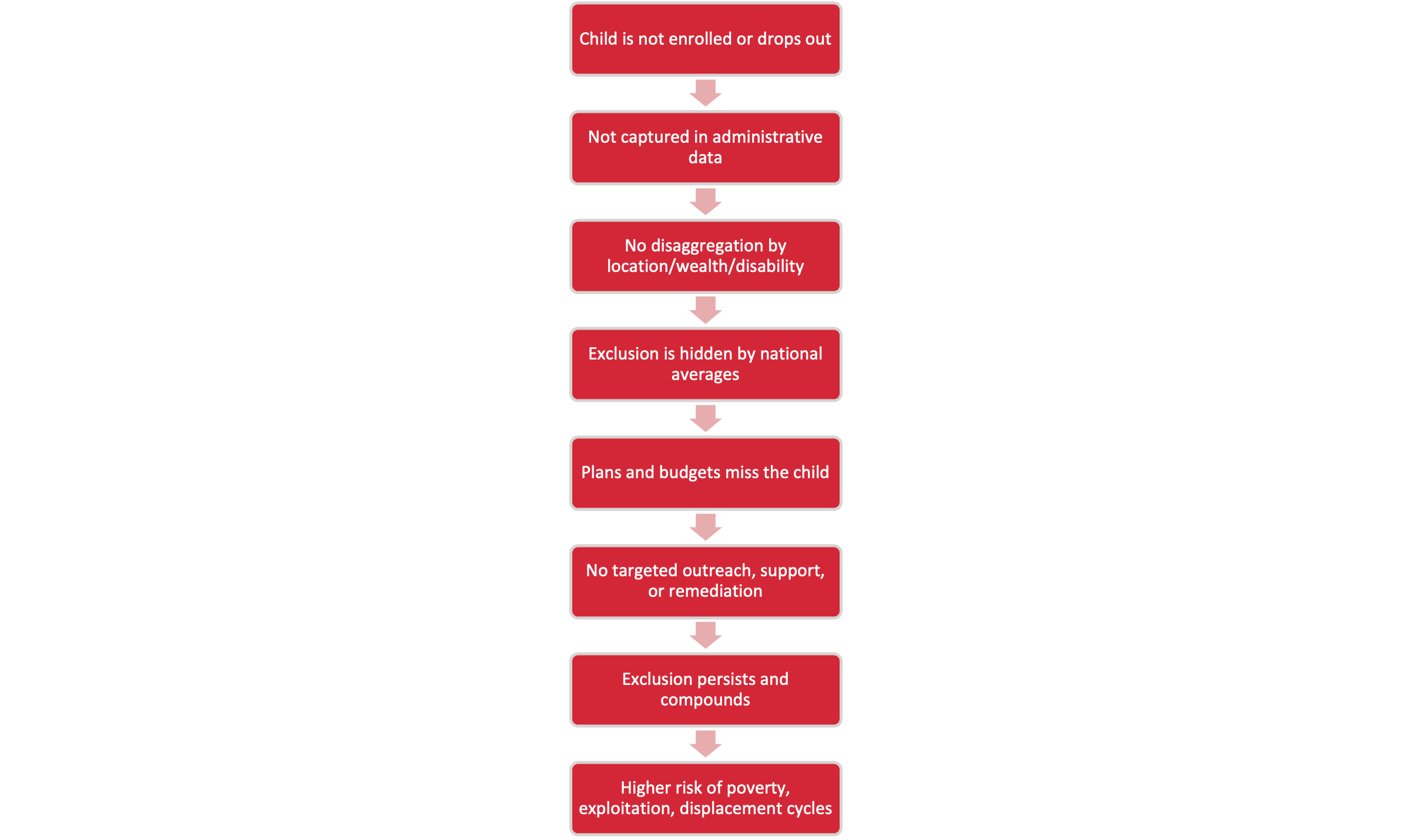
How Data Gaps Translate Into Exclusion
The consequences of weak education data systems are real. At every stage of the education cycle, missing or incomplete data can shape whether children are identified, supported, retained, or ultimately excluded from learning altogether. The pathways below illustrate how data gaps can translate directly into educational exclusion, particularly for children facing poverty, displacement, disability, conflict, and other intersecting vulnerabilities.
About the Author:
Noor Muhammad Ansari is the Director of Monitoring and Evaluation at Education Above All Foundation’s Educate A Child (EAC) Programme.
References:
UNESCO. (2026). Global Education Monitoring Report 2026. UNESCO Publishing.
UNESCO. (2024). Global Estimates of Out of School Children 2024. UNESCO Institute of Statistics.
EAA Foundation. (2019). Inclusion: Counting and Accounting for out of school children – occasional paper #5. (Occasional Paper No. 5). Education Above All Foundation.
EAA Foundation. (2023). EAA launches “Zero” education project with the Ministry of Education and Save The Children to enrol all out-of-school children in Rwanda in primary education. Education Above All Foundation.
EAA Foundation. (2019). Leveraging community and government resources for gender and educational equity in India: A case study of Educate Girls. Education Above All Foundation.
UNICEF. (2022). Module on Child Functioning: Questionnaires. UNICEF Publishing.
UNHCR. (2025). UNHCR Education Report 2025. United Nations High Commissioner for Refugees.