


The Emergence of Public Private Partnerships (PPPs) in Education in Pakistan
In this blog post, Sajid Ali, Kadija Gul, Sohail Ahmad, Aisha Naz Ansari, Yasir Qadir, and Sadia Bhutta trace the emergence and evolution of Public Private Partnerships (PPPs) in education in Pakistan. Drawing on the background of PPPs in the country, the blog explores the policy landscape, regional variations, and the key programmes that have shaped PPP models in Pakistan over three decades. It maps the different models that have emerged over time, documents key education-related PPP programmes introduced at national and provincial levels across Sindh, Balochistan, Khyber Pakhtunkhwa, and Punjab since 1992, and examines the current landscape of PPP schools in Pakistan today.
Background
Education in Pakistan has long been regarded as a state responsibility, which was further enhanced under the 18th Constitutional Amendment with a bold commitment to provide free and compulsory education to all children 5-16 years (Article 25a). However, persistent constraints of finances, governance and capacity have reshaped how it is delivered. While there are public schools that provide education to a large population, there are a significant number of private schools too. The third category of schools that are hybrid between public and private sectors are also in vogue, which are referred as Public Private Partnerships (PPP) schools. Globally, the past three decades have seen a gradual rise of these PPP schools through a series of global policy shifts toward hybrid arrangements in education (Rose, 2010). This shift, arguably, is popularised by various international organisations, particularly the World Bank and supported through global development agendas such as SDGs.
Conceptually the shift to PPP is connected to various policy threads such as privatisation of education; PPP as a preferred modality promoted by international organisations; and heightened PPP discourse in global development. In terms of privatisations of education, the UIS data shows a sustained growth in private education across regions. This is partly due to neoliberal reforms that prioritise , and performance-oriented governance. In terms of PPP as a preferred policy modality, the international organisations particularly the World Bank and Asian Development bank have played a key role in promoting PPPs as a policy lever to improve access, quality and governance, particularly in LMICs. Lastly, the global education development discourse shaped by the Sustainable Development Goals (SDGs) have promoted partnership agenda through explicit goals and targets such as SDG 17 and Target 17.17 (UN, 2015).
Education-related PPPs in Pakistan
PPPs in education have been widely promoted globally, especially in LMICs where the state capacity remains constrained (Patrinos et al., 2009). PPPs encompass a diverse set of arrangements – including school-industry collaborations, contracting private actors for public education delivery, and hybrid public-private school models – that seek to mobilise non-state resources and expertise in support of public education goals (Caldwell & Keating, 2004). The expansion of such models globally has been underpinned by the belief that structured collaboration between public authorities and private partners can address systemic inefficiencies while maintaining public oversight.
Likewise, in Pakistan, PPP in education was promoted in response to longstanding challenges of access, quality, finance and governance in education. Educational PPPs in Pakistan started around the 1990s through the establishment of education foundations under the 1992 education policy but it began to take strong institutional form in the early 2000s under Educational Sector Reform (ESR) (Ministry of Education, 2004). The ESR recognised that expanding the number of public schools alone would not resolve systemic inefficiencies or improve learning outcomes, hence PPPs were promoted as better way forward.
“Among other initiatives, the GoP has undertaken policy reforms and provided incentives for PPPs to flourish in the education sector. From initiating innovative programs to working in tandem with non-governmental organizations (NGOs) that manage public schools through formal adoption, the government has stepped up its efforts to include various other stakeholders in the delivery of education” (ESR, 2004, p. 4.).
The explicit mention of PPP as a core feature of the ESR signals that government formally embraced PPP not as supplementary initiative, but as a central pillar of its education reform agenda. The Ministry of Education in Pakistan committed to foster an atmosphere that would support the expansion of PPPs to achieve this goal (MoE & UNESCO IIEP, 2002). Subsequently several models of PPP provisions were initiated at federal and provincial levels (Bano, 2007; MoE & UNESCO IIEP, 2002; MoE, 2004).
Models of PPPs in Pakistan
Pakistan’s PPP landscape evolved through distinct provincial pathways, resulting in multiple models that differ in financing, management, and accountability structures. Broadly, these arrangements fall into two categories: publicly financed but privately managed schools, and government-owned schools outsourced to private operators. Within these broad categories some variations also exist. Figure 1 shows both the variety of PPP models along with their historical and milestones in Pakistan.
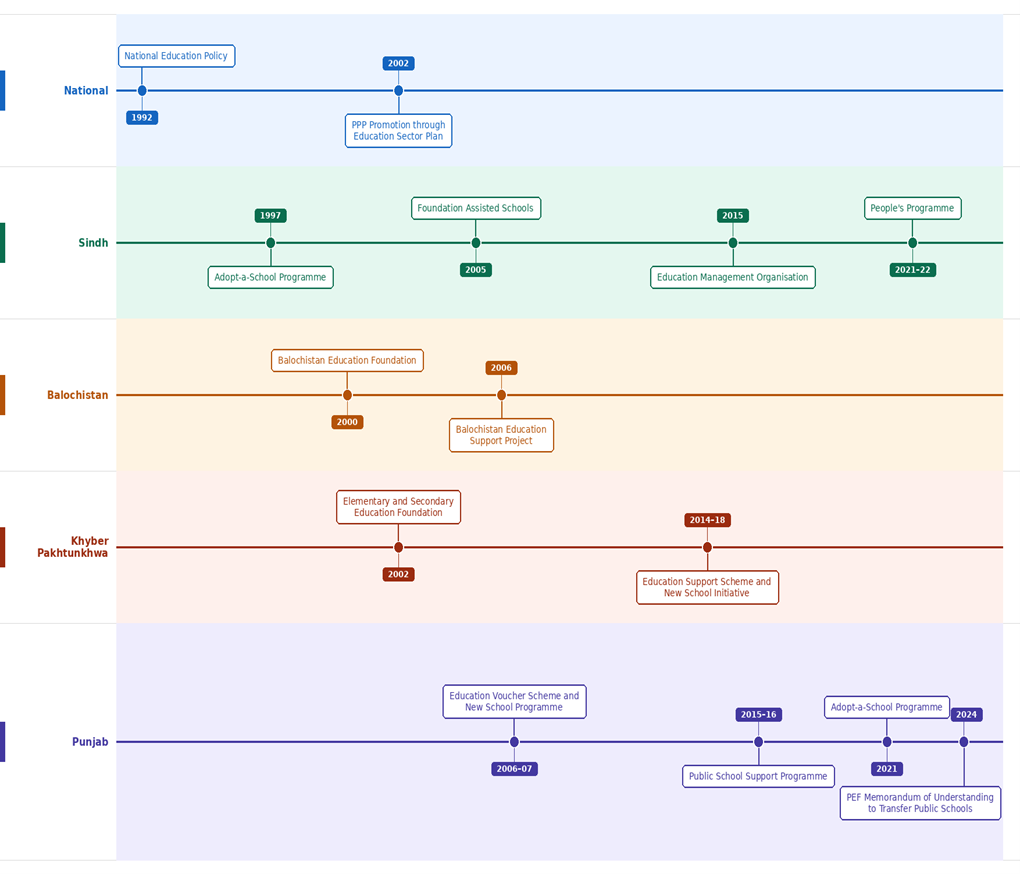
Figure 1: Models, historical trends and important milestones for PPP in education, Pakistan
The PPP policy has evolved differently in different provinces in Pakistan. In Sindh, the Sindh Education Foundation (SEF) pioneered structured PPP engagement in the early 1992. Its Adopt-a-School Programme was launched in 1997 inviting individuals, civil society organisations, and community groups to government schools through financial contributions, in-kind donations (such as furniture, books, and equipment), and governance oversight, with SEF acting as facilitator and monitor (SEF, 2022-23). Over time, the model expanded beyond community support towards formal contracting (Sindh Education Foundation, 2011).
Balochistan province followed a similar trajectory through the Balochistan Education Foundation, restructured in 2001 to strengthen private sector engagement. Unlike other provinces where PPP models incorporated private and for-profit operators from an early stage, Balochistan’s initial approach was distinctly community-centered, relying on local communities and civil society rather than commercial actors to expand access. Early initiatives emphasised community schooling and institutional reform to address low enrolment and gender disparities (Bano, 2008).
In (KPK), the Elementary and Secondary Education Foundation, was established in 2002 and developed partnership models to increase access for out-of-school children, particularly girls. Its Education Support Scheme and New School Initiative financed low-cost private and community-managed schools where public provision was limited (Elementary & Secondary Education Foundation, Govt. of Khyber Pakhtunkhwa, 2002).
institutionalised large-scale PPPs through the Punjab Education Foundation (PEF). The Foundation Assisted Schools (FAS) programme, launched in 2005, subsidised low-cost private schools on a per-student basis (Ansari, 2020; Bano, 2008; Crawfurd et al., 2024; Malouf Bous & Farr, 2019). The Education Voucher Scheme (EVS) and New School Programme (NSP) were introduced in 2006-07 claiming to extend access by financing enrolment in underserved areas. These models combined public funding with private provision under performance conditions (PEF, 2025).
Across provinces, these models share a common feature of public financing tied to private management, yet differ in scope, targeting strategies, and accountability mechanisms. It is also important to note that provinces are also at different stages of their ; while Punjab and Sindh maintain large and established PPP portfolios, the KPK and Balochistan currently operate smaller and more nascent programmes. Whether these provinces continue or expand their PPP engagement will depend on political commitment, institutional capacity, and evidence of effectiveness from existing pilots; any future trajectory remains uncertain rather than assumed and is likely to vary across contexts.
Current landscape of PPP schools in Pakistan
Since the mid-2010s, PPPs have shifted from access-oriented expansion toward systemic outsourcing and -based governance. In Sindh, the government introduced Education Management Organisations (EMOs) in 2015, initially transferring more than 200 public schools to private operators under structured contracts (SE&LD, 2017). This marked one of the province’s largest PPP-based reforms. Under these arrangement, ‘performance’ is defined through contractual Key Performance Indicators (KPIs) that typically school enrolment growth, student attendance (with thresholds of 70–80%), reductions in dropout, improvements in learning outcomes assessed through standardised tools such as the Annual Status of Education Report (ASER) and provincial achievement tests, teacher attendance and deployment, and compliance with basic infrastructure and school-environment standards (SE&LD, 2017; ASER Pakistan, 2023). Punjab similarly expanded outsourcing through the Public School Support Programme (PSSP), contracting underperforming public schools to private entities with third-party validation mechanisms (PEF, 2016; Crawfurd, 2020). While the broad KPI categories are similar across provinces such as focusing on access, attendance, learning outcomes, and school-level management, specific indicators and targets vary by programme and are not governed by a single national policy framework. In 2024, Punjab education ministry initiated to outsource thousands of public schools through PEF showing a massive move towards PPP (Accountability Lab Pakistan, 2024). Geographically, Punjab and Sindh host a greater number of PPP models compared with other provinces (see Table 1 for details).
Table 1: Number of schools and enrolment trends in PPP models
| Model | Number of PPP Schools | Student‑enrolment or Scale Info |
| FAS in Sindh | 2644 | 897,799 |
| Adopt A School Program, Sindh | 319 | 124,576 |
| EMO schools | 221
|
———- |
| FAS in Punjab | 3,586 | 1.72 million |
| EVS Punjab | 1,780 | 0.5 million |
| PIEMA | 4276 | 20,655 |
| Sources: Government of Punjab, School Education Department, “Annual School Census, 2023-24” PESRP, https://pesrp.edu.pk/annual-school-census/
Sindh Education Foundation (SEF), https://www.sef.org.pk/#s |
||
Recently, Khyber Pakhtunkhwa announced the outsourcing of 1,500 low-performing public schools under performance-linked contracts, signalling a shift toward results-based financing (Ashfaq, 2025). In Balochistan, PPP expansion has been supported through donor-backed initiatives, including the World Bank-supported Balochistan Education Support Project and subsequent grants from the Global Partnership for Education. link funding to enrolment growth, girls’ participation, and learning outcomes (Bano, 2008; Webdesk, 2025).
Conclusion
In light of the above discussion, PPP in Pakistan’s education system can be understood as part of the global shift towards alternative policy mechanism to provide publicly funded education. Interestingly, there are various models currently being practiced in Pakistan and many of them supported by international organisations such as the World Bank, the Asian Development Bank, and GPE. It can be argued that Pakistan is implementing a global policy push in favour of public private partnerships in education to address long-standing systemic challenges.
These PPP models promise to improve the governance, quality, accessibility, infrastructure and financial efficiency of educational institutions (LaRocque, 2008; Patrinos et al., 2009; Verger & Moschetti, 2017). However, whether these promises translate into actual improvement is a matter that requires careful evaluation and it invites several critical questions (Aslam et al., 2016). Do PPP models genuinely enhance educational quality and access, or do they risk reproducing existing inequalities in new forms? What accountability and monitoring mechanisms are necessary to ensure that PPP initiatives remain transparent, responsive, and aligned with the needs of marginalised communities? Ultimately, as PPPs continue to expand across Pakistan, we must ask who truly benefits from this rapid shift and what will be the long-term implications of this for students, teachers, and the broader education system. These questions and the broader implications of PPP in Pakistani educational landscape are worth exploring. We aim to continue this discussion through upcoming series of blogs to unpack these, and many other issues related to the PPPs, examining how they function in practice and what they mean for educational policy and practice in Pakistan in light of the emerging findings from our study funded by DARE-RC.
About Authors:
Sajid Ali is an Endowed Amir Sultan Chinoy Professor and Director of Research at Aga Khan University, Institute for Educational Development, Pakistan at the Aga Khan University’s Institute for Educational Development, Pakistan. He is the current General Secretary of Pakistan Association for Research in Education (PARE).
Khadija Gul is a Research Associate at the Aga Khan University Institute for Educational Development (AKU-IED).She also worked as a research Consultant with Sightsavers.
Sohail Ahmad is a Ph.D. candidate in Education and Research Specialist at Aga Khan University’s Institute for Educational Develop-ment, Pakistan. Currently a Commonwealth Split-Site Scholar at the University of Cambridge’s Faculty of Education.
Aisha Naz Ansari is a PhD Scholar at Durham University under NINE DTP (ESRC) scholarship. Previously, she served as a Research Specialist at the Aga Khan University, Institute for Educational Development (AKU-IED), Pakistan as well as a working group member for ESIC for safe and responsible use of AI in evidence synthesis.
Sadia Bhutta is working as an Associate Professor at Aga Khan University Institute for Educational Development, Pakistan. Her research interests include classroom practice, learning outcomes, and quantitative research methods.
Yasir M. Qadir, is a research Associate at Aga Khan University Institute for Educational Development, Pakistan also worked as a consultant with The Citizens Foundation (TCF), where he supported the development and execution of a comprehensive framework for whole-school evaluation.