

Nearly Nine in Ten Failed, and Hundreds of Thousands Never Sat: Ethiopia’s Grade 12 Results
In this blog post, Tebeje Molla looks into Ethiopia’s Grade 12 pass rate to examine the growing number of students who never reach the examination hall and what this reveals about the country’s deepening educational crisis.
Every August, hundreds of thousands, if not millions, of Ethiopian families await the news about the Grade 12 results. For most of them, it will be bad news, as it has been for years. But many families had no result to wait for at all, as their children never reached the examination hall.
A Meagre Result against a Low Bar
On 22 August 2026, the Ministry of Education announced that 70,554 of the 550,210 Grade 12 candidates had scored 50 per cent or above, a pass rate of 12.8 per cent and the strongest showing in five years.
The announcement led with that rate. It is a rate that conceals more than it reveals. First, the threshold sits at 50 per cent, so what is being celebrated is a bare half mark. Second, the rate is a ratio, and as Figure 1 shows, the denominator has been falling year after year, which lifts the percentage without lifting the number of young people who succeeded by very much. Third, 87 per cent of those who sat failed to score a passing mark and were shut out of the tertiary pathway the examination offers.
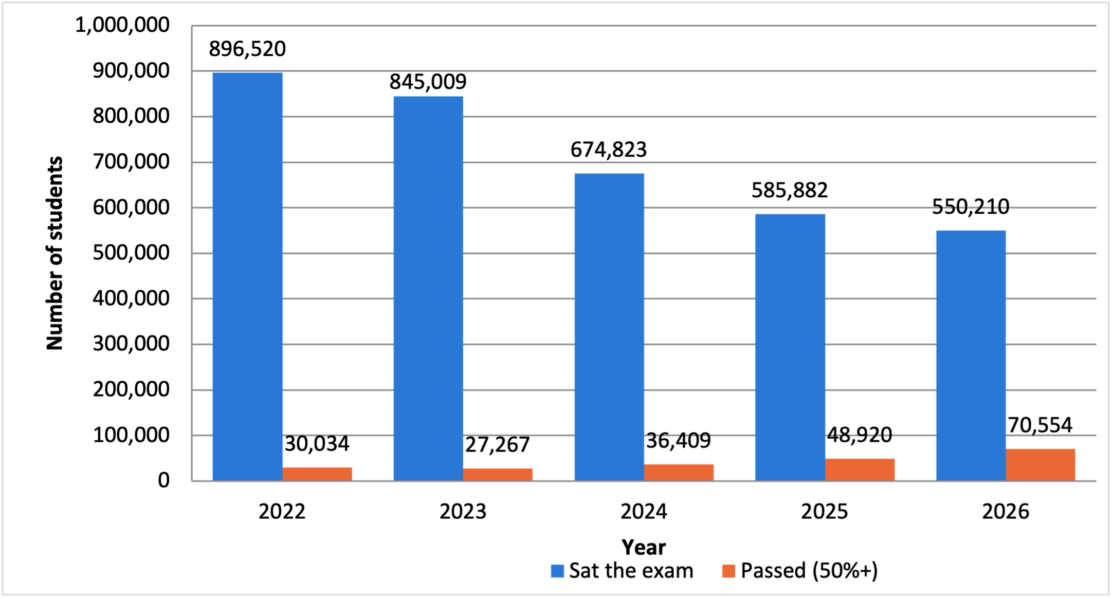
Figure 1. Students sitting and students passing the Grade 12 examination, 2022 to 2026
Source. Ministry of Education examination results, 2022 to 2026.
The Uncounted Cohort
Four years ago, 896,520 students sat this same examination. This year, the number dropped to 550,210. A raw fall of 346,310 candidates understates what has happened, because Ethiopia’s population has been growing throughout. The country’s annual population growth rate sits at about 2.6 per cent, and growth of that kind compounds: each year’s increase builds on a larger base than the year before.
Applying that rate to the 2022 figure of 896,520 gives a Grade 12 cohort of roughly 993,458 by 2026, an expansion of close to 97,000 young people. Measured against that benchmark, 443,248 students are missing from the examination. That number is significant. It accounts for nearly 45 per cent of the group that should have been there (see Figure 2).
But the public announcement of Minister Berhanu Nega is silent on the far larger group who never reached the examination hall at all.
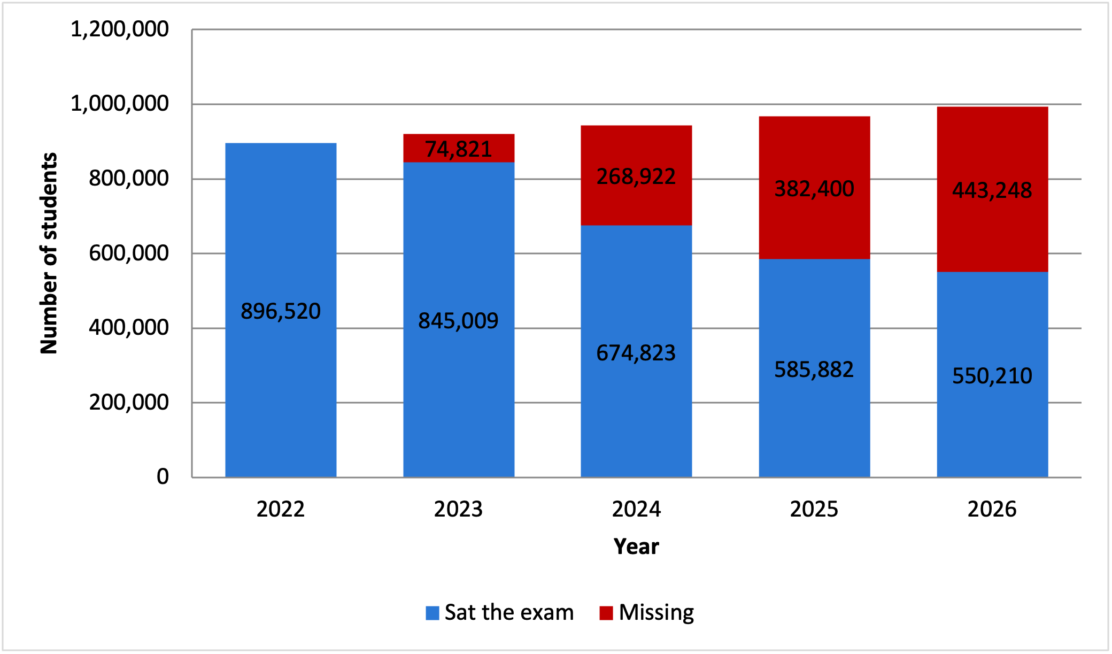
Figure 2. Actual candidates against a cohort projected at 2.6 per cent annual growth
Source. Ministry of Education examination results and author’s projection from World Bank (2025) population growth data.
As shown in Figure 2, almost half of a national cohort has been removed from the last formal assessment of Ethiopian schooling, and the removal has accelerated every year since.
The 2022 base is itself inflated by the removal of the Grade 10 examination in 2019, which pushed Grade 11 and 12 enrolments sharply upward, so the projection should be read as an upper bound.
The Armed Conflicts that Emptied the Classrooms
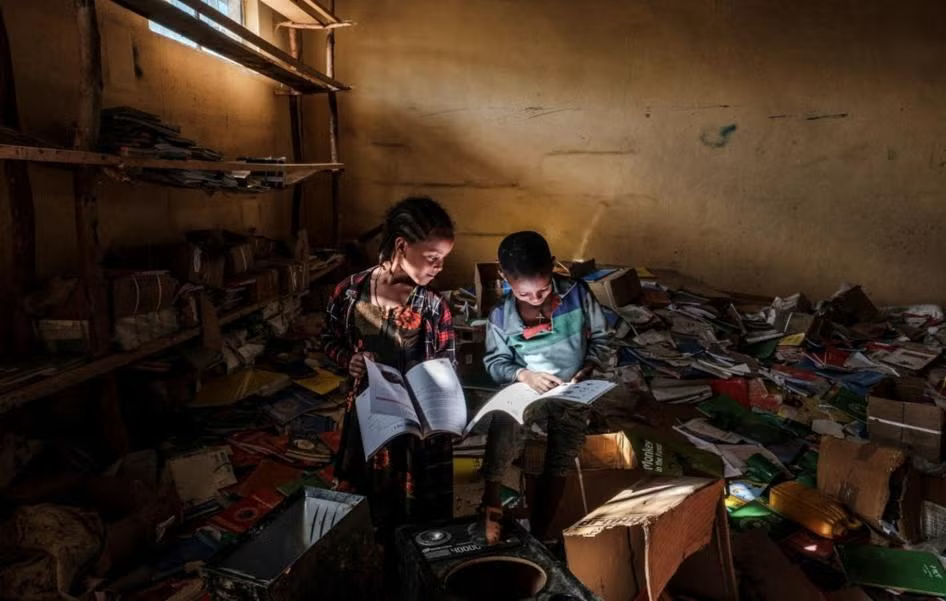
The ongoing armed conflict has significantly impeded the nation’s ability to deliver education outside the main urban centres. Ethiopia is ranked among the countries with the highest incidence of attacks on education globally in the Education under Attack 2026 report by the Global Coalition to Protect Education from Attack. Schools are shelled, occupied or closed, teachers are killed, threatened or left unpaid, and families who move take their children out of classrooms they never return to.
Three regional states account for most of the loss.
No region in Ethiopia has more children out of school than Amhara, the second most populous regional state. Armed conflict between federal forces and Fano militia has run across Amhara since April 2023, and schools have been among its casualties. In the 2024/25 academic year, the regional education bureau counted 4.1 million out-of-school children.
Tigray regional state once recorded some of the highest school participation rates in the country. But war disrupted it all. Between 2020 and 2022, the war in Tigray pushed some 1.4 million children out of school, and the region is still rebuilding the schools and the teaching workforce it lost. This year, over 28,000 students in Tigray sat the examination, and only 3,146 reached the pass mark, a pass rate of about 11 per cent, below the national average of 12.8 per cent.
Oromia, the country’s largest region, had 3.2 million children out of school in 2024.
At the national level, the cumulative effect of the ongoing violence and instability is visible in the staggering number of students who failed or did not sit for the Grade 12 examination.
Private and Public Costs
In Ethiopia, the Grade 12 examination is the single route into university. There is no meaningful second sitting. There is no alternative entry scheme operating at scale. There are no viable lifelong learning arrangements that would benefit school dropouts. For a young person who does not sit for the national exam, the door is closed.
The consequence is lasting. Those without post-secondary qualifications are likely to remain in long cycles of insecure work and unemployment. Some respond by taking the migration routes across the desert and the Gulf, at considerable risk to their lives. Girls out of school for years also face early marriage.
The cost is societal too. As noted before, the consequences run well past the individual disappointment. When millions of young people leave school without skills or qualifications, the national human capital diminishes. There is no sustainable and fair development without sufficient skilled workforce.
Who fails and who never sits also runs along the lines of class, gender and geography. The rural residents and the urban poor disproportionately fall behind. Left unaddressed, this entrenched inequality will further fracture the nation’s social cohesion.
What can be done?
There is a lot the government can do to avert this crisis. I name a few here.
The government needs to take immediate action towards an unconditional peaceful settlement with armed groups in the country. Without peace, no funding, no curriculum reform, or infrastructure investment would ensure educational access and success.
The government also has to reverse the fall in real education spending. Sufficient funding can help strengthen the teaching workforce, expand access, and update curricular materials.
The government should also be fully transparent about the size of the Grade 12 age cohort, along with the number who sat, region by region, every year, as well as by gender and field of study. Celebrating the few who pass while ignoring the many who failed or never sat the examination is the policy equivalent of an ostrich burying its head in the sand. It may make for a better headline, but it does nothing to address the crisis.
Author:
Tebeje Molla is an Associate Professor and ARC Future Fellow in the School of Education at Deakin University. His research examines educational disadvantage and policy responses. His current study focuses on young people of African heritage and refugee backgrounds in Australian schools and universities.
Image credit: Human Rights Watch https://www.hrw.org/news/2021/05/28/ethiopia-tigray-schools-occupied-looted