


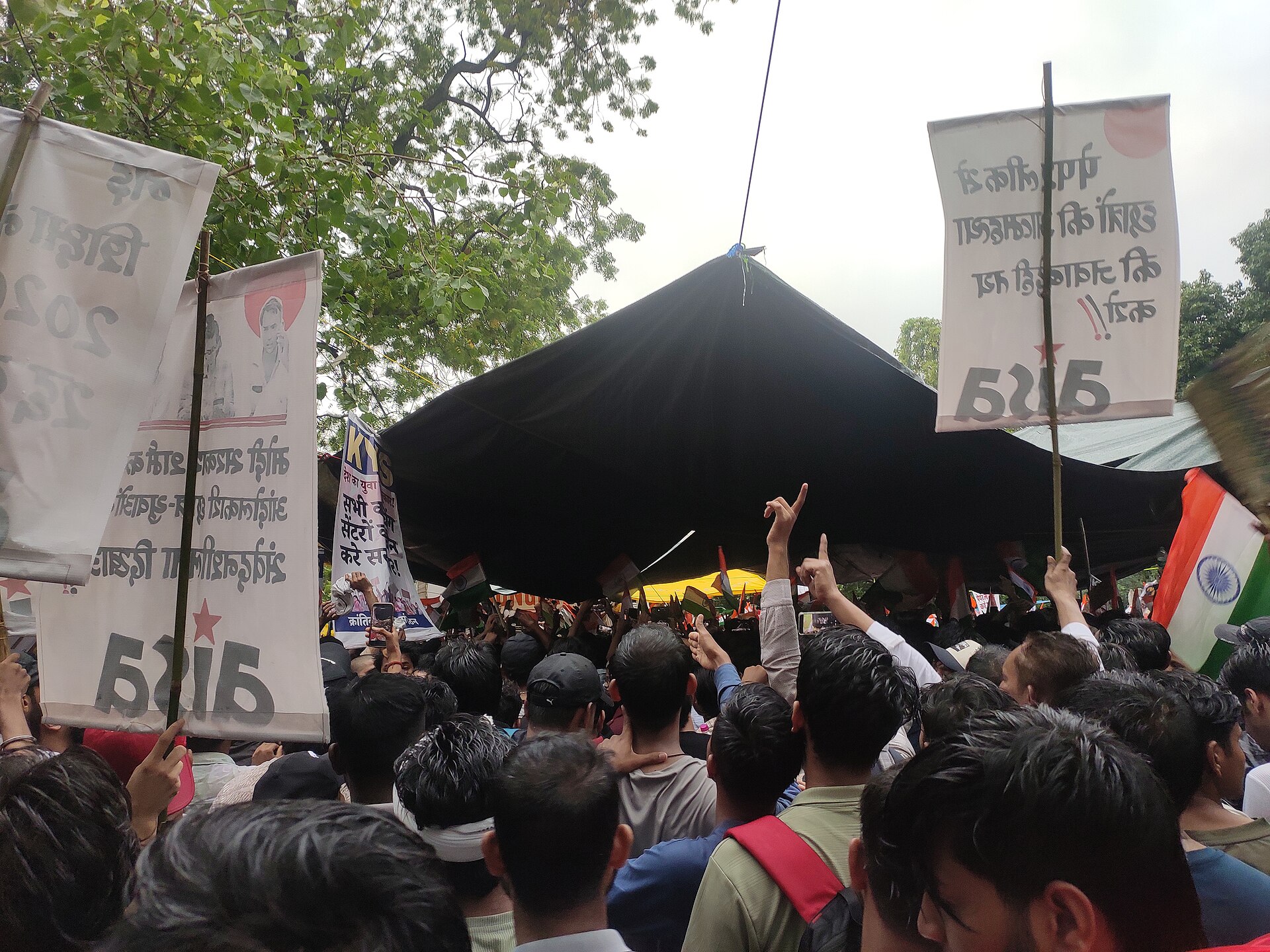
The Hollowing of the Classroom: Gen Z Resistance and Educational Legitimacy in India
In this article, Keerthan Chandra analyses the structural origins of youth uprising in India’s education system and considers what constitutes sustainable and credible systems for democratic access to education.
As geopolitical focus shifts toward global education standards, the hollowing of local public schooling represents a major crisis of state legitimacy. In India, a generation coming of age is actively resisting the imposition of technocratic, high-stakes testing cartels and structural disinvestment. Moving beyond traditional campus politics, Gen Z student collectives are leveraging grassroots civic audits to hold public administration accountable to constitutional mandates. Their struggle offers vital lessons on reclaiming public education as a sovereign, democratic commons.
-
The Breaking of the Educational Covenant
In developing democracies, public schooling is conventionally framed as the primary institutional vehicle through which social mobility is negotiated and intergenerational poverty dismantled. However, as reproduction theorists argue, these systems frequently function to entrench existing class hierarchies, a reality increasingly evident in India, where the public education system has been subordinated to a profound structural contradiction. While official communiqués celebrate the country’s imminent ascent as a global ‘knowledge superpower’—a Vishwa Guru exporting technical talent—the material reality experienced by over 250 million enrolled students reflects an accelerating institutional hollowing out. This hollowing threatens to undermine progress toward the United Nations Sustainable Development Goal 4, which mandates equitable, quality education for all.
This systemic degradation, mirroring austerity-driven educational crises in other Global South democracies like South Africa, operates across multiple fronts: the widespread closure of rural schools under the banner of fiscal rationalisation; protracted freezes on permanent teacher recruitment; crumbling physical infrastructure devoid of basic sanitation; the dilution of foundational nutrition programmes; and the substitution of evidence-based pedagogy with unverified curricular revisionism. For years, this decay was insulated from democratic oversight by a compliant mainstream media that dismissed student grievances, routinely pathologising civic dissent as politically motivated disruption.
Yet, institutional pressures do not dissipate; they accumulate. In mid-2024, this pressure cooker ruptured when systemic corruption and paper leaks in centralised entrance examinations—most prominently the National Eligibility cum Entrance Test (NEET, a medical entrance examination distinct from the Western acronym for youth ‘Not in Education, Employment, or Training’)—shattered the meritocratic promise that sustains youth compliance. What followed was a decisive generational turning point: a decentralised, non-partisan mobilisation led by fifteen-to-nineteen-year-olds that resisted sectarian polarisation, forced ministerial accountability, and sparked grassroots civic counter-audits of rural classrooms. This analysis examines the structural roots of this crisis, interrogates the state’s punitive legislative response, and analyses the emerging role of youth as frontline auditors of educational accountability.
-
Structural Disinvestment and the Crumbling Base
The contemporary crisis of Indian public education is fundamentally rooted in fiscal austerity. While the National Education Policy 2020 reaffirmed the historic recommendation that public education expenditure reach at least 6.0 per cent of Gross Domestic Product (GDP), actual budgetary allocations across central and state governments remain stagnant between 3.0 and 3.5 per cent of GDP, as documented in the Economic Survey 2023-24. By comparison, most nation-states managing a youthful demographic dedicate approximately 13 per cent of their total public expenditure to education, placing India starkly behind its global peers. Under fiscal constraints, education departments have pursued aggressive ‘school rationalisation’ policies, unilaterally merging or closing tens of thousands of rural primary facilities under the guise of administrative efficiency.
The consequences of this physical retreat are acutely regressive. In agrarian peripheries lacking public transit, closing a village school forces children to traverse dangerous distances. This physical distance operates as an active mechanism of social exclusion, triggering disproportionate dropout rates among adolescent girls, Dalit communities, and Adivasi households. Compounding this physical abandonment is a crippling personnel deficit. Despite millions of qualified graduates completing Teacher Eligibility Tests, state governments have enforced prolonged hiring freezes to suppress recurring establishment costs, leaving over one million teaching posts vacant nationwide, according to UDISE+ 2022–23 statistics. In their place, administrations rely on precarious, low-wage contract instructors or permit single-teacher schools to proliferate.
Physical classroom conditions mirror this personnel neglect. Thousands of schools operate without separate, functional toilets for girls—a primary catalyst for female pubertal dropout—while safe drinking water and science laboratories remain scarce. Furthermore, disinvestment has compromised the flagship Mid-Day Meal scheme (PM-POSHAN). Historically vital for classroom attendance and caloric stability, the programme has faced administrative dilution. In multiple states, essential dietary staples such as eggs have been removed under ideological pressure, replacing balanced nutrition with substandard catering that directly undermines child cognition and retention in marginalised communities.
-
Pedagogical Degradation and Castes Dynamics
Parallel to physical decay, the curriculum has suffered deliberate distortion. Schooling in a constitutional republic derives its legitimacy from fostering critical inquiry and scientific temper. In recent years, however, education authorities have systematically excised foundational scientific topics—including evolutionary biology, the periodic table, and environmental ecology—under the pretext of ‘syllabus rationalisation’. Simultaneously, historical units covering social justice movements, minority history, and South Asian cultural pluralism have been replaced with mythologised, revisionist narratives designed to serve contemporary majoritarian politics. Crucially, while this current wave of cultural nationalism is pronounced, it exposes a deeper, systemic vulnerability: the historic inability of India’s educational institutions to remain insulated from the ideological shifts of changing political regimes. This recurring vulnerability dismantles the empirical foundation of education, replacing critical thought with deference to authority.
In tandem, the retreat of quality public schooling reinforces entrenched caste hierarchies. While affluent elites insulate their children in high-fee private academies, working-class and Dalit families are forced into resource-starved government facilities or predatory, unregulated ‘budget private schools’. Within remaining public institutions, structural discrimination endures: from segregated seating during meals to informal tracking of marginalised youth away from academic streams. Crucially, this decay unfolded under manufactured silence, as commercial media networks routinely framed student and teacher protests as politically motivated disruptions, hiding systemic vulnerabilities until the foundation cracked.
-
The High-Stakes Testing Cartel and the NEET Rupture
The crisis erupted into the national consciousness when systemic failure intersected with the commercial monopoly of centralised testing. Over the past decade, Indian higher education policy centralised admissions into monolithic national examinations administered by the National Testing Agency (NTA). The peak of this model was NEET-UG, through which over 2.4 million medical aspirants competed for approximately 100,000 undergraduate seats.
Rather than democratising access, centralisation created a multi-billion-pound shadow education cartel. Concentrated in commercial coaching hubs like Kota, this industry turned secondary schooling into an exclusionary commercial market. Working-class families who could not afford coaching fees running into thousands of pounds were structurally disadvantaged. Regular secondary schools degenerated into ‘dummy institutions’, where students paid fees solely for attendance while studying sixteen hours daily in rote-learning factories. This mirrors the predatory shadow education cartels that prompted China’s sweeping, though largely evaded, 2021 ‘Double Reduction’ policy, highlighting a broader crisis of hyper-competitive commercialisation in the Global South.
In mid-2024, the meritocratic premise collapsed. The NEET-UG 2024 results revealed extreme anomalies: improbable score clustering at commercial exam centres, arbitrary ‘grace marks’ awarded without clear rules, and verified question paper leaks circulated on social messaging platforms for millions of rupees. This scandal followed a documented epidemic of over forty major public examination paper leaks across Indian states in five years, compromising recruitment tests for teachers and public servants. In an economy where secure public employment and medical degrees represent rare avenues out of informal precarity, corrupt entrance exams represent an existential breach of the social contract.
-
The Gen Z Mobilisation: Grassroots Civic Audits
The protests that followed the NEET scandal differed fundamentally from past campus demonstrations. Historically, authorities managed student movements by leveraging communal or political polarisation, labelling university protests as partisan. In 2024, that strategy failed entirely. The vanguard was Generation Z: fifteen-to-nineteen-year-old school leavers and their working-class parents. Authorities could not credibly brand teenage medical aspirants as political conspirators, nor convince families that leaked papers were foreign plots. The grievance was universal and undeniable.
Utilising horizontal digital networks, messaging platforms, and student-led legal collectives, young aspirants organised nationwide resistance. Street protests and rallies swept state capitals, supported by independent student unions and civil liberties lawyers who took the fight to the Supreme Court. The moral clarity and scale of this youth mobilisation compelled parliamentary debates, testing agency restructuring, and testing leadership changes.
Recognising that performative state reforms like harsh anti-cheating legislation only address symptoms while leaving testing cartels and disinvestment intact, the youth movement expanded its mission. Rather than disbanding, student collectives transformed into active monitoring networks, initiating unannounced ‘civic inspections’ of rural government schools. Armed with the Right to Information (RTI) Act and mobile cameras, these young auditors enter village schools to document frontline conditions. Their findings expose the very failures official communiqués deny: absent teachers, locked computer rooms, non-functional toilets, and sub-standard midday meals, establishing a new paradigm of youth-led public accountability.
-
Reclaiming Public Education as a Democratic Right
The trajectory of India’s educational unrest carries urgent lessons for global youth policy and the global governance of education. It demonstrates that technocratic, high-stakes testing cannot substitute for sustained, equitable investment in basic schooling. When governments abandon publicly funded education, they produce predatory private markets that inevitably collapse under systemic corruption.
Rebuilding that covenant requires structural change: meeting the statutory benchmark of 6 per cent of GDP for education; filling teacher vacancies with permanent staff; ending regressive school closures; restoring scientific integrity to curricula; and establishing independent ombudsmen for student rights. State institutions must cease treating young people as passive consumers or security risks. The students walking into rural classrooms with notebooks and cameras are not agitators; they are the true custodians of democratic and developmental accountability in the Global South.
Author Bio
Keerthan Chandra is a public policy researcher with a background in Computer Science and Engineering. He recently completed the Public Policy Analysis programme at the London School of Economics and Political Science (LSE) and is currently undertaking the Artificial Intelligence programme at the University of Oxford. He serves as a researcher through the UN Online Volunteering Service, focusing on youth development, institutional governance, and policy evaluation in the Global South.
Image Credit:
-
Caption: Generation Z Mobilisation: Students gather at Jantar Mantar in July 2026 to protest the systemic paper leaks and structural failures of the centralised NEET-UG examinations.
-
Credit: Sumita Roy Dutta / Wikimedia Commons (CC BY-SA 4.0)