

Between Politics and Education: Five Tests for Language-of-Instruction Policy in Syria during Recovery
In this blog post, Kouteba Alkhalil discusses five ways to support child-centred language-of-instruction policy in Syria.
In January 2026, Decree No. 13 recognised Kurdish as a Syrian national language, marking an unprecedented change to the rigid linguistic framework that had, for decades, restricted education to Arabic. However, the decree did not settle the place of Kurdish in language-of-instruction policy; it only allowed Kurdish to be taught as an optional subject or as a cultural and linguistic activity in areas where Kurds constitute the majority of the population. This was followed by an announcement from the Syrian Ministry of Education that it had begun preparing a dedicated curriculum allocated two periods per week.
The question that remains unresolved is: When should the different national languages be used in schools? What should be the limits of their use? And what options are available to policymakers?
Officially, Arabic remains the country’s official language under Article 4 of the 2025 Constitutional Declaration, meaning that it is the language of government communication and administration. Decree No. 13, by contrast, recognised Kurdish only as a national language, giving its presence in the public sphere legitimacy and cultural and identity-based recognition.
Accordingly, the term “national languages” is used here to refer to all living languages that continue to be used by Syrian communities and passed down across generations. In addition to Arabic and Kurdish, Syria’s linguistic environment includes Modern Aramaic/Syriac, Armenian, Circassian, Turkish/Turkmen, and Domari, as well as the languages and communication systems used by persons with disabilities. However, these languages do not officially enjoy the same level of legal equality.
The debate over language-of-instruction policy in Syria is shaped by three main perspectives. The government views Arabic as a tool for unifying society and facilitating administration; local linguistic communities view the use of their languages as a right that guarantees recognition and the continuity of their cultures; and the educational perspective may offer a middle position between the two. It reframes the issue around the best interests of the child, which do not conflict with other administrative, political, and cultural interests, but reorganise them and reset their priorities. We should therefore ask: Which linguistic arrangement improves school enrolment rates, supports children’s return to school, accelerates comprehension and learning, and can be implemented fairly and sustainably? The answer is not a ready-made model to be applied or copied, but an option developed participatively within the context itself, through the following five tests:
Assessing the linguistic distance between home and school. Researchers, including Maya Alkateb-Chami and Nakamura and colleagues, point to causal evidence linking teaching children in their mother tongue to improved literacy and reading and writing skills. This requires starting by identifying the home language actually used, rather than making assumptions based on the language that expresses ethnic identity and belonging. This assessment also includes examining the distance between spoken Arabic and Modern Standard Arabic because of its effect on learning to read, as shown by Elinor Saiegh-Haddad in her study of Arabic diglossia.
Institutional capacity to include the language. Introducing any language into education requires teachers who can teach it or teach subjects through it, reading materials in that language in local communities and public libraries, and the development of the linguistic tools needed for schooling, these include a school lexicon with established vocabulary, suitable scientific terms, and linguistic forms that support asking questions, providing justifications, drawing inferences, making comparisons, and other functions. Nevertheless, a shortage of books and terminology does not indicate that the language may not be used for teaching science; it means that long-term investment is needed to build its educational resources.
Rights and equity. The 2025 Constitutional Declaration committed Syria to all treaties and conventions to which it has acceded. These include the Convention on the Rights of the Child, to which Syria acceded in 1993, and the International Covenant on Civil and Political Rights, to which Syria acceded in 1969. Both affirmed respect for the child’s cultural and linguistic identity and the right of minorities to use their languages. The Qur’an also provides an ethical basis that resonates with Syrian society: “We did not send any messenger except in the language of his people, so that he might make things clear to them” (Ibrahim: 4). The emphasis is therefore on clarity, effective communication, and conveying the message, without specifying any particular language. The conclusion here is that communities should be enabled to participate in choosing the language in which the child learns, without coercing the child.
Continuity and mobility. Although fighting has stopped, population movement within Syrian communities remains active because of the return of internally displaced persons and refugees and the gradual stabilisation of communities. Accordingly, it is important that education in any language ensures that certificates are recognised and accepted locally and regionally, does not obstruct a student’s ability to move to another school and community, and enables later entry into higher education. This makes it necessary to view language-of-instruction policy as a matter of comprehensive language planning for all language pathways and their efficient and sound management, so that languages do not consume excessive educational time and resources. Schools need a multilingual system that includes Arabic as the official language; other national languages, such as Kurdish and Turkmen; a second foreign language, such as English or French; and an additional foreign language for students returning from diaspora countries, such as Turkish and German.
Governance and evidence. The process must begin with a linguistic map that records what students and teachers actually understand and use in the classroom. Decisions should not be based on assumptions linked to the name of the student or teacher or to their ethnic or racial affiliation. At the same time, the map must be developed in a way that respects ethical standards and security sensitivity because of the risks it may pose to the most vulnerable individuals and communities, as recommended by a case study from Afghanistan. A comparative assessment of the languages should also be conducted to identify the potential of each language for use in schools. It is also necessary for this process—including setting the questions and indicators and interpreting the results—to be conducted participatively with representatives of linguistic communities, persons with disabilities, and returnees, as well as provincial education directorates and the teachers’ union.
These five tests help policymakers identify and assess the available options and then choose among them according to the evidence- and data-based best interests of the child. They also give language-of-instruction policy greater legitimacy among the communities affected by it.
References
Barrett, A. M., Bowden, R., Essien, A. A., Phyak, P., & Trudell, B. (Eds.). (2025). Multilingualism and language transition: Innovations and possibilities (NORRAG Special Issue 11). NORRAG. https://resources.norrageducation.org/resource/922/multilingualism-and-language-transition-innovations-and-possibilities
Sithole kaMiya, N., & Mndende, A. (2024, December 12). Ukuqonda ezilimini zethu: Mother tongue-based bilingual education as a decolonial response to literacy challenges in South Africa’s early childhood development (ECD). NORRAG. https://www.norrageducation.org/ukuqonda-ezilimini-zethu-mother-tongue-based-bilingual-education-as-a-decolonial-response-to-literacy-challenges-in-south-africas-early-childhood-development-ecd/
Supporting academic reference
Nakamura, P., Molotsky, A., Castro Zarzur, R., Ranjit, V., Haddad, Y., & De Hoop, T. (2023). Language of instruction in schools in low- and middle-income countries: A systematic review. Campbell Systematic Reviews, 19(4), e1351. https://doi.org/10.1002/cl2.1351
Author:
Kouteba Alkhalil, a PhD researcher in diplomacy and education governance at the University of Manchester. kouteba.alkhalil@postgrad.manchester.ac.uk.
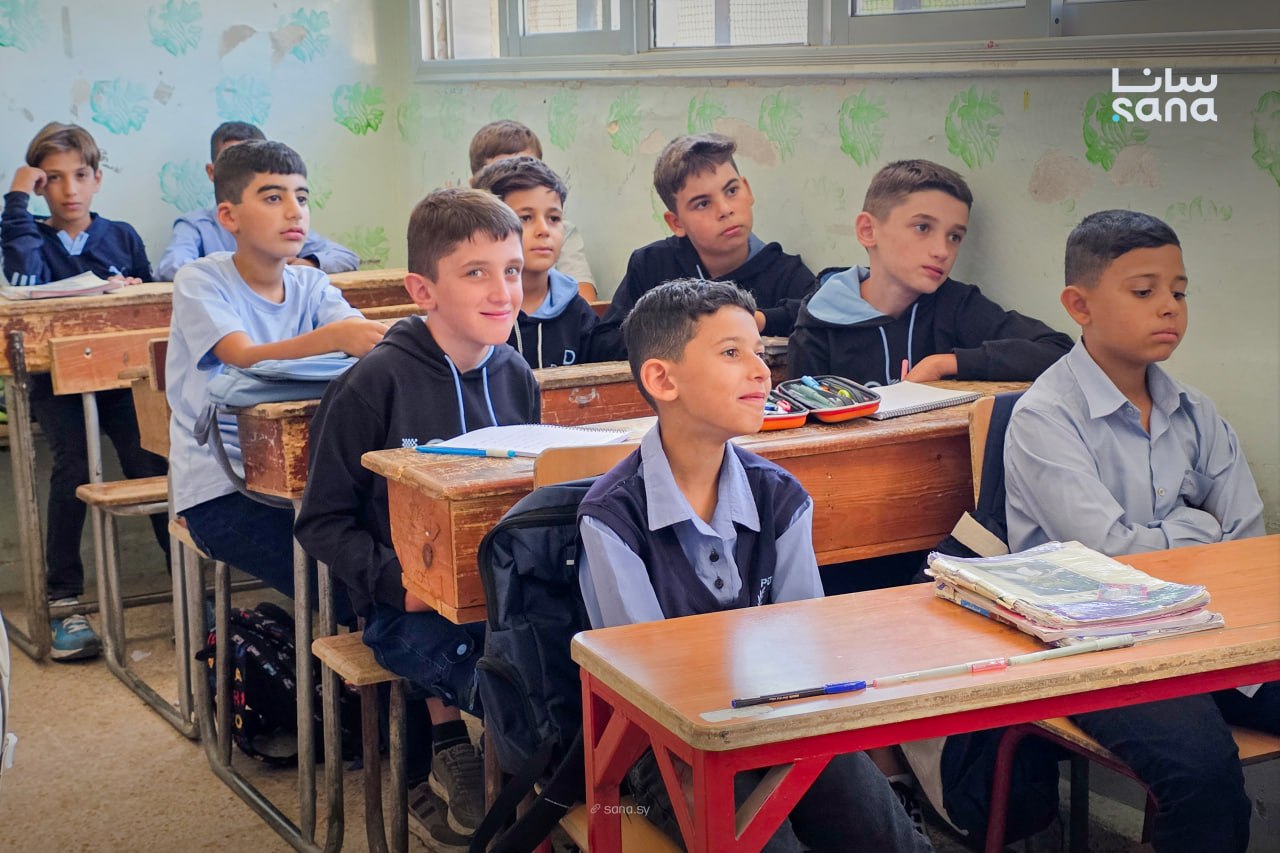
Photo credit: Syrian Arab News Agency (SANA). https://sana.sy/photos/2573630/?utm